Climb 398 stone steps, turn around, and you get the frame you have seen a thousand times on postcards, posters, and social feeds — a five-story pagoda, Mount Fuji, and a foreground of cherry blossoms or autumn maples, all stacked in one shot. This is the Chureito Pagoda at Arakurayama Sengen Park in Fujiyoshida, a war memorial tower completed in 1962 and one of the most photographed Fuji compositions in Japan. But the important, unglamorous news first: the 2026 cherry festival here has been cancelled because of overtourism. That does not mean you cannot go — it means you need to know how to go, when to go, and how to behave. This guide covers the 398-step barrier, the two-leg walk from the station, light and Fuji visibility, the goshuin situation, and how to dodge crowds without disturbing the residents who live right below the shrine.
📍 The park sits across in Fujiyoshida, and many people pair it with Lake Kawaguchiko on the same trip. For that side, see the Kawaguchiko autumn guide; for getting from Tokyo to the Fuji area, see the Tokyo to Mt. Fuji access guide.
- The 398-step "Sakuya-hime Kaidan" has no step-free alternative — all stone stairs, so plan around knees, elderly companions, and strollers
- Count the walk in two legs: ~5 min station-to-shrine (flat), then ~15–20 min up to the pagoda deck — it is not "5 minutes to the pagoda"
- 2026 cherry festival is cancelled (overtourism) — the park is still open in blossom season with safety controls, but do not trespass or shoot freely in residential streets
- Fuji is about weather, not season — high winter clear-sky rates, afternoon cloud build-up, so come in the morning
- Park is free and open 24 hours; the goshuin is now issued as a pre-written paper slip (kakioki)
📖 Table of Contents (click to expand)
- The 398 steps: fitness, time, and accessibility limits
- Shooting it: composition, light, and Fuji visibility
- Seasonal calendar and the 2026 festival cancellation
- Arakura Fuji Sengen Shrine and the goshuin
- Access: the two-leg walk and Tokyo options
- Eat and browse: Honmachi-dori and Yoshida udon
- Beating crowds and: is it worth the trip?
- FAQ
The 398 steps: fitness, time, and accessibility limits
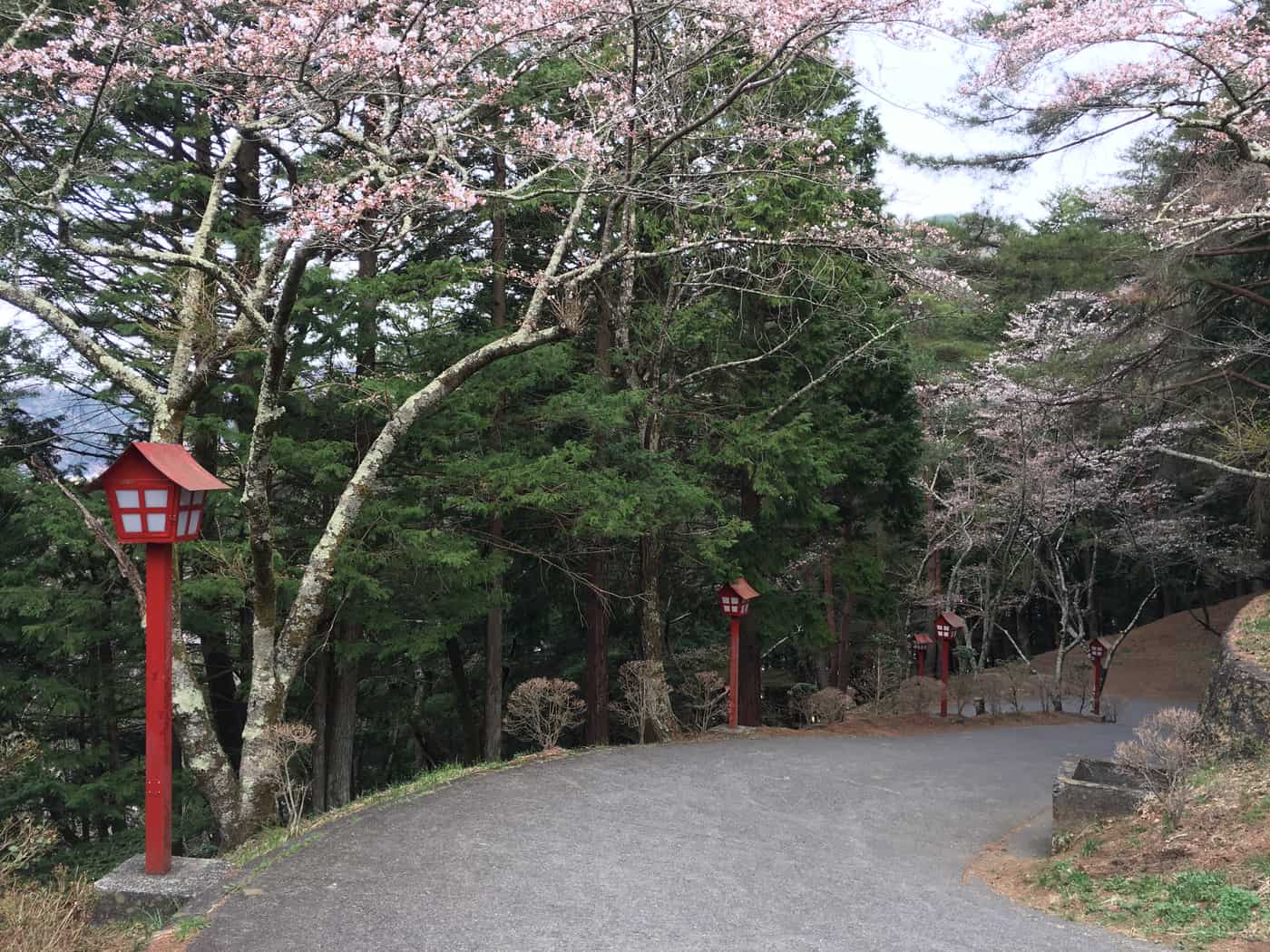
Let me put the real barrier up front: to get the pagoda-and-Fuji frame, you must climb the full 398 steps of the "Sakuya-hime Kaidan" from the park entrance up to the hillside viewing deck. Per Wikipedia the stair run is about 200 meters long, all steps, with no escalator, no gentle ramp, and no elevator — no step-free way up. I say this plainly because the beautiful shots online make it look effortless; in reality there is a genuine fitness threshold.
There is no official "reach-the-top-in-X-minutes" figure, and I will not invent a precise one. Based on visitor accounts, budgeting 10 to 15 minutes with a couple of pauses on the mid-way landings is realistic for average fitness; give yourself more with older companions, knee issues, a stroller, or heavy luggage, and go in expecting that the visit is mostly stair-climbing. There are a few landings partway where you can catch your breath and look back at Fuji.
On accessibility, I want to be clear rather than reassuring: ordinary visitors do not have a step-free option. The shrine's site notes only that people with disabilities may apply in advance for permission to drive up to the plaza in front of the pagoda — but that permission is not granted during "weekend and holiday congestion" or during "busy periods such as cherry season, long weekends, and autumn foliage." In other words, the peak times when step-free access matters most are exactly when vehicle access is closed. If you are traveling with someone who cannot manage the stairs, plan around off-peak, confirm the application process with the shrine in advance, or accept the compromise of visiting the shrine at the base without pushing up to the deck.
Shooting it: composition, light, and Fuji visibility
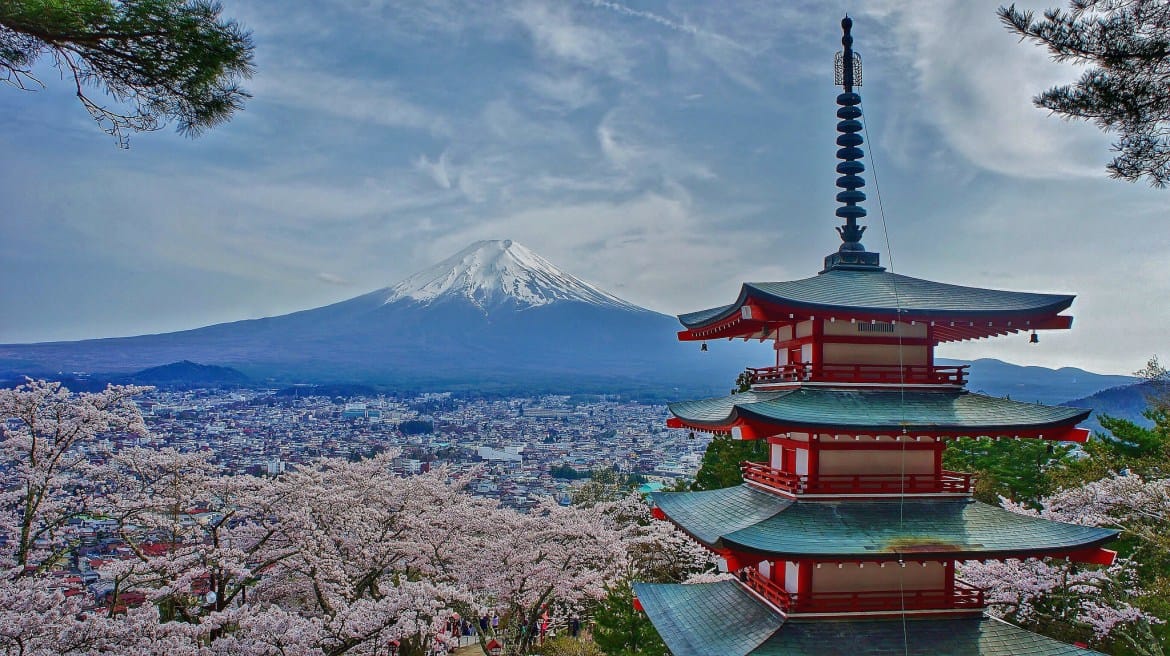
The reason this became "the postcard of Japan" is that it stacks three elements along one sightline: the pagoda in the near ground, the Fujiyoshida townscape in the middle, and Mount Fuji beyond — with a layer of cherry blossoms in spring or maples in autumn. The park itself uses this exact composition as its promotional hero image. The viewing deck is the classic spot for it; climb the 398 steps and you will find everyone aiming their cameras the same way.
Timing beats season. Whether Fuji shows up is about weather, not the month. As a general Japanese climate pattern, winter has high clear-sky rates and crisp air, so Fuji appears relatively often; summer is humid and the whole mountain is frequently swallowed by cloud. That is a nationwide rule of thumb — I do not have a Chureito-specific visibility statistic, so I will not hand you a fake "X percent chance" number, but the direction is clear: to improve your odds of a clean Fuji, aim for a clear autumn or winter day, and come in the morning, because afternoon cloud build-up markedly raises the chance of the mountain vanishing.
On tripods, keep it conservative: some visitors report that the deck may bar tripods during the day and allow them only at night, but this is not a rule I could confirm in an official page — more likely it is crowd management during busy periods. Treat it as "follow the on-site signage." When the deck is shoulder-to-shoulder in peak season, it is no place to set up a tripod and hold a spot anyway. Shoot a few handheld frames to bank the shot, then check for any tripod notice on site.
Seasonal calendar and the 2026 festival cancellation
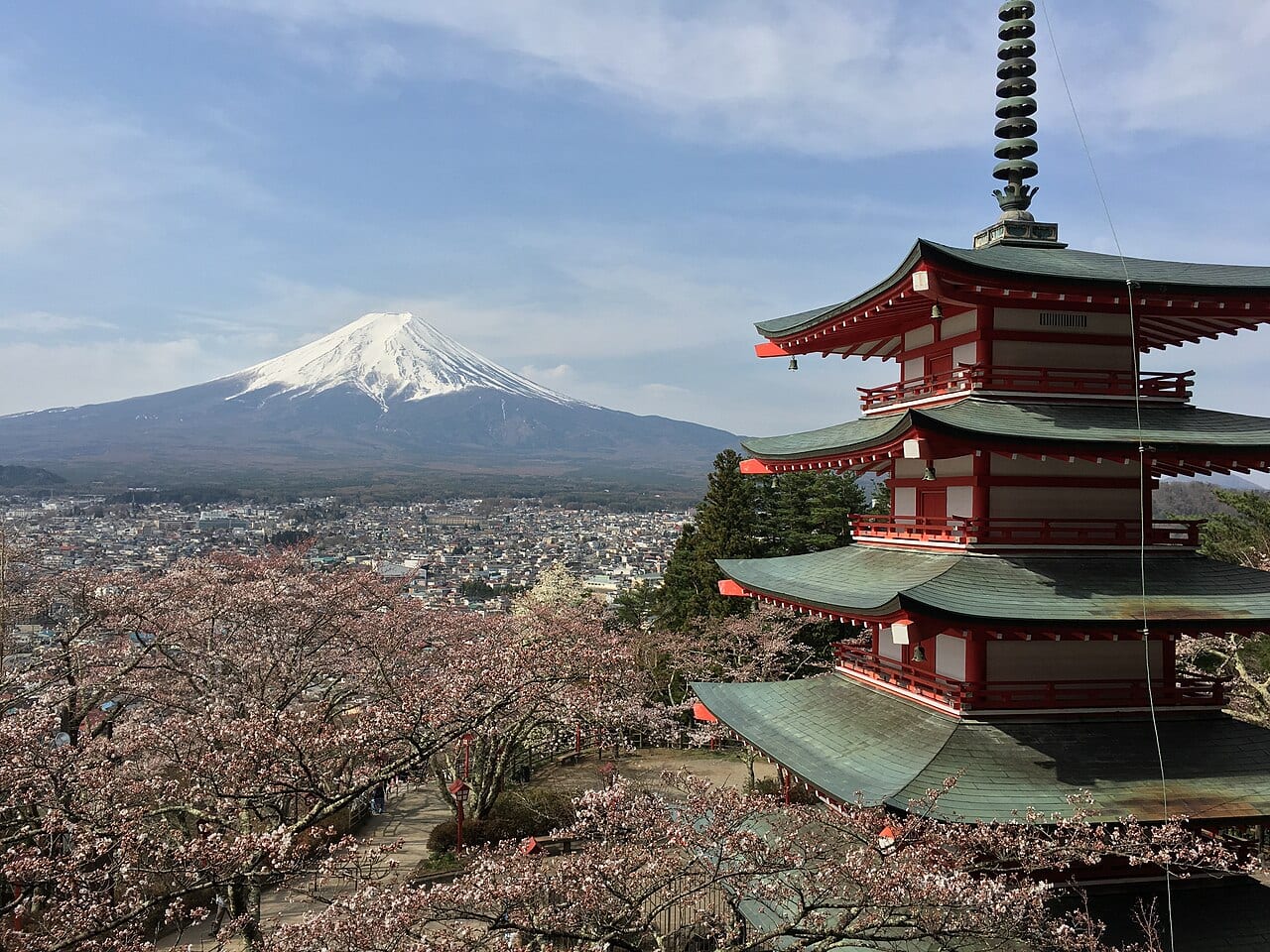
Start with the most famous season: cherry blossoms. The park has about 650 Somei-Yoshino cherry trees, with peak bloom typically around mid-April. That is when the "pagoda + sakura + Fuji" poster shot happens — and precisely because it is so famous, it triggered a problem that has to be faced honestly.
⚠️ 2026 update: the Arakurayama Sengen Park cherry festival is cancelled.
Fujiyoshida City has officially announced there will be no cherry festival in 2026. The stated reason is the severe impact of overtourism on residents: chronic gridlock, tourists trespassing into homes, people relieving themselves in residents' front gardens, and children being jostled by crowds on the way to school. But cancelling the festival is not closing the park — you can still enter and view the blossoms during the season, and the city still runs safety controls (security, traffic management, temporary parking, timed entry to the deck).
So the correct read is: there is no official festival in 2026, but you can still come during the season — you just have to do it more responsibly. Per the official notice, the 2026 "reinforced-measures period" runs April 1 to 17, with traffic control continuing to April 19; there is also a "hi-ire" event (officially listed for April 12, rain backup April 19, with no further detail given in the official material). Blossom-season parking differs from normal: the first car park next to the park is closed, the fourth is motorcycle-only, and the shuttle bus does not run, with a temporary lot at the Shimoyoshida No.2 elementary school ground (regular car 500 yen; free on April 18–19). During the season the deck runs on a timed-entry system, and per the official feature page the wait can stretch to one to three hours.
My view on this is blunt: it is worth going, but you owe it some self-discipline. The city is not banning visitors — it was pushed to the point of publicly asking tourists not to enter private homes, not to shoot freely in residential streets, and not to create congestion. What you can do is come early, walk the routes you are meant to walk, and point your camera at the park and Fuji rather than into someone's yard. That matters more than any tactic in this guide.
Other seasons: for autumn foliage, the official page only offers the qualitative "autumn, when the leaves turn color, is appealing too" — it does not give a precise peak week, so I will not pretend there is a defined koyo window here the way there is along the Kawaguchiko shore. If you want autumn, follow the broad early-to-mid-November rhythm of the Fuji area and judge by the trees on the day. A snow-capped Fuji behind the pagoda in winter is a classic too, riding the same high-clear-sky advantage.
Arakura Fuji Sengen Shrine and the goshuin
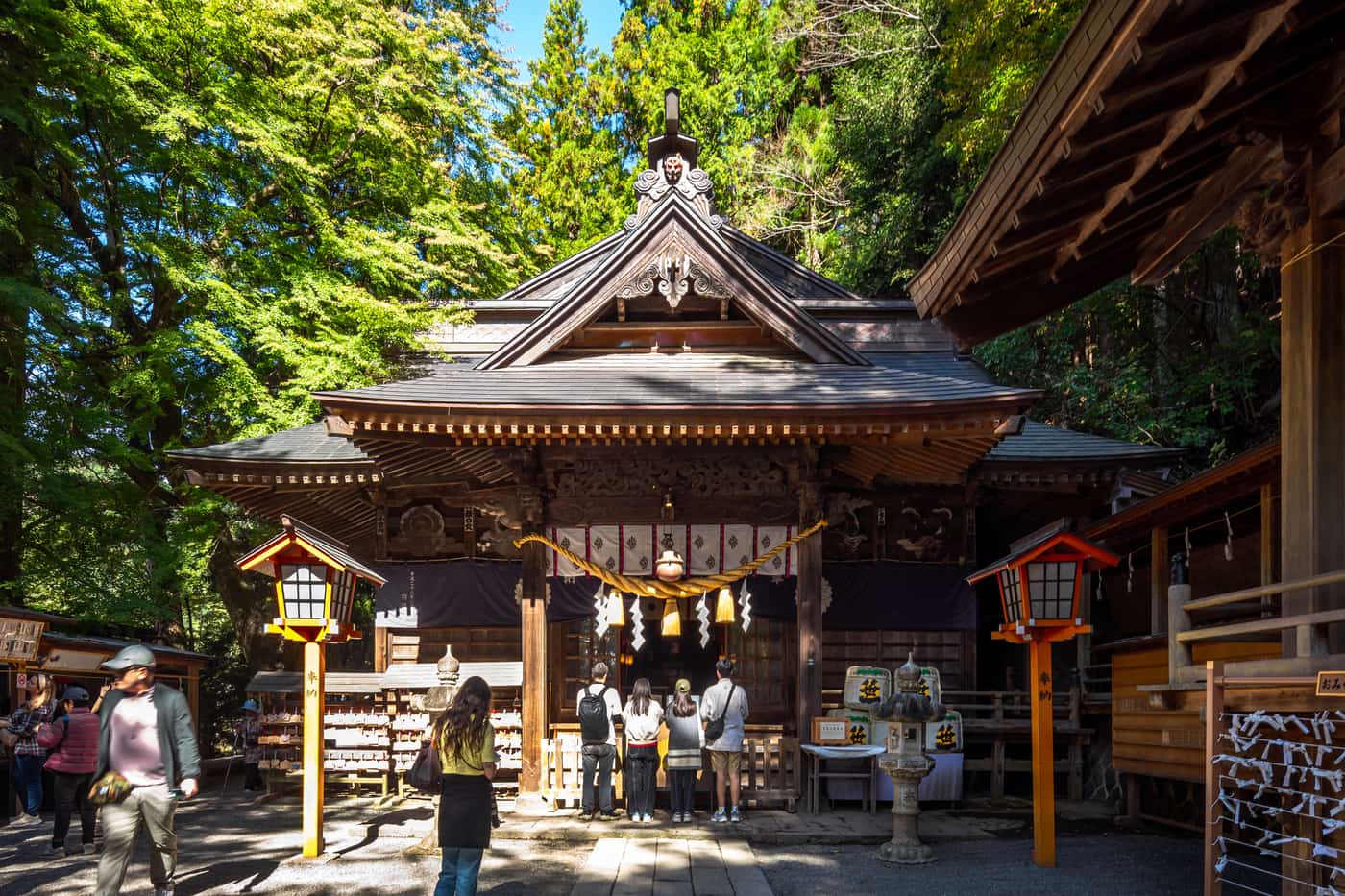
Many people fixate on climbing up to shoot the tower and miss that the base of the 398 steps is Arakura Fuji Sengen Shrine — the pagoda in fact stands on the hillside within the shrine grounds. The shrine has real pedigree: per Fujiyoshida tourism materials it was founded in 705 (in the reign of Emperor Monmu), making it an old shrine of more than 1,300 years, enshrining deities tied to the worship of Mount Fuji. Paying respects at the torii and hall at the base before climbing is the courteous order of things; shrine visiting hours are 9:00 to 16:00.
There is one change to flag on the goshuin: per the shrine's own site, to ease crowding the goshuin is now issued as "kakioki" — a pre-written paper slip rather than inscribed on the spot in your goshuin book. This is increasingly common at popular shrines under crowd pressure. As for reception hours and the offering amount, the shrine site does not list them item by item; goshuin-collector sites put the offering roughly between 300 and 1,200 yen depending on the design (regular, monthly, double-page, paper-cut), but that is not an official first-source figure, so I treat it as reference rather than a price — confirm on site.
If you are here to collect goshuin, or it is your first time and the etiquette is fuzzy (how to prepare the book, how to file a kakioki slip, how to make the offering), read our Japan goshuin guide first — it makes the visit far smoother. Incidentally, the spring "pagoda + sakura + Fuji" here is a fixture on every Japan cherry-blossom shortlist; for other Fuji Five Lakes blossom spots, see the Fuji Five Lakes cherry blossom guide.
Access: the two-leg walk and Tokyo options
First, kill the most common misconception: "it's a 5-minute walk from the station to the pagoda" is wrong. The official page does say "5 minutes," but that is to the shrine torii and main hall at the base — a flat stretch; climbing the 398 stone steps from the shrine up to the pagoda deck is a completely different leg. Official pages even disagree on that second leg (one says about 10 minutes, another about 25). My advice is to remember it in two parts:
- Shimoyoshida Station → shrine torii/hall: about 5 minutes (flat, official figure)
- Shrine → pagoda deck (up the 398 steps): another 15 to 20 minutes (depending on pace and photo stops)
So conservatively, budget 20 to 25 minutes from Shimoyoshida Station to the deck including the climb. The nearest station is Shimoyoshida on the Fujikyuko Line; if you drive, the park has paid parking (off-season weekday rates: P1 1,500 yen per 6 hours, P2–P3 1,000 yen per 6 hours, P4 car 1,500 yen / motorcycle 750 yen), but blossom-season parking is restricted (see the section above).
How to get there from Tokyo? There are three main routes — here are the official figures at a glance:
| Route | Time to Shimoyoshida | Fare reference | My call |
|---|---|---|---|
| Limited Express Fuji Excursion (direct from Shinjuku) | ~105 min | Reserved-seat limited express (per current JR/Fujikyu site) | Most comfortable, no transfer, but few runs — book early |
| Highway bus (from Shinjuku / Tokyo) | ~115 to 120 min | Per Fujikyu bus site | Cheaper, more frequent, but exposed to traffic |
| JR Chuo Line → Otsuki → Fujikyuko Line | Per connection | Fujikyu Otsuki–Shimoyoshida adult ¥310 (+ Chuo Line) | Best with a JR Pass, which covers the Chuo Line leg |
How to choose? If your plans are fixed and you want comfort, grab a reserved Fuji Excursion seat (no transfer, but limited daily runs sell out fast in peak season); if budget matters and you can absorb traffic, take the highway bus; JR Pass holders should ride the Chuo Line to Otsuki and change to the Fujikyuko Line. Many people pair the pagoda with Lake Kawaguchiko — Shimoyoshida and Kawaguchiko are both on the Fujikyuko Line, one stop apart at ¥230 adult one way, so they string together easily. If you base yourself at Kawaguchiko, the Shinjuku highway-bus fare there is around ¥2,200 and up; for lakeside foliage and the ropeway, see the Kawaguchiko autumn guide.
One practical reality: checking Fujikyuko timetables, matching them to the day's Fuji visibility, and re-planning on the fly all need data — and signal in the Fuji foothills is patchy. Set up an unlimited eSIM before you go and scan the QR on landing: KKday Japan eSIM; for how the five main eSIMs compare, see the Japan eSIM guide.
Eat and browse: Honmachi-dori and Yoshida udon
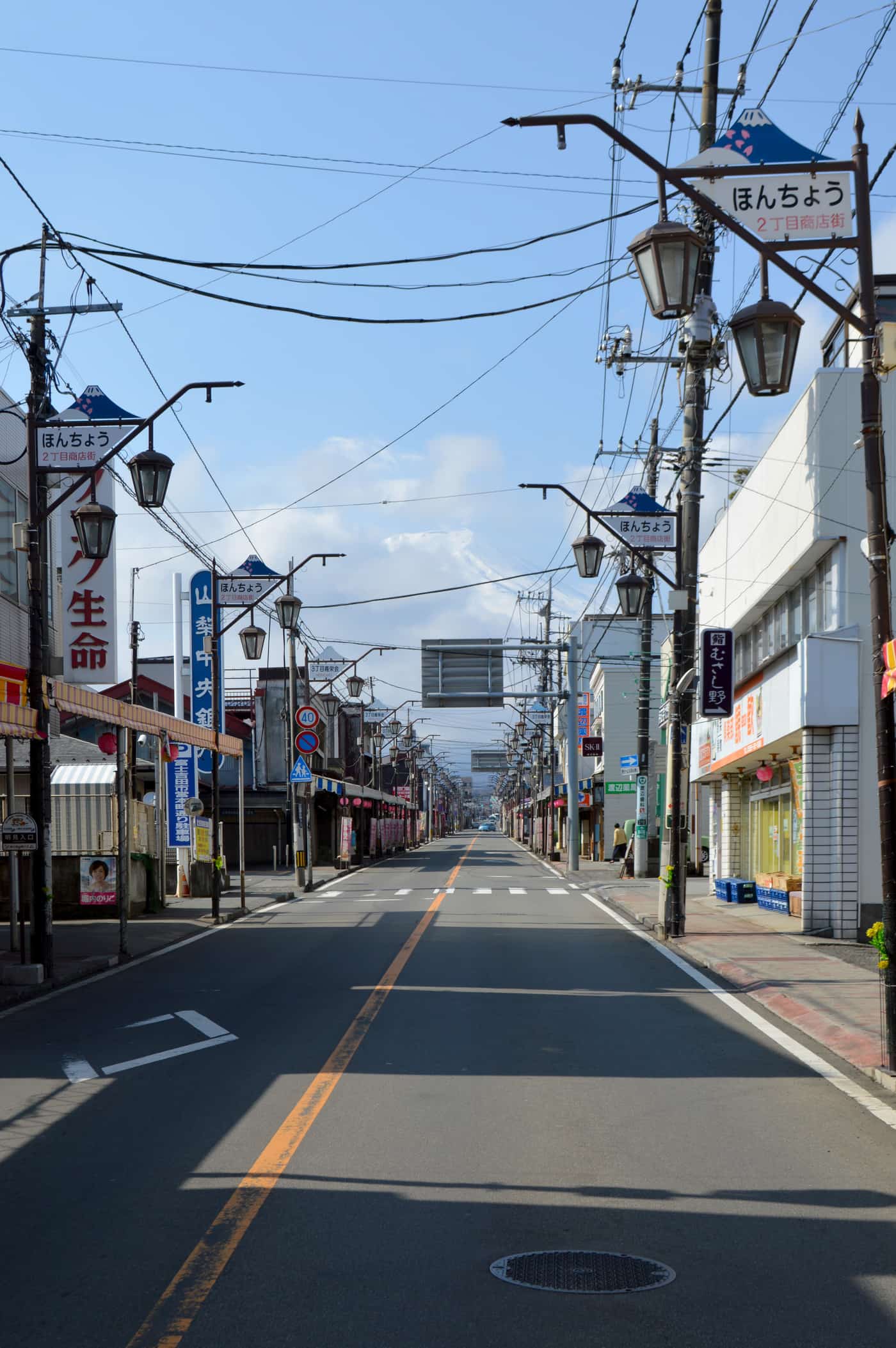
Once you have the pagoda shot, do not rush straight back to the train. The Honmachi-dori (Fuji-michi) shopping street around Shimoyoshida Station is a Showa-era streetscape well worth a wander. Its formal name is "Fuji-michi (Honmachi-dori)," locally also called the Shimoyoshida shopping street, and its most famous frame is the view from the "Nikkawa Clock Shop" crossing — the whole street lines up with Mount Fuji directly behind it, a spot locals often mention. Per local photography accounts, come before 10 a.m. when the light and air clarity are better and Fuji is less likely to be hidden by afternoon cloud. (This street and photo spot are from local, non-official sources, so verify on site.)
To eat, Fujiyoshida's specialty is Yoshida udon — thick, notably firm noodles in a broth that often blends miso and soy, with a lot of local character. Per local food sites, most udon shops here come in under 1,000 yen, and some start from the low 300s, making it a cheap, satisfying meal. A shop local food writers frequently recommend is "Ganso Miura Udon," about a 10-minute walk from Shimoyoshida Station, known for its meat udon. These are local recommendations rather than an official list, so check each shop's latest hours and closing days before you go so you are not caught out.
Beating crowds and: is it worth the trip?
📍 Chureito is about looking at Fuji. If you want to climb it, that is a wholly different rulebook — two prefectures charging under two different names with opposite refund terms. See the two very different ¥4,000s.
First, crowds. The peaks at Chureito are very concentrated: cherry season (around mid-April) and peak weekends, when the deck runs on timed entry and the queue can stretch to one to three hours — those are officially published festival-season measures. Off-season weekdays draw far fewer people; the city gives no visitor count, but the comparison is reasonable. So my advice is simple:
- Avoid blossom-season weekends if you can. A clear autumn or winter weekday morning is the sweet spot: good light, a decent shot at Fuji, and no crush.
- If it has to be peak, go at dawn. Early on the hill you get the best light before afternoon cloud hides Fuji, and before the crowds pour in. There are online mentions of an early-morning (roughly 6:00–8:00) reservation system during the season, but I could not verify that word-for-word on an official first source, so if you plan to rely on it, confirm in advance through official channels whether it still applies and whether it is season-only — do not treat it as a guaranteed fixed system.
So, is Chureito Pagoda worth a dedicated half-day round trip from Tokyo plus 398 steps for one photo? My verdict: yes, with two conditions. The first is weather — the value here rides almost entirely on whether Fuji shows its face. If the day is heavily clouded and the mountain is fully hidden, you will have climbed 398 steps to a pagoda with no leading character, and the payoff collapses; so check the Fuji-area forecast before you go, and on an overcast day I would simply reschedule. The second condition is self-discipline — the 2026 festival cancellation is, at heart, the result of residents being pushed past their limit by overtourism, and going means a responsibility not to be the next straw: come early, follow the rules, and keep your lens off people's front yards.
If you can meet both conditions, this is one of the rare places where a single photo genuinely justifies a dedicated trip — it stacks three of Japan's most recognizable symbols in one frame, and the park is free and open 24 hours, with only your legs and your weather luck as the barriers. Stringing it together with Kawaguchiko and the Mt. Tenjo ropeway into a one- to two-day Fuji-area plan beats a single-point round trip; you can buy the ropeway's round-trip e-ticket in advance at Trip.com Mt. Tenjo ropeway round trip → to skip the ticket-machine line in peak season. If you would rather not work out transfers and timetables at all, there is a Fuji day tour that includes the Mt. Tenjo ropeway (from Tokyo, door-to-door): Kawaguchiko & Mt. Tenjo ropeway day tour, which suits families with kids or older travelers who would rather not manage transport.
Frequently Asked Questions
- Q1:How many steps to Chureito Pagoda, and how long is the climb?
- To reach the viewing deck where the five-story pagoda and Mount Fuji line up, you climb 398 steps, the "Sakuya-hime Kaidan" — all stone stairs, with no escalator, ramp, or step-free alternative. There is no official standard climb time, but based on visitor accounts, a moderately fit person should budget 10 to 15 minutes with a breather or two on the mid-way landings; allow more if you have knee trouble or are with older travelers. The real barrier is not distance but these 398 steps.
- Q2:How long is the walk from Shimoyoshida Station to the pagoda?
- Split it into two legs — many people are misled by the "5 minutes" on the official page. Shimoyoshida Station to the Arakura Fuji Sengen Shrine torii and main hall is about 5 minutes on the flat (the official figure). But from the shrine you still climb the 398 stone steps to the pagoda deck, and different official pages disagree on that leg (one says about 10 minutes, another about 25). To be safe, budget 20 to 25 minutes from the station to the deck including the climb — do not assume the pagoda is "5 minutes away."
- Q3:Is there still a cherry blossom festival at Arakurayama in 2026?
- No. Fujiyoshida City has officially announced that the Arakurayama Sengen Park cherry festival will not be held in 2026. The city's stated reason is the severe impact of overtourism on residents — chronic traffic gridlock, tourists trespassing into private homes, people relieving themselves in residents' front gardens, and schoolchildren getting pushed around by crowds. Importantly, cancelling the festival does not mean the park is closed: you can still enter and view the blossoms during the season (peak around mid-April), and the city still runs safety controls (security, traffic management, temporary parking, timed entry to the deck). The 2026 traffic-control period runs roughly April 1 to 19. Please be considerate: do not enter private property and do not photograph freely in residential streets — this is exactly what the city's notice asks of visitors.
- Q4:Is Chureito Pagoda a Buddhist pagoda? When was it built?
- No. It has the form of a five-story pagoda, but it is actually a war memorial tower (commonly called Chureito; per available sources its formal name is the Fujiyoshida City War Memorial Tower), built of reinforced concrete. Per Wikipedia it was completed in 1962, stands about 19.5 meters tall, and enshrines 1,055 war dead; Arakurayama Sengen Park itself was laid out in October 1959. Some non-official sites give a conflicting account (built in 1963, roughly 960 enshrined), so this guide uses the single Wikipedia figure — confirm the exact year on site.
- Q5:Can you still get a goshuin at Arakura Fuji Sengen Shrine?
- Yes, but the format has changed. Per the shrine's own site, to ease crowding the goshuin is currently issued as "kakioki" — a pre-written paper slip rather than hand-inscribed on the spot. The shrine site does not list reception hours or the offering amount item by item; goshuin-collector sites suggest the offering runs roughly 300 to 1,200 yen depending on the design (regular, monthly, double-page, paper-cut), but that is not an official first-source figure, so treat it as a rough guide and confirm on site. Shrine visiting hours are 9:00 to 16:00. For how goshuin collecting works before you go, see our Japan goshuin guide.
- Q6:When is Mount Fuji clearest, and what should I know for shooting the pagoda?
- Whether Fuji shows itself depends on weather far more than season. As a general Japanese climate pattern, winter has high clear-sky rates and crisp air, so Fuji appears more often; summer is humid and the mountain is frequently veiled in cloud (a nationwide rule of thumb, not a Chureito-specific statistic). Within a day, cloud tends to build in the afternoon, so mornings give you a much better shot at a clean Fuji. On tripods, some visitors report they may be barred on the deck during the day and allowed only at night, but this is not an official published rule — treat it as "follow the on-site signage." Deck space is limited and crowded in peak season, so mind the flow and don't hold a spot for long.
Read next
Kawaguchiko Autumn 2026: Momiji Corridor & Ropeway Guide
A spot-by-spot peak-timing table, Fujikaiyu vs highway bus math, and how to dodge the leaf-season crowds.
Tokyo to Mt. Fuji day trip guide
Kawaguchiko, Oshino Hakkai, Arakurayama — bus times, prices, must-knows.
Mt. Fuji Cherry Blossoms 2027: Chureito Pagoda & Lake Kawaguchi
The cherries + Mt. Fuji + pagoda postcard — Kawaguchiko peaks mid-April, two weeks after Tokyo. Spots, best hours, and access.
📊 See the 2026 Price Index (JR Pass, DPA, eSIM, Airport Transport) →