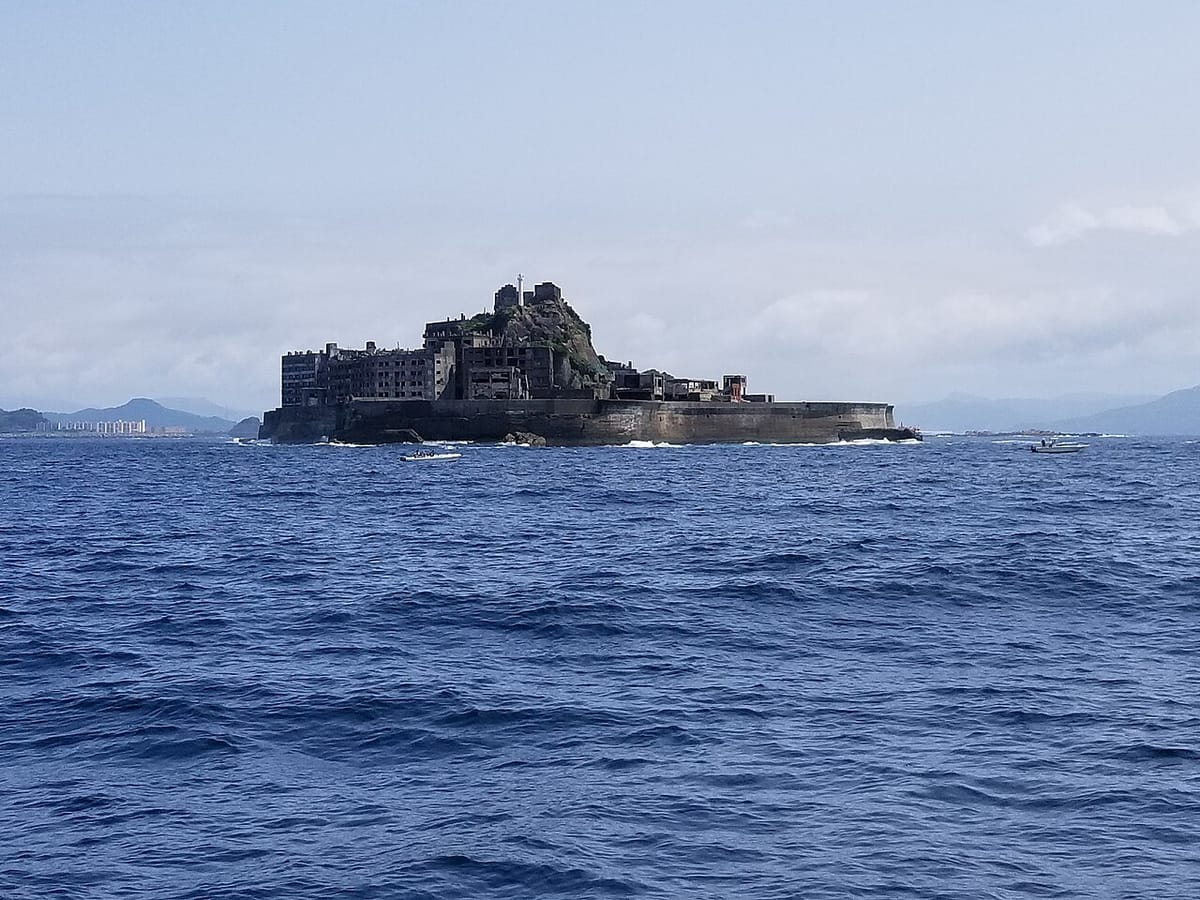
Gunkanjima (Hashima) is an uninhabited, abandoned coal-mining island off Nagasaki that was once the most densely populated place on Earth, left a concrete ghost town after it closed, and is now a World Heritage site and Japan's most famous ruin. Its appeal is matched by its catch: whether you can actually "land" depends on the day's sea conditions, and cancellations are common. This guide covers Hashima's rise and fall and its full history, the two different ways a landing gets called off (the day's sea state, and Nagasaki City closing the facility), what the five operators actually charge alongside the site fee that doubled to ¥650 in April 2026, and the digital-museum backup when the tour is cancelled. It's the Gunkanjima deep-dive for our Nagasaki guide.
- A World Heritage abandoned coal island: once the most densely populated place on Earth, closed in 1974
- Two ways it gets called off: the day's sea state (waves ≤0.5 m, wind ≤5 m/s, visibility ≥500 m), and Nagasaki City suspending use of the facility
- Cost: boat fare ¥3,150-¥12,000 (wide spread across five operators; online beats walk-up) plus the ¥650 Hashima facility fee (¥320 for school students, free under school age), booked ahead
- Fixed path only on the island: three observation plazas, no entering buildings, no roaming
- Backup if cancelled: Gunkanjima Digital Museum ¥1,800 (half price if you booked with Gunkanjima Concierge)
📖 Table of contents
What Gunkanjima is
Hashima lies about 18 km off Nagasaki port, an artificial island that grew up around an undersea coal seam. To pack a mine and a population onto a tiny reef, the whole island was extended by reclamation, ringed with concrete sea walls and built over with dense high-rises — and from the sea, the silhouette looks just like a warship, especially the battleship Tosa of the era, which earned it the name "Gunkanjima" (Battleship Island). It's a component of the "Sites of Japan's Meiji Industrial Revolution" World Heritage, and that end-of-the-world ruined atmosphere has made it a location and inspiration for films and other works.
That pop-culture afterlife is part of why so many travelers seek it out. The island's bristling concrete skyline helped inspire the villain's lair in the James Bond film Skyfall (though the interiors were a set, not the island itself), it has appeared in the live-action Attack on Titan films, and it lends its name and imagery to documentaries and games about urban decay. Seeing it in person, what photos rarely convey is the scale and silence — a cramped vertical city built for thousands, now standing empty in the open sea, the wind and waves the only sound. That contrast between former density and present emptiness is the real reason a visit sticks with you.
Hashima's rise and fall
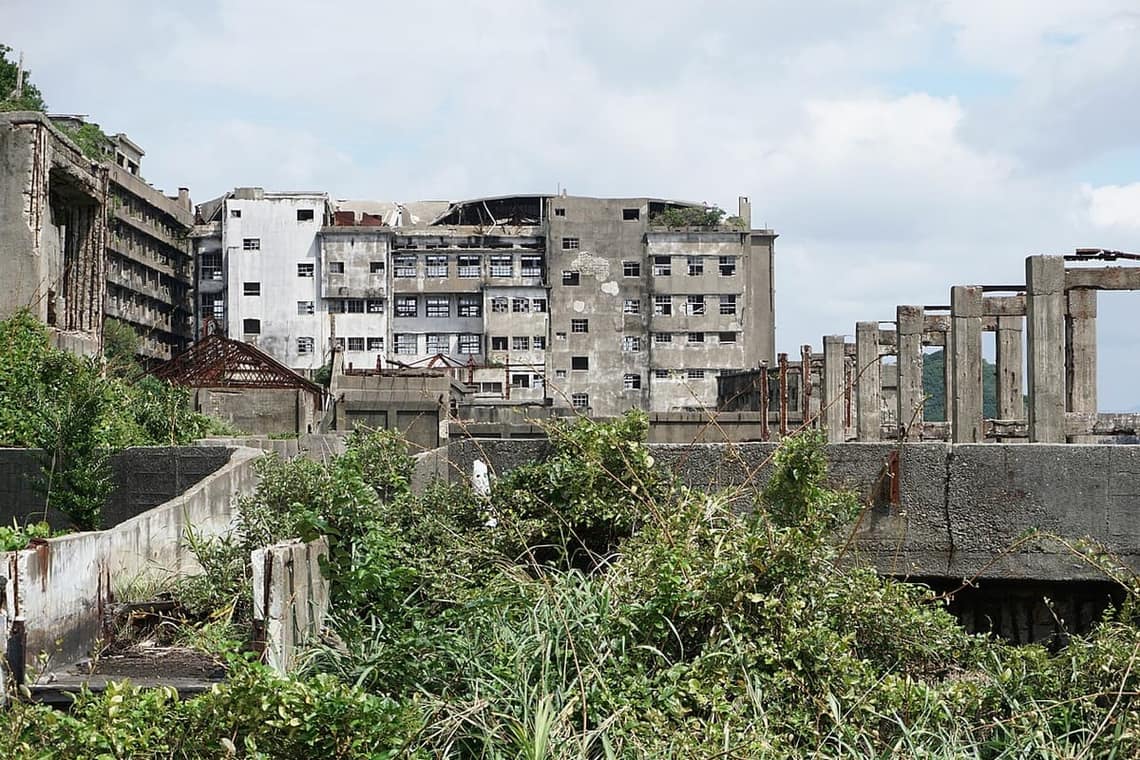
Hashima's coal mine was operated by Mitsubishi and boomed as Japan's modernization sent demand for coal soaring. To house the many miners and their families, the island built one of Japan's earliest reinforced-concrete apartment blocks in 1916 (Building 30), and later filled with schools, a hospital, shops, a cinema and a shrine — a tiny but complete city. Around its 1959 peak, this island of just 6.3 hectares held over 5,000 people, a population density that was briefly the highest in the world, far above contemporary Tokyo.
Life on the island was famously dense and ingenious. With no flat land to spare, apartment blocks were linked by a maze of stairways, corridors and rooftop passages, and residents grew gardens on the roofs of a place with almost no soil. The island had its own school, hospital, public bath, shops, a cinema, a shrine and even a pachinko parlor — everything a town needed packed onto a rock you could walk across in minutes. Coal was the engine of it all, and for a time the miners here were among the better-paid workers in Japan, with television sets in homes when they were still a luxury on the mainland.
But as energy shifted from coal to oil the mine declined, and in 1974 the Hashima mine closed and the residents all left within a short span, the island turning instantly into a no-man's-land. Decades of abandonment let sea wind and salt erode the buildings into the ruins you see today. In 2015 it was inscribed as part of the "Sites of Japan's Meiji Industrial Revolution" World Heritage, and limited landing tours have run since 2009.
The full history not to skip
To see Gunkanjima honestly is to look past the romantic "boom-and-abandonment" narrative alone. During WWII, laborers including many forcibly mobilized workers from the Korean Peninsula and China toiled in Hashima's harsh undersea mine — a part of Hashima's full story, and the very content that drew international debate at its World Heritage inscription, which Japan committed to present in full. Holding this in mind isn't to deny the island's industrial-history value, but to add a layer of understanding and respect to the visit — behind an island's "golden age" there is often more than one kind of human experience. Looking at those ruins with that in view carries more weight than "ruin exploration" alone.
Landing conditions and the island visit
First, the key point most people miss: buying a ticket and booking a tour does not guarantee you'll land. Nagasaki City sets clear safety conditions — wave height measured at Iojima ≤0.5 m, wind speed at the vessel ≤5 m/s, and visibility around Hashima ≥500 m — all three at once for a chance to dock; even within the numbers, the captain will cancel landing if the pier is unsafe. Winter and typhoon season bring rougher seas and noticeably higher cancellation odds. These three thresholds are set by Nagasaki City and published identically by every operator.
Those thresholds became binding in April 2020, and that is the real reason cancellations are so common. Before then the captain decided at the pier on the day; from April 2020 operators have had to hold strictly to the city's criteria, and the wave reading comes not from the water beside Hashima but from a wave gauge far offshore at Iojima. Gunkanjima Concierge publishes the effect plainly: an average landing rate of 94% in the captain's-judgment era, dropping to roughly 60% once the Iojima gauge became the reference. The sea did not get worse — the yardstick changed, and the measuring point still isn't at the island. Both percentages are that one operator's own figures, not Nagasaki City statistics.
Then there is the second kind of cancellation, and it has nothing to do with the weather on your date: Nagasaki City can simply suspend use of the Hashima viewing facility, and once that notice goes out no one lands however flat the sea is. It happened in 2026. In late August, heavy swell or a typhoon bent the fall-prevention railing on the Dolphin Pier connecting bridge; the city gave notice on August 28 that use was suspended from August 29, and service only resumed on the afternoon of September 1, once an on-site inspection was done. Earlier, the mid-August stoppage was because the railing had been removed ahead of a typhoon, and landings resumed on the afternoon of August 13 only after it was restored. The two operators gave different reasons for the August 29 stoppage — one wrote high waves, the other a typhoon — and we could not obtain Nagasaki City's own ruling. Nobody can forecast how long such a suspension will run, and it never shows up in a weather forecast, so read your operator's news page before you book, not just the fare page. As of our check on September 6, 2026, landings were running.
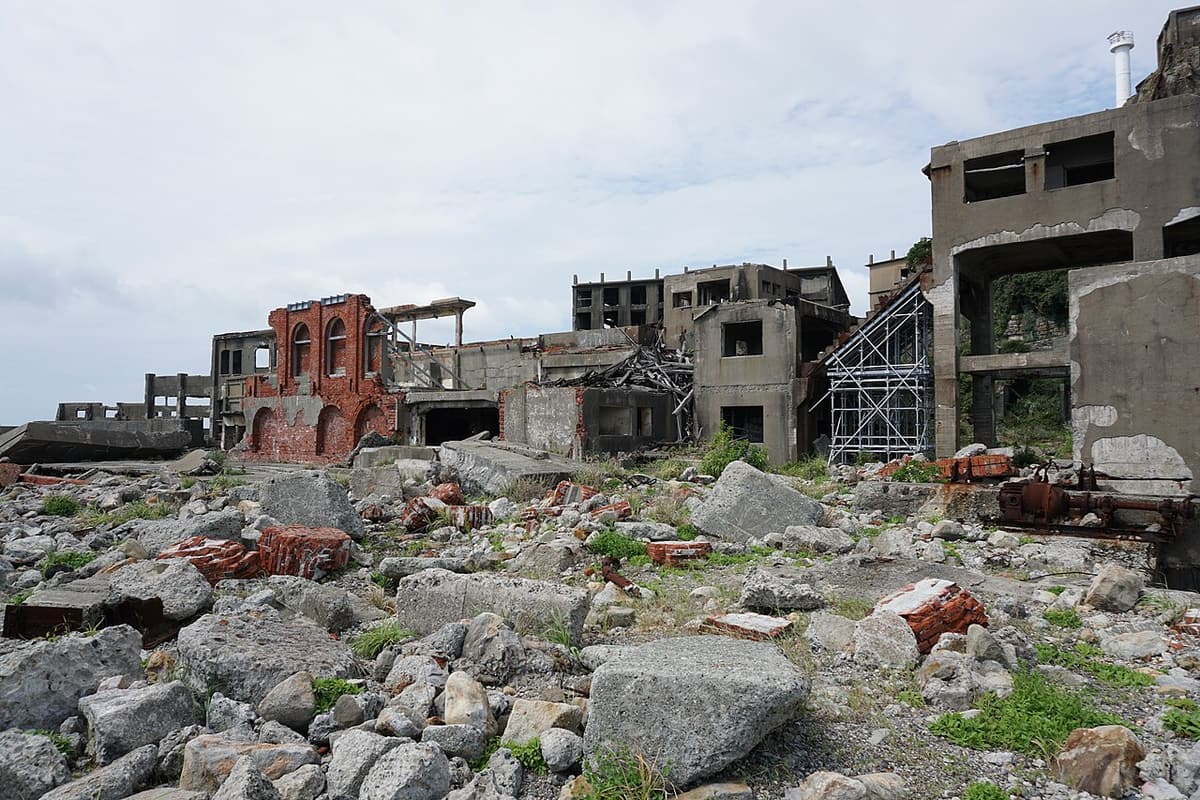
If you do land, the visit is limited too: you walk only a prepared fixed path, stopping at three observation plazas for the guide's commentary, seeing the exteriors of production-facility ruins and landmarks like Building 30 up close, but you cannot enter any building or leave the path to explore (for safety and preservation). So don't expect free-roaming "ruin exploration" — a Gunkanjima landing is a guided, routed visit.
Booking the boat and the cost
You can't sail to Gunkanjima yourself — you must join a Nagasaki operator's tour. The cost is always two parts: the operator's boat fare plus Nagasaki City's Hashima viewing-facility fee. The five operators call that fee five different things on their sites — landing fee, admission fee, facility viewing fee, facility use fee — so don't count it twice when you compare.
The city fee changed on April 1, 2026: ¥650 general, ¥320 for elementary through high school students, free for pre-schoolers. That is the first change since the October 2019 consumption-tax pass-through took it from ¥300 to ¥310, and it more than doubled in one step. The bracket depends on being in school rather than on age, so don't try to match it to a birthday: Nagasaki's own tourism site writes "general (15 and over)" while operator Seaman Shokai writes "general (18 and over)" — two official wordings that contradict each other. The money isn't an admission charge either; it goes into the Hashima maintenance fund for sea walls and ruin preservation. One warning: Nagasaki City's own World Heritage office page still prints ¥300, a full revision behind even the old price. (That ¥310 figure comes from an operator's 2019 notice plus the city finance division's statement that fees had not been revised except for tax pass-through and statutory changes — it is not a published before-and-after table.)
Boat fares spread wide: individual travelers pay anywhere from ¥3,150 to ¥12,000 depending on operator, cabin class, weekday versus peak date, and group size. So when you see Takashima Kaijo Kotsu's ¥3,600 first, don't read it as the market floor — it's one operator's online rate. Every fare below is before the facility fee:
| Operator | Adult boat fare | What to know before booking |
|---|---|---|
| Dai-nana Ebisu Maru | ¥3,150 pp (at 15-20 people) | A charter split, not a per-seat fare: 1-4 people pay ¥24,000 for the boat. Departs not from Nagasaki port but from the pier by the Nomon-yu carbonated hot spring. 20 seats, about 90 minutes |
| Takashima Kaijo Kotsu | ¥3,600 (booked online) / ¥4,000 (standard) | Online bookings are paid in cash on the day only; minimum 15 passengers to sail, age 4 and up; the tour includes a landing on Takashima, about 180 minutes |
| Seaman Shokai | ¥3,900 (with the site's coupon) / ¥4,200 (without) | The price on the site is the discounted one; without the coupon add ¥300. If landing is off they switch to a cruise plus a Takashima landing and keep the same return time. About 150 minutes |
| Yamasa Kaiun | ¥4,700 (landing tour) | Post-revision fare effective October 1, 2025; the cruise-only tour is ¥4,200; a family discount takes 10% off the boat fare |
| Gunkanjima Concierge | ¥5,500 (weekday) / ¥6,000 (peak date) | That's the standard cabin. Above it sit ¥9,000/¥10,000 and ¥11,000/¥12,000 tiers, which take no pre-school bookings and bar under-3s entirely. Peak dates are weekends and holidays, spring break, Golden Week, summer and winter holidays. About 240 minutes, museum included |
Check whether the price you're reading is the online rate or the walk-up rate — within one operator that's a ¥300-400 gap.
Practical advice: book ahead on each operator's site, since peak season often sells out. Confirm two things first. One, which pier you're going to — they don't all leave from Nagasaki port: Takashima Kaijo Kotsu sails from Motofune Pier at Nagasaki port, Gunkanjima Concierge from Tokiwa Pier (check-in at the Gunkanjima Digital Museum), Dai-nana Ebisu Maru from the Nomon-yu pier. Two, that operator's "what if we can't land" policy, because all five differ: Seaman Shokai swaps in a cruise plus a Takashima landing at the same return time, Takashima Kaijo Kotsu includes Takashima anyway, Gunkanjima Concierge refunds the fare difference plus the full facility fee, and Yamasa Kaiun runs a 120-minute cruise while use is suspended. Each operator also pauses for annual vessel inspection, and those dates differ by company and by year, so check that company's site before planning a winter trip. On the day you'll check the assembly point and check-in time at the port, so set up a KKday Japan eSIM online first.
The digital museum and planning
Because landing isn't guaranteed and you only see exteriors ashore, the Gunkanjima Digital Museum (central Nagasaki) is a worthy pairing. With VR, large-scale projection and abundant records, it recreates Hashima's peak-era streets, building interiors and miners' daily lives — exactly what a landing can't show. Admission runs ¥1,800 general, ¥1,300 junior and senior high, ¥800 elementary, ¥500 pre-school and free under 3, with half price for a disability certificate holder plus one companion. The ¥1,500 in brackets on the official page is the group rate for parties of 15 or more, not an online discount — individual visitors can't get it. There is also a perk that often gets over-stated: if you booked with Gunkanjima Concierge and your landing tour is cancelled, the museum is half price. The museum and that operator belong to the same group; the museum's own information page doesn't list the offer, and tours booked with the other four companies don't qualify. Even with a successful landing, understanding the background at the museum first makes those ruins land harder.
For planning, spend two days in Nagasaki and slot Gunkanjima into a half day, keeping flexibility for the cancelled-switch-to-plan-B case: one day for the city (Mt. Inasa, Glover Garden, Dejima, Peace Park), a half day for the Gunkanjima landing plus the digital museum. If you're drawn to this kind of World Heritage history around Nagasaki, you can extend across the water to Kumamoto's Amakusa, home to the Sakitsu Church Hidden-Christian site and its dolphin coast. For the whole city and how to get there from Fukuoka, see our Nagasaki travel guide and Kyushu 3-day rail itinerary. Before you go, our Japan packing & weather guide covers preparing for the wind out on the water.
Practical tips for the boat trip
A Gunkanjima tour is a small-boat sea crossing, not a sheltered ferry ride, so a little preparation makes it far more comfortable:
- Motion sickness: even on a "landable" day the open-sea legs can be bouncy. If you're prone to seasickness, take medicine 30 minutes before departure and sit toward the middle and rear of the boat where the motion is gentler.
- Sun and wind: the deck is exposed with no shade, and the wind is strong. Bring a hat with a chin strap (or one you can stash), sunscreen, and a windbreaker even in summer; the temperature on the water is noticeably cooler than in the city.
- Footwear: the island's walkway is uneven in places, so closed, flat shoes beat sandals or heels.
- Photography: you shoot from the fixed observation plazas, so a standard zoom is plenty — there's no getting closer to the buildings. Keep your gear strapped; it's windy and you'll have salt spray on the crossing.
- Time buffer: arrive at the port with margin for check-in, and if the weather looks marginal, have the digital museum or another Nagasaki plan ready so a cancellation doesn't leave a hole in your day.
One more honest note: a landing is a guided, time-boxed walk along a set route, not a free wander through the ruins. Go in expecting that, pair it with the museum for the interiors and back-story, and Gunkanjima becomes one of the most memorable half-days in Kyushu — weather permitting.
Frequently Asked Questions
- Q1:Is a Gunkanjima landing guaranteed?
- No — cancellations are common. Nagasaki City requires all of these to land: wave height measured at Iojima ≤0.5 m, wind speed at the vessel ≤5 m/s, and visibility around Hashima ≥500 m; even within range, if the captain judges it unsafe the pier won't be used. Winter and typhoon season bring rougher seas and higher cancellation odds. And there are two ways it gets called off: the day's sea state failing the numbers, and Nagasaki City suspending use of the facility itself (a damaged railing, an inspection, typhoon damage) — the second can last for days on end and has nothing to do with the weather on your departure date. So treat landing as "a bonus if the weather cooperates" and don't pin the trip on it — most operators switch to a cruise around the island when landing isn't possible, still circling the ruins up close.
- Q2:How much is a Gunkanjima landing, and how do I book?
- The cost is always two parts: the operator's boat fare plus Nagasaki City's Hashima viewing-facility fee (operators call it the landing fee, admission fee or facility fee — it's the same money). Since April 1, 2026 the city fee is ¥650 general, ¥320 for elementary through high school students, free for pre-schoolers; the bracket depends on being in school, not on age. Boat fares vary a lot across the five operators — ¥3,150 to ¥12,000 for individual travelers depending on company, cabin class, weekday versus peak date, and group size, and the same operator's online rate can run ¥300-400 below the walk-up rate, so check which one you are looking at. Five Nagasaki companies run landing-and-cruise tours, with morning and afternoon departures, and you must book in advance on each operator's site (peak season fills up). The trip runs about 2.5-3 hours including the round trip and time ashore, where you can only walk a fixed path and view from three observation plazas — no free roaming (for safety and preservation).
- Q3:What can I actually see once I land?
- After landing you follow a prepared walking path and stop at three observation plazas with a guide's commentary, seeing the exteriors of production-facility ruins and landmark buildings like one of Japan's earliest reinforced-concrete apartments (Building 30, from 1916) up close. For safety and preservation, you cannot enter any building or leave the path to explore. To see the interiors and the town at its peak, you rely on the Gunkanjima Digital Museum on the mainland, which recreates them.
- Q4:What's the backup if the tour is cancelled?
- The Gunkanjima Digital Museum (in central Nagasaki) is the pick. With VR, projection and a wealth of records it recreates Hashima's peak-era streets, building interiors and miners' lives — exactly what you can't see on a landing. Admission is ¥1,800 general, ¥1,300 junior/senior high, ¥800 elementary, ¥500 pre-school, free under 3, with half price for a disability certificate holder plus one companion; the ¥1,500 figure on the official page is the group rate for parties of 15 or more, not an online discount. One perk that gets mis-stated: if you booked with Gunkanjima Concierge and the tour is cancelled, that museum is half price — the museum and that operator are in the same group, the museum's own information page does not list it, and tours booked with the other companies do not qualify. Even with a successful landing, seeing the museum first deepens the visit.
- Q5:Where does the name "Gunkanjima" come from?
- Hashima was expanded by land reclamation and ringed with concrete sea walls, and packed with dense high-rises, so from the sea its silhouette looks just like a warship — and especially like the battleship Tosa of the era — hence "Gunkanjima" (Battleship Island). It's a component of the "Sites of Japan's Meiji Industrial Revolution" World Heritage, and its shape and ruined atmosphere have made it a location and inspiration for films and creative works.
- Q6:How does Gunkanjima fit into a Nagasaki trip?
- The landing tour is a half day (about 2.5-3 hours), so with the port assembly and Nagasaki's other sights, plan two days in Nagasaki and slot Gunkanjima into a half day, keeping flexibility for the "cancelled, switch to plan B" case. The smoothest flow is one day for the city (Mt. Inasa, Glover Garden, Dejima, Peace Park) and a half day for Gunkanjima plus the digital museum. For the whole city, see our Nagasaki travel guide.