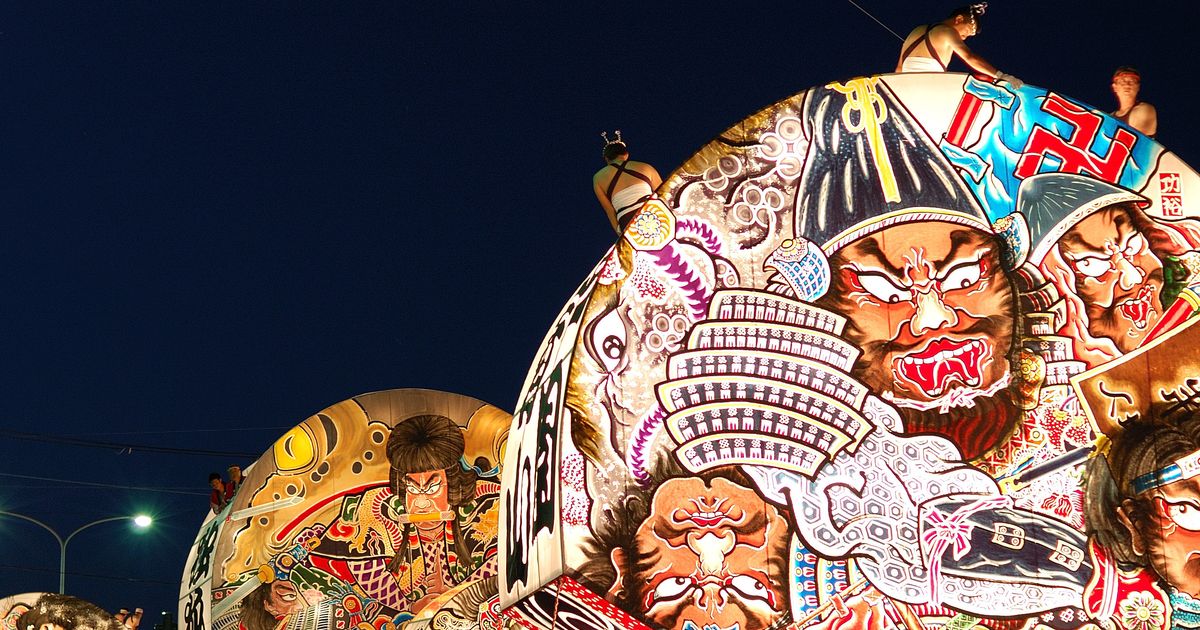
Start with the mistake that costs a whole day: Hirosaki Neputa's August 7 parade begins at 10:00 in the morning, not in the evening. The published traffic restriction runs 9:30 to 11:30, so arrive at Dotemachi at seven that night and the road has been open to cars for eight hours. The dates themselves need no announcement: Hirosaki states August 1 to 7 every year, so 2027 runs Sunday 1 to Saturday 7 August, with Goshogawara Tachineputa on 4 to 8 August. What does need watching is that the three Tsugaru lantern festivals are not one event with three venues. Their dates overlap for only four days, August 4 to 7, and their ticketing systems have nothing in common whatsoever: Hirosaki sells a fully reserved ¥3,000 chair seat that does not go on sale until June 22 and sits under no roof where umbrellas are banned outright; Aomori runs a ¥4,000 lottery; and Goshogawara has no official ticket office at all — its chamber of commerce says so in writing, leaving six private groups selling by telephone. August 7 is the one day special trains let you see two festivals, and it is also the day that forces you to choose between Hirosaki's closing fire rite and Goshogawara. Prices, times and services below are the 2026 figures — the dates are fixed, the rest follows each year's announcement.
📍 This guide covers Hirosaki and Goshogawara, plus how to choose between all three. For Aomori Nebuta itself — the haneto rules, the ¥4,000 seat lottery, the August 7 sea parade and fireworks — see the Aomori Nebuta Festival guide. For Aomori city year-round, see the Aomori travel guide.
- 2027 is bookable now: Hirosaki Sun 1 – Sat 7 August, Goshogawara Wed 4 – Sun 8 August, fixed every year regardless of weekday
- The final day starts at 10:00: in 2026 the 7th was a morning course while the other six days started at 19:00; the 2027 route split follows the official announcement
- Hirosaki seats were ¥3,000 in 2026, on sale from late June — three weeks after Aomori — and no advance tickets are sold over the counter
- No roof, no umbrellas, the festival runs in rain, and refunds happen only on cancellation: bring a raincoat
- Goshogawara has no official ticket office: six private groups sell ¥1,000–¥5,000 by phone, all unreserved
- August 7 is the only two-festival day, but Hirosaki's 17:00–20:30 Nanukabi-okuri collides with Goshogawara's 19:00 start — pick one
📖 Contents
- 2027 dates and when booking opens
- The clash matrix: which town on which night
- Hirosaki: routes, times and the 10 a.m. trap
- Three ticketing systems, zero overlap
- August 7: two festivals, one impossible choice
- Goshogawara Tachineputa: 23 metres and the omiai
- Getting around during festival week
- If you miss the dates
- Which one is worth it if you only pick one
- FAQ
2027 dates and when booking opens
Hirosaki runs Sunday 1 to Saturday 7 August 2027, Goshogawara Wednesday 4 to Sunday 8 August — you can book on that today. The three Tsugaru festivals share a trait that makes them unusually plannable: fixed calendar dates that ignore the day of the week. Hirosaki states August 1 to 7 every year; the Goshogawara committee states August 4 to 8 every year regardless of weekday; Aomori is August 2 to 7. Mapped onto 2027:
- Hirosaki Neputa 2027: Sunday August 1 to Saturday August 7
- Aomori Nebuta 2027: Monday August 2 to Saturday August 7
- Goshogawara Tachineputa 2027: Wednesday August 4 to Sunday August 8 — a Sunday finale, which is convenient for flying home
The overlap window is again August 4 to 7, with August 1 exclusive to Hirosaki and August 8 to Goshogawara. Flights and hotels can be booked on this now, which is the most underrated advantage these festivals have.
Everything else waits: seat prices, sales opening dates, the day-by-day route split, JR special services, Nanukabi-okuri and the fireworks festival have published nothing at all for 2027. Times, prices and services in the rest of this guide are the 2026 figures, useful as a reference clock rather than a promise:
| Festival | 2026 groups | 2026 individuals |
|---|---|---|
| Hirosaki Neputa | April 1 – June 30 | June 22, 10:00 – July 30 (unreserved seat added July 3) |
| Aomori Nebuta | Second round from April 16 | Lottery June 1; general June 27 and July 18 |
| Goshogawara Tachineputa | Each private group takes its own bookings; the official Q&A is refreshed around May 15 | |
The practical move: set a reminder to check the Hirosaki bureau's seating sub-page in mid-June — the sub-page, not the summary page, which will look as though individual seats do not exist.
The clash matrix: which town on which night
“Three festivals in one week” is only the starting point. What decides your trip is the day-by-day exclusivity: which nights offer a real choice, which force one, and which belong to a single town. The table below is the published 2026 schedule — weekdays in brackets are 2026 ones, and the 2027 weekdays are in the section above. The dates are fixed; the times and route split follow each year's announcement.
| Date | Hirosaki Neputa | Aomori Nebuta | Goshogawara Tachineputa | Our read |
|---|---|---|---|---|
| Aug 1 (Sat) | Dotemachi 19:00 (opening ceremony 17:50) | Preview event only | — | Hirosaki has the night to itself, and it is the only date with the ¥2,000 unreserved seat |
| Aug 2 (Sun) | Dotemachi 19:00 (judging day) | 19:00 | — | Hirosaki or Aomori |
| Aug 3 (Mon) | Dotemachi 19:00 | 19:00 | — (Goshogawara fireworks 19:20–21:00) | Three mutually exclusive options |
| Aug 4 (Tue) | Dotemachi 19:00 | 18:45 (approx. 20 large floats) | 19:00 (omiai 18:30) | All three clash. Goshogawara is at its best |
| Aug 5 (Wed) | Station front 19:00 | 18:45 | 19:00 | All three clash |
| Aug 6 (Thu) | Station front 19:00 | 18:45 (prizes announced) | 19:00 | All three clash |
| Aug 7 (Fri) | Morning 10:00 + Nanukabi-okuri 17:00–20:30 | Daytime 13:00 + sea parade and fireworks 19:15–21:00 | 19:00 | The only two-festival day, but the evening is still a three-way choice |
| Aug 8 (Sat) | — | — | 19:00 (finale, omiai 18:30) | Goshogawara has the night to itself |
Three sentences summarise the table: August 1 belongs to Hirosaki, August 8 belongs to Goshogawara, and the four days in between all cost you something. If you only have one evening, the bookend days deserve more attention than they usually get — August 1 in Hirosaki has the opening ceremony and those 100 unreserved seats, and August 8 in Goshogawara has three 23-metre floats gathering at one intersection, with neither night competing for hotel rooms against the other two towns.
Hirosaki: routes, times and the 10 a.m. trap
The Hirosaki Convention and Visitors Bureau is unambiguous: the festival period is August 1 to 7 every year. Like Aomori, it does not float with the calendar. But the seven days are not seven identical evenings — they split into three blocks, as allocated in 2026.
| Dates | Route | Parade starts | Traffic restrictions |
|---|---|---|---|
| Aug 1 (Sat) – Aug 4 (Tue) | Dotemachi course | 19:00 | 18:30 to approx. 22:00 (Sakura-odori closed from 17:30) |
| Aug 5 (Wed) & Aug 6 (Thu) | Station-front course | 19:00 | 18:30 to approx. 22:00 |
| Aug 7 (Fri) | Dotemachi morning course | 10:00 | 9:30–11:30 |
Read that last column as road closure times, not parade times: the organisers publish no end time for the August 7 morning parade, and inventing one would be guesswork dressed as information.
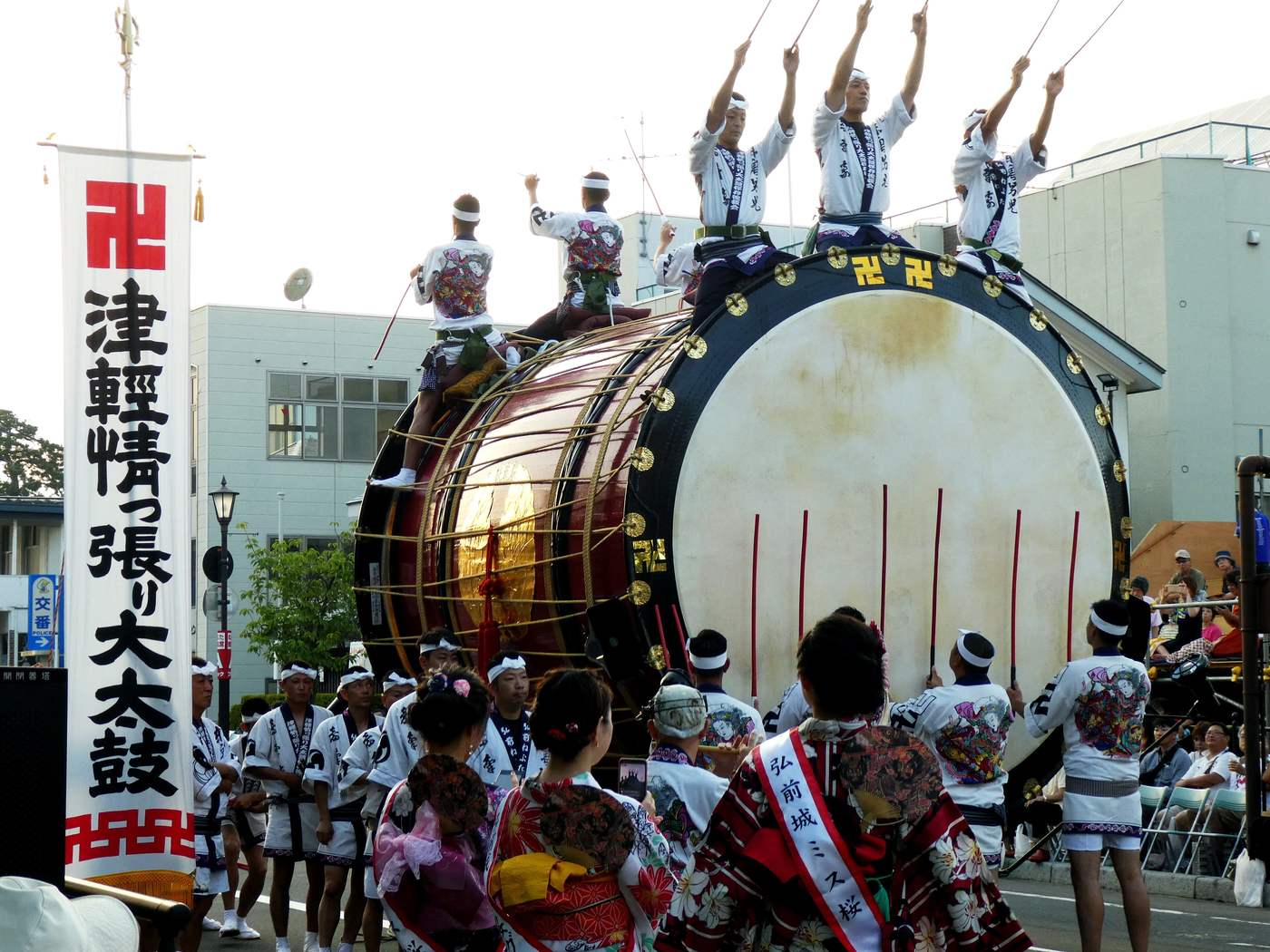
The first four days carry an extra element on Sakura-odori: the shutsujin-shiki opening ceremony, a demonstration by the Tsugaru Jouppari great drum followed by the ceremony proper, finishing at 19:00. Start times shift daily — 17:50 on August 1, 18:00 on the 2nd, 18:15 on the 3rd and 4th — and the whole thing disappears once the parade moves to the station-front course on the 5th. If you want to see the Tsugaru Jouppari drum, 3.3 metres across with a 3.6-metre body, reconstructed in 1970 and designated by the organisers as the lead unit of the joint parade, those four evenings are the window.
Small floats first — why arriving late costs you the range
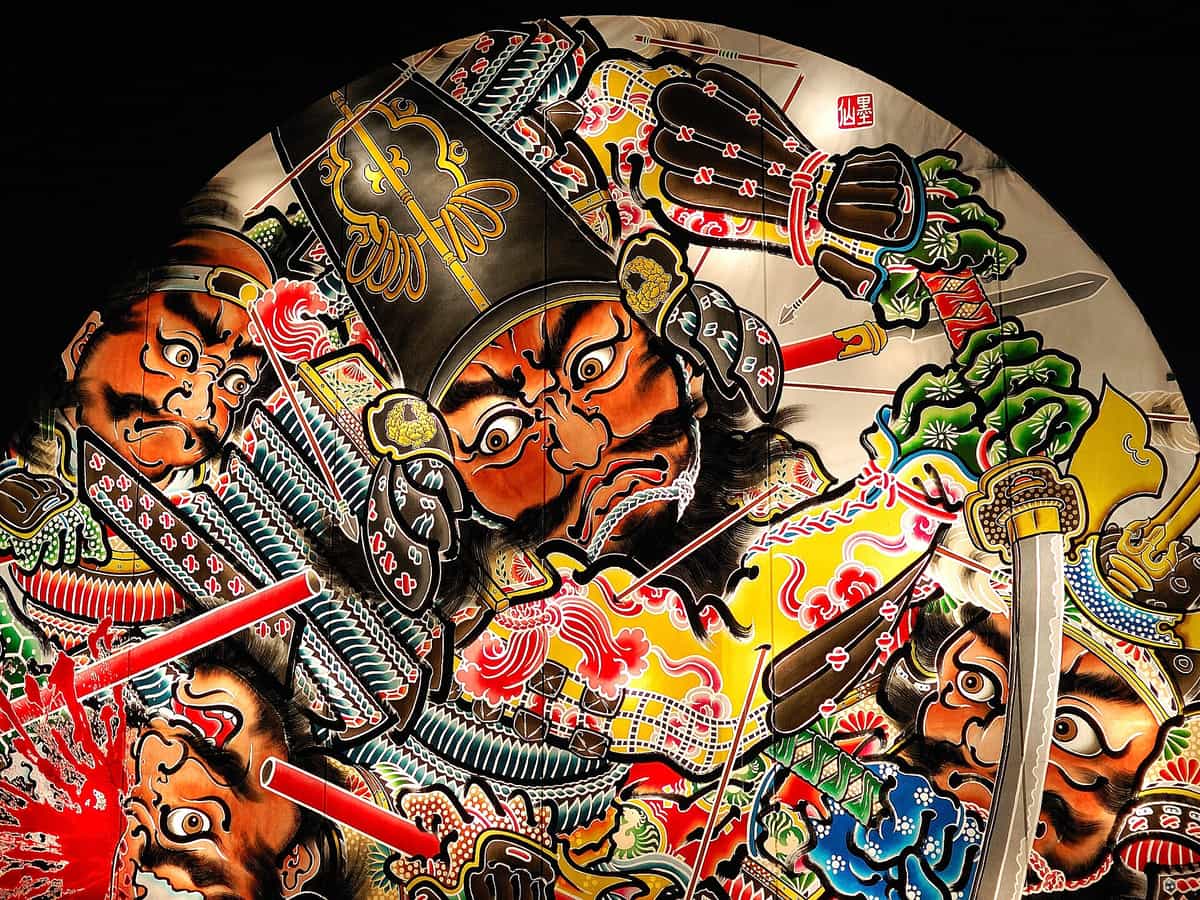
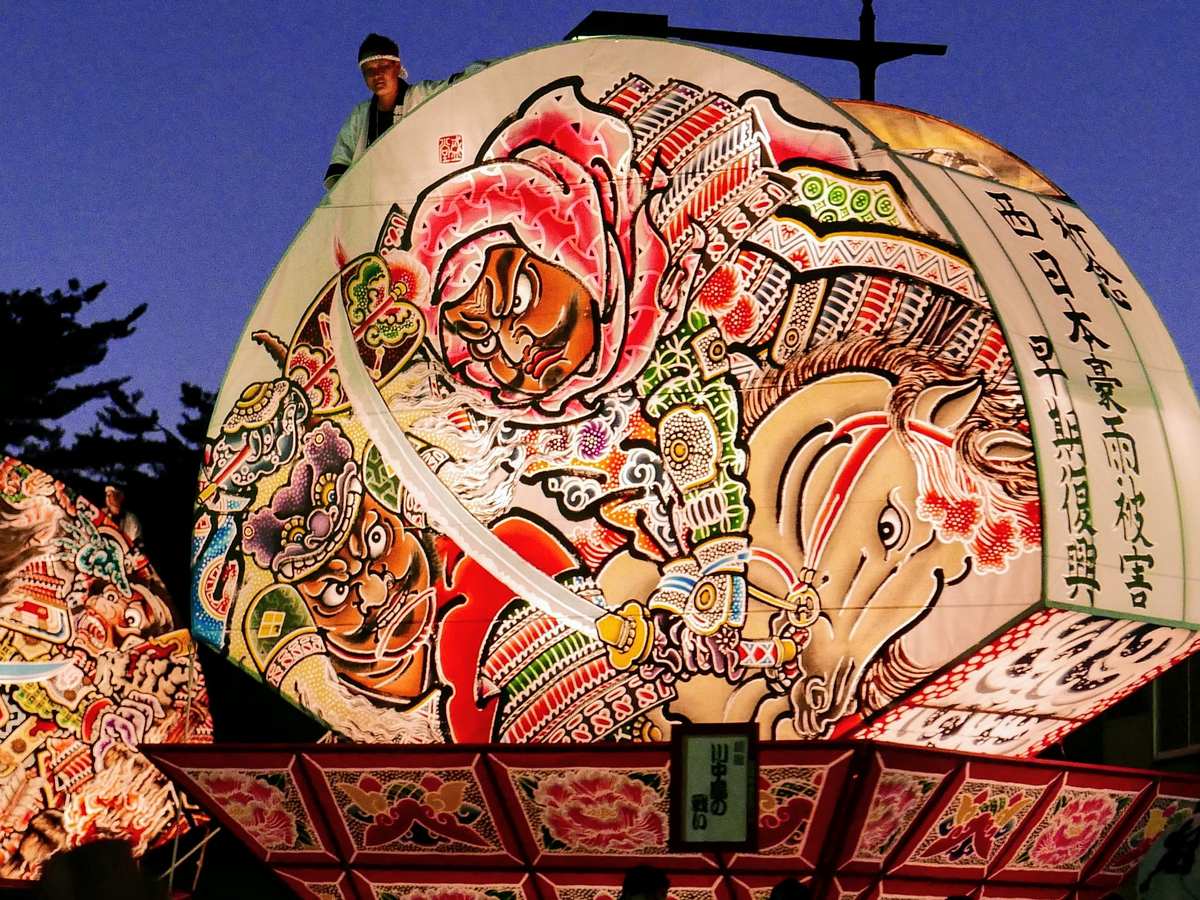
One practical line sits on the official page:the floats run in order from small to large, with the big ones coming later in the procession. In behavioural terms, arriving late means seeing only the giants and missing the size gradient entirely — and that gradient is the point, because the largest Hirosaki floats exceed nine metres and the sight the organisers themselves single out is the way they dodge overhead power lines and shop signs. If you want to watch that manoeuvre, pick a stretch of street with cables crossing it rather than the widest intersection.
A related piece of housekeeping: “neputa” and “nebuta” are not a typo. Hirosaki officially uses neputa — the national cultural property designation is literally Hirosaki no Neputa, registered January 28, 1980 — Aomori uses nebuta, and Goshogawara uses tachineputa. The chants differ too: Hirosaki calls ya-ya-do, Aomori rassera, Goshogawara yattemare. Three festivals, three vocabularies, three organisers. Hirosaki first appears in the written record in the domain diary of 1722, making 2022 its 300th year, and it is listed among Japan's 100 soundscapes worth preserving.
Nanukabi-okuri: the closing rite on the evening of the 7th
The festival does not end with the morning parade. It ends on the Iwaki River flats near Akane Bridge, at Nanukabi-okuri, August 7, 17:00 to 20:30 (planned), cancelled in rain — the opposite weather rule to the street parades. The published running order is precise: gates 17:00, stage 17:30, float display 18:00, floats set adrift at 19:30, organisers' address 20:00, and the burning of the floats at 20:10. A week of paper and paint is floated down the river and then set alight. That is the emotional terminus of the whole thing, and it has no equivalent at the other two festivals.
A free shuttle links Chuo-Hirosaki Station, the Hirosaki Tourist Information Center bus pool and the Seibu school lunch centre. First departure is 16:45 from Chuo-Hirosaki; the last is 21:00 from the lunch centre, run by two buses shuttling back and forth, and the organisers state that departure times are not fixed. Two officially flagged traps: local buses from the Tourist Information Center towards JR Hirosaki Station stop running shortly after 20:00, and Chuo-Hirosaki to JR Hirosaki is about a 15-minute walk. Watch the 20:10 burning and you should plan on walking that last stretch — build the 15 minutes into your evening or you will miss whatever you were connecting to.
Rain: the 17:00 firework signal
Hirosaki Neputa runs in the rain. When a heavy rain, storm or thunder warning or advisory is in effect, the final call is made at 17:00, with an unusually legible signal: if fireworks go up at 17:00, the parade proceeds. Cancellations are posted to the official site and social media.
That rule interacts badly with the seating rules. The seats have no roof, and both rain and sun umbrellas are prohibited, while refunds apply only if the festival is cancelled — buyer-side changes and cancellations are not accepted at all. So wet weather does not mean a refund; it means a raincoat and three hours of sitting in it. And because the 17:00 decision reaches you only through the website and social media, your phone needs to be online that afternoon in a town where the network is congested all week; getting connected is covered in our Japan eSIM guide.
Three ticketing systems, zero overlap
This is the section worth the read. Because the three are marketed together as Tohoku's great summer festivals, most visitors assume some shared ticketing logic. There is none — three organisers, three sales models, three entirely different purchasing behaviours, each with its own trap.
| Hirosaki Neputa | Aomori Nebuta | Goshogawara Tachineputa | |
|---|---|---|---|
| Individual price | ¥3,000 (same for adults and children) | ¥4,000 | ¥1,000–¥5,000 by group |
| Seat assignment | Fully reserved (choose your own online) | Reserved | All six unreserved |
| 2026 individual sales | June 22, 10:00 – July 30 | Lottery June 1; general June 27 & July 18 | Set by each group; Q&A dated May 15 |
| Sold by | Convention bureau (pomit.jp / 017-718-5544) | Festival committee (site, convenience stores, phone) | Six private groups, phone only |
| Counter sales | None at all | Convenience stores | Phone the groups |
| Roof / umbrellas | No roof, umbrellas banned | Varies by seat type | Set by each group |
| Refunds | Cancellation only | Per official terms | Ask the group |
Hirosaki: the seat that looks like it does not exist
Hirosaki's problem is not that seats are hard to buy. It is that they are hard to find. The bureau's festival landing page summarises sales as special viewing seats for groups from April 1, travel agency and group pre-booking, and local elementary school judging seats from June 26 — a list with no individual option anywhere in it. The ¥3,000 seat appears only on the seating sub-page, and it does not open until June 22. Do your research in early June, as most people planning a summer trip do, and you will conclude Hirosaki has nothing for independent travellers. That conclusion is wrong.
The system itself is unusually friendly once found: fully reserved, same price for adults and children, and the online channel lets you choose your seat. Locations are Sakura-odori on the Dotemachi course from August 1 to 4 (gates 17:30), and three points on the station-front course on August 5 and 6 — beside the station police box, the station taxi pool, and in front of the Art Hotel Hirosaki City (gates 18:00) — with parades starting at 19:00 in both cases. Individual capacity for 2026 was 335 seats a day across the Dotemachi A, B and E blocks and 297 a day across the station-front G and J blocks, shared between the web and phone channels. That is not a large pool.
Two hard limits. First, no counter sales of advance tickets — the organisers name the Hirosaki Tourist Information Center and the Machinaka Information Center specifically as places that do not sell them, and same-day tickets from August 1 consist only of leftover advance stock, which may be none. Second, no changes or cancellations after purchase. Together they mean Hirosaki is not a town you can improvise.
Two further seat types exist for specific needs: a group garden table at ¥20,000 for up to six people, sold through JTB BOKUN with outside food permitted and souvenirs included, and a VIP box at ¥200,000 for up to four, available only August 1 to 4 and limited to four parties a day, including local sake, drinks, light food and Tsugaru Vidro glassware. The second is irrelevant to almost every independent traveller; it is listed here mainly so you understand what that group-only summary page is actually describing.
Goshogawara: the organisers say they do not sell tickets
The Goshogawara Chamber of Commerce, which hosts the festival secretariat, writes in its official Q&A that it does not sell viewing seats. Six independent private groups do:
| Seller | Reference seats/day | Price per person | Phone |
|---|---|---|---|
| Hirayama Bungu-ten | 35 | ¥1,000 | 090-9633-5697 |
| Goshogawara FM | 300 | ¥3,300 (Omachi 2-chome) / ¥3,500 (Yanagimachi) | 0173-34-3311 |
| Omachi Neighbourhood Association | 240 | ¥3,300 | 0173-34-2264 |
| Machinaka Goshogawara | 500 | ¥3,500 | 0173-33-6338 |
| Kohii Shijin | 40 | ¥3,500 | 0173-33-1584 |
| Mohodori Distillery | 84 | ¥5,000 (souvenir included) | 0173-23-5805 |
Three things to be clear about. All six are explicitly unreserved — you are buying access to a viewing area, not a numbered chair. All six take bookings by telephone only, with no online channel of any kind, which is a genuine barrier if you do not speak Japanese. And the prices and capacities above come from the official Q&A dated May 15, 2026 and are re-set annually; this is what that document says, not live availability.
The good news is buried in the same document: you may watch from the parade route without buying anything, and anywhere along it, with the single request that you not hold space for long periods; the festival guide adds that claiming space on the roadway or pavement is prohibited, as is flying drones. So the honest advice is this: if you cannot make a Japanese phone call, stop worrying about tickets for Goshogawara. Free viewing is the officially sanctioned normal way to attend, and at 1.3 kilometres the loop is short enough that you are not going to miss the floats by standing in the wrong place.
August 7: two festivals, one impossible choice
Only August 7 lets you see two festivals on officially documented services, because Hirosaki runs in the morning that day and Goshogawara always runs at night. The Tachineputa festival guide publishes the JR East special trains added for August 4 to 8 (2026 services; the 2027 additions follow the official announcement):
| Direction | Section | Services (Aug 4–8) |
|---|---|---|
| Outbound | Hirosaki → Goshogawara | 14:53 → 15:40 / 17:55 → 18:46 |
| Return | Goshogawara → Hirosaki | 20:26 → 21:12 / 20:46 → 21:29 |
Applied to August 7, two mutually exclusive itineraries emerge:
- Plan A — Hirosaki morning plus Goshogawara. Watch the 10:00 morning course (roads reopen 11:30), spend the afternoon in Hirosaki, take the 17:55 to arrive Goshogawara at 18:46 ahead of the 19:00 start, and leave on the 20:26 or 20:46. The risk is on the return: if the parade runs to its scheduled 21:00 finish, the 20:46 has already gone and no later service is published. Budget your exit.
- Plan B — stay in Hirosaki all day. The 10:00 morning course, an afternoon off, then Nanukabi-okuri from 17:00 to 20:30 with the floats set adrift at 19:30 and burned at 20:10, on a free shuttle running 16:45 to 21:00.
You cannot have both, and that is the single most useful sentence in this guide. As for squeezing Aomori's 13:00 daytime parade in between for a three-festival day, that depends entirely on the Hirosaki–Aomori frequency on a current timetable — festival-week services differ from normal operation, so do not plan it on weekday journey times.
So which plan? First visit to Tsugaru: take Plan A. Goshogawara delivers the strongest visual impact of the three, and on August 7 the special trains make reaching it almost frictionless. Already seen the Tachineputa, or came specifically for Hirosaki: take Plan B. Nanukabi-okuri is not an encore, it is a different kind of event — a week's work floated away and burned — and it happens once a year, weather permitting.
Goshogawara Tachineputa: 23 metres and the omiai
The headline specification first, because I previously left it out for lack of a source: the large Tachineputa stand roughly 23 metres tall and weigh about 19 tonnes. Both the City of Goshogawara and tachineputa.jp state the same figures, so it is not folklore. Where Aomori builds broad sculptural figures and Hirosaki paints fans, Goshogawara builds vertically — and the sight of one of those towers threading between buildings is the most physically imposing image the three festivals produce.
The 2026 fundamentals: the festival runs August 4 to 8, with the official Q&A stating that these dates hold every year regardless of the day of the week, and all five nights run 19:00 to a planned 21:00 finish. The route starts at the old rotary intersection — about two minutes on foot from JR Goshogawara Station — and loops via the Teramachi-Iwakicho, Yanagimachi and Nunoyacho intersections for roughly 1.3 kilometres. Three large floats appear on all five nights: Susanoo-no-Mikoto, Enma, and the 2026 debut, Sarutahiko-no-Okami by Akinori Tsuruya. Five medium floats and nine small neputa are also planned, with numbers varying by night — the official roster shows August 7 as the thinnest evening.
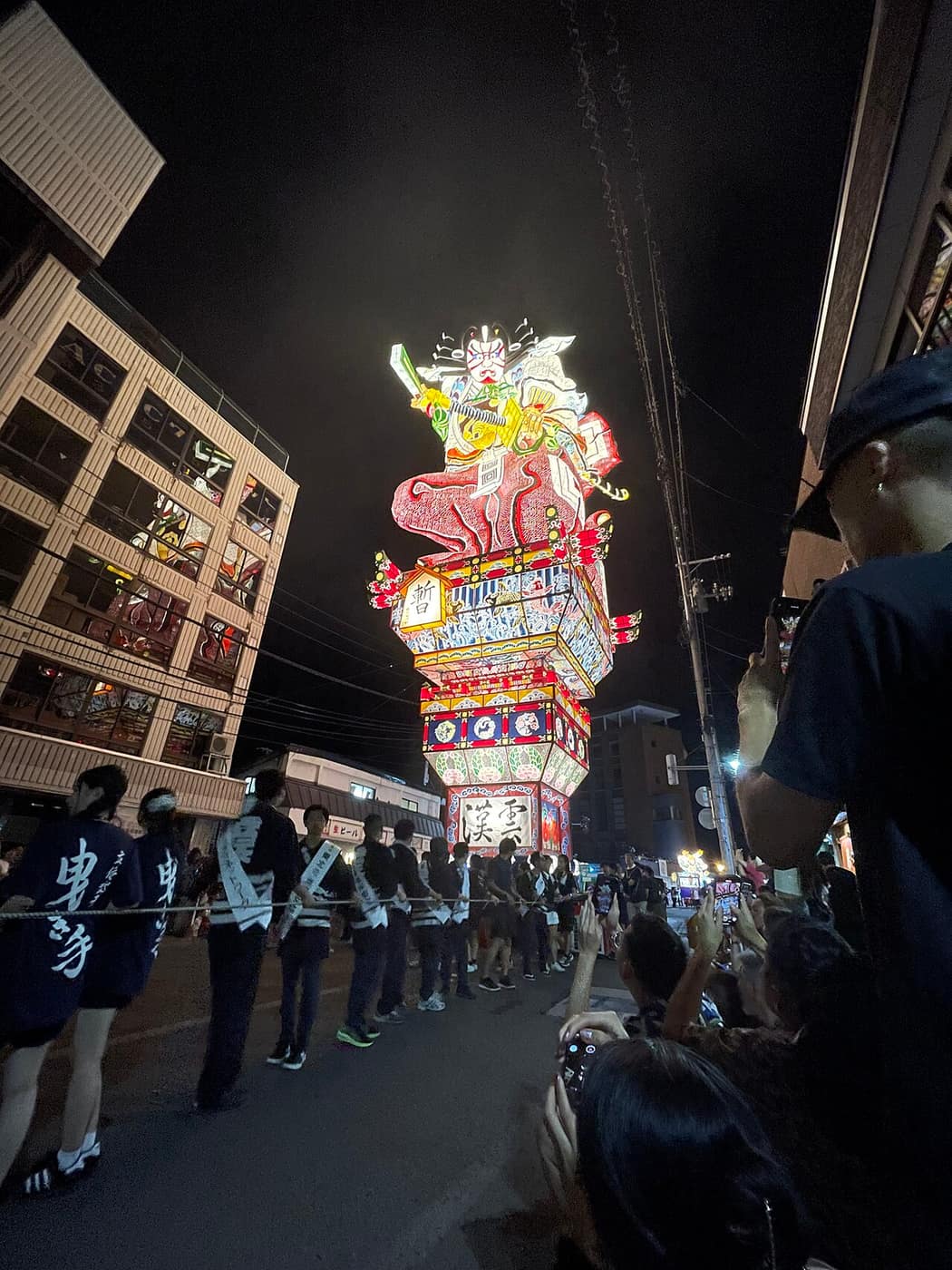
If you can only make one night in Goshogawara, make it August 4 or 8. The official Q&A states that on the opening and closing nights the three large floats gather at the old rotary intersection for the omiai, roughly 18:30 until the 19:00 start — about thirty minutes with three 23-metre towers standing at one junction, and it happens twice a year. Those are also the two nights you can watch them leave the museum, since the Q&A notes they depart shortly after 17:30 on August 4 and 8 to reach the gathering.
Practical notes. Traffic restrictions run from 17:45 each evening, lifting at 21:00, August 4 to 8. The shuttle bus no longer exists — the Q&A says plainly that a service used to run from the ELM shopping centre and does not now; the ELM car park remains usable at your own risk, about a 25-minute walk. Official temporary parking is the Iwaki River flats (approx. 500 spaces) and Plaza Maryu (approx. 120) at ¥1,000, plus Hortensia (approx. 325 spaces) free, all 16:00 to 21:30. Wheelchairs can be borrowed via the Goshogawara Tourism Association subject to availability, and there is a dedicated wheelchair viewing area. Food stalls and kitchen cars cluster near the Yanagimachi paid seating and trade until the parade ends — eat at the stall before moving on rather than walking with food, which on a packed parade route is both hazardous and poor manners.
One more event is worth stacking on the front: the Goshogawara Fireworks Festival on the Hokuto Ground on the Iwaki River flats, with around 5,000 shells; the 75th edition ran on 3 August 2026 from 19:20 to 21:00, and the 2027 date has not been announced. It lands the night before the festival opens, which suits anyone arriving early. For how it compares with the rest of Japan's summer fireworks calendar, see our Japan summer fireworks guide.
Finally, a piece of honesty about designations. No mention of any cultural property designation for the Goshogawara Tachineputa appears on the city website, tachineputa.jp, or the official festival site. Absence of a record is not proof of absence, so this guide says only that nothing is stated officially — neither claiming a designation nor denying one. Hirosaki, by contrast, holds a clear national Important Intangible Folk Cultural Property designation as Hirosaki no Neputa, dated January 28, 1980. And to settle the recurring confusion: none of the three is individually inscribed by UNESCO. The 2016 Yama, Hoko, Yatai list — 33 entries at the time — includes, from Aomori Prefecture, the float event of the Hachinohe Sansha Taisai.
⚠️ Worth adding a date: that list was superseded on 8 December 2025. UNESCO's 20th intergovernmental committee adopted decision 20.COM 7.b.52, whose text states that the new inscription "incorporates and replaces" the 2016 entry for Yama, Hoko, Yatai float festivals (No. 01059), and that the Japanese inventory "comprises the thirty-three float festivals included in the original nomination, along with four additional festivals included between 2016 and 2021." So 33 is the 2016 figure rather than the current one — the decision names neither the four additions nor a new total, so this guide does not guess. For the three Tsugaru festivals the answer is unchanged either way: none of them is on the list, however far it expands.
Getting around during festival week
Check regular services between Hirosaki, Goshogawara and Aomori on a current timetable before you commit to an evening. Festival-week operation differs from the normal pattern, and planning a late return on weekday journey times is how people get stranded. The one thing fixed in advance is the set of special JR services published in the Goshogawara festival guide (August 4 to 8, enquiries 050-2016-1600), listed above.
The only train times written here are the four JR special services published in the official Goshogawara festival guide for August 4 to 8 (enquiries 050-2016-1600), listed in the previous section. That document is the sole route by which official JR timings could be obtained at all, and it is why the two-festival itinerary above can be written as concrete departures.
Other officially sourced options:
- Tsugaru Railway (0173-34-2148): from August 4 to 8 it runs vintage carriages, Tsugaru-Goshogawara 12:00 to Kanagi 12:29 to Tsugaru-Nakasato 12:44, returning Nakasato 13:37 to Goshogawara 14:21; from August 3 to 8 there is also a late service, Goshogawara 21:10 to Nakasato 21:47. Standard adult fares from Tsugaru-Goshogawara are ¥560 to Kanagi, ¥650 to Ashino-Koen and ¥870 to Tsugaru-Nakasato. ⚠️ Whether the August vintage carriages carry a surcharge is not stated officially — the ¥1,000 winter stove-train charge is a separate scheme — so confirm by phone before boarding. Kanagi is the birthplace of the novelist Osamu Dazai, which makes this a worthwhile branch line in its own right if you have a free afternoon.
- Tsugaru Free Pass: valid on designated sections of JR East, Konan Railway, Tsugaru Railway and Konan Bus — precisely the network these three festivals sit on. Two limits matter: the Tsugaru Railway free zone ends at Kanagi, so Kanagi to Nakasato costs extra, and the pass is sold only through TOHOKU MaaS, a smartphone-only site, not at ticket windows. ⚠️ We do not quote its price — that page sits on the JR East site, which was inaccessible.
- Odate-Noshiro Airport to Hirosaki shuttle: laid on for 1 to 8 August in 2026, two round trips a day, roughly 80 minutes, ¥3,300 one way per person, picking up and dropping off at Tsugaruhan Neputa Mura close to the festival area. It is laid on for Hirosaki's four major festivals; whether it returns in 2027 has not been announced.
- Goldfish Neputa train: the Konan Railway Owani Line decorates a carriage with around 350 goldfish-shaped neputa lanterns, running July 4 to August 31 in 2026, with 2027 dates not yet announced. Not transport so much as a small pleasure, and available either side of the festival week.
⚠️ For Konan Railway's festival-week special services, call the operator on 0172-44-3136 for the current year — the block on the tourism bureau's page has been left showing the previous year's dates for a whole season before.
On reaching Tohoku at all: this is a genuine long-haul move to the northern tip of Honshu, and whether a rail pass pays off depends on whether you are also covering Sendai or Morioka on the same trip. One thing to update first: the Tohoku-area JR East Pass was withdrawn on March 13, 2026, folded from March 14 into the all-JR-East JR EAST PASS (¥35,000 for five consecutive days, not the old "any five days within a fortnight") — wider coverage, higher break-even, so older break-even figures no longer transfer — the comparison method is in our JR Pass guide, and continuing south is covered in the Sendai guide. On accommodation there is only one honest sentence: Hirosaki, Aomori and Goshogawara are all in festival week simultaneously, so none of them is the quiet overflow option. Book months out.
Hirosaki listings are below. A list cannot tell you whether festival week still has rooms; you only see that once the dates are set to those August nights:
| Platform | Before you click |
|---|---|
| Booking.com Hirosaki stays → | The list opens on today's date; change it to the festival nights first |
| Agoda Hirosaki stays → | Hirosaki City only; Aomori and Goshogawara need a separate search |
| Rakuten Travel Hirosaki stays → | Only a dozen or so properties here; that is this platform's inventory, not every hotel in town |
One number this guide also declines to publish: the total float count for Hirosaki's joint parade. The organisers release a participating-group roster but no total, and the roughly 80 figure repeated in the media has no official source. The verified and more useful rule is the one already given — small floats first, large ones later.
If you miss the dates
Missing the first week of August does not write off the region. Tsugaru has an unusually dense set of permanent facilities, and 2026 brings one change with a short shelf life.
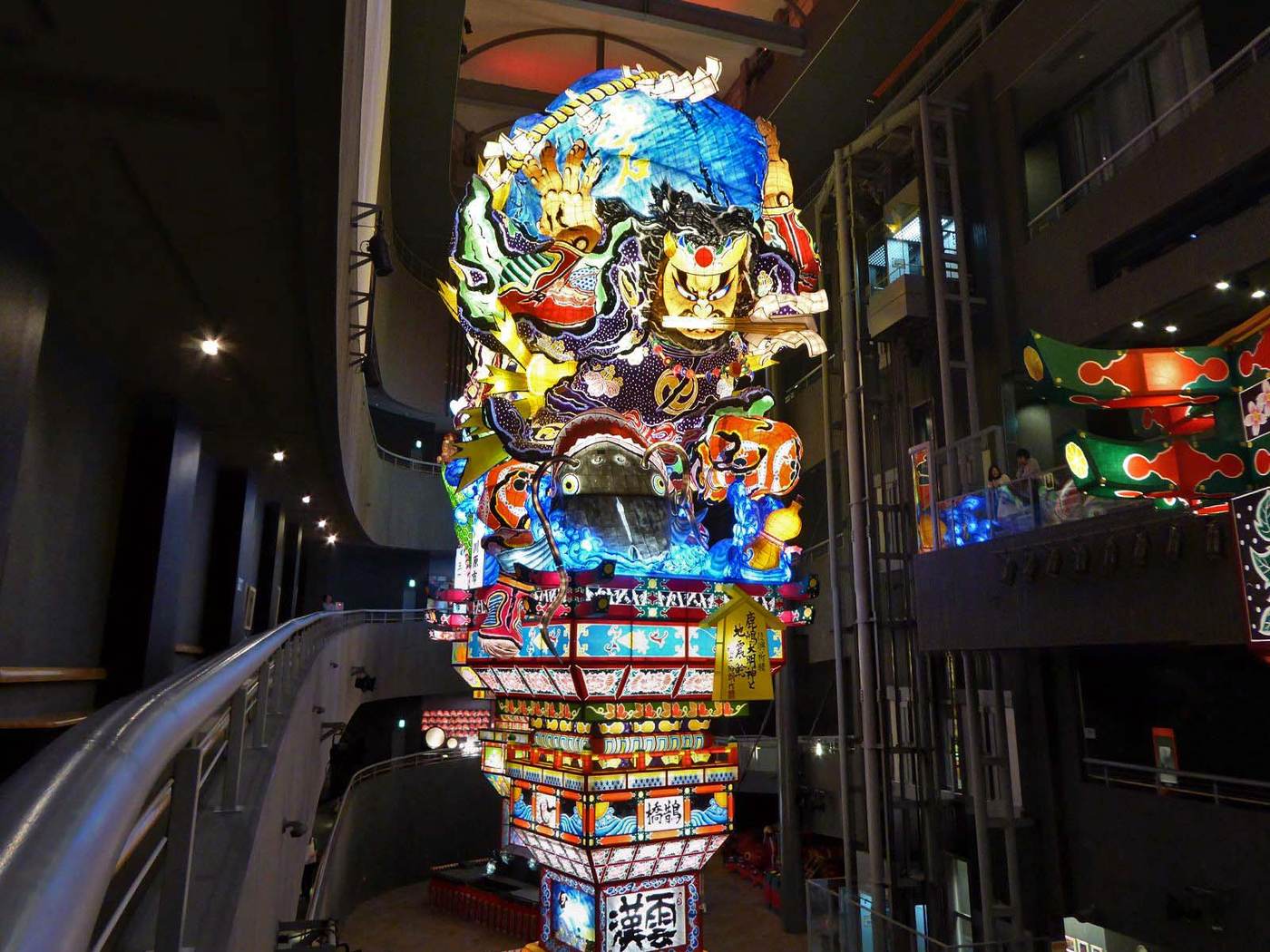
Tachineputa no Yakata: the 23-metre float, all year round
This is the one to prioritise. The museum closed in April 2025 for a major renovation and reopened only on Friday July 10, 2026, with exhibition viewing from July 11 and a new facility on the fourth floor — meaning anyone who visited on the strength of an older guide during 2025 found it shut, and that stale information is still online. Admission to the Tachineputa hall is adults ¥800, high school students ¥500, elementary and junior high ¥300, with a combined ticket including the art gallery at ¥1,000 for adults. A 10 percent discount covers groups of 20 or more, Resort Shirakami passengers, disability certificate holders and JAF members.
The viewing method is the reason to go: you ride up and descend a spiral ramp alongside the 23-metre float, reading it from crown to base — a vertical perspective the street simply cannot offer. It is about three minutes' walk from JR Goshogawara Station.
Two scheduling traps. Standard hours are 9:00 to 19:00 April to September (last entry 18:30) and 9:00 to 17:00 October to March (last entry 16:30), closing only on January 1, with early closes on August 13 and December 31. But during the festival, August 4 to 8, the exhibition hall and gallery close at 17:00, which will wreck an afternoon plan on a festival day. And on August 4 and 8 the three large floats leave the building shortly after 17:30; whether they are inside during the day on August 5 to 7 is not officially stated, so this guide makes no promise about it.
Tsugaruhan Neputa Mura: open every day of the year
Hirosaki's permanent counterpart. Admission is ¥600 general, ¥400 high and junior high, ¥300 elementary and ¥100 for children aged three and up, and it is open year-round, with the exhibition and workshop areas running 9:00 to 17:00 and the building closing at 17:30. Inside are the Hirosaki Neputa hall, the Ya-ya-do float room, the Tsugaru Kurakobo craft workshop, the Sangendo hall with live Tsugaru shamisen performances, and the Yokien Japanese garden.
One rule is worth pulling out because almost nobody repeats it: using only the shops and restaurants — the free zone — requires no admission ticket, and neither does taking a craft workshop without touring the facility. So if you only want souvenirs or lunch, do not buy a ticket first. The site is also the pick-up point for the Odate-Noshiro airport shuttle.
Two free options belong here too. Floats are displayed free of charge from August 1 to 6, 8:00 to 17:00, at the Shimin Chuo and Kikkomachi plazas, which is the easiest way to study the painted faces in daylight. And the station-front special display runs July 1 to August 16 beside the central exit of Hirosaki Station, showing the construction sequence from bare frame to pasted kagami-e — a layer the night parade completely hides.
Hirosaki Park and the castle: no interior access until FY2032
It is hard to visit Hirosaki without walking through Hirosaki Park, but one condition applies for years yet: you cannot go inside the castle keep. Officially, the keep interior has been closed since the winter shutdown of November 24, 2025, and remains closed for the duration of the relocation and conservation works — through fiscal 2032. The exterior comes in stages. In fiscal 2026 the keep is being hauled back onto its original stone base, with the work platform and scaffolding hiding the lower portion and the upper part still visible; the exterior stays visible through the 2027 and 2028 cherry blossom seasons; only from autumn of Reiwa 10 (2028) does a temporary roof enclosure go up and hide the keep entirely. Hirosaki City has given two wordings for that enclosure — “around summer” in its Reiwa 7 version and “around autumn” in its Reiwa 8 version — but both state that the exterior remains visible through the final day of the 2028 cherry blossom festival. For what that work platform actually looks like up close, and which angles still work for photos in 2027 and 2028, see our rundown of the keep's current state.
Admission to the Honmaru and Kita-no-Kuruwa area is ¥320 for adults and ¥100 for children, the rate in force since April 1, 2025, with opening hours 9:00 to 17:00 from April 1 to November 23 and free entry from November 24 to March 31.
Hirosaki's other identity, as one of Japan's great late-blooming cherry cities, is covered in our Hirosaki and Hokkaido cherry blossom guide.
Which one is worth it if you only pick one
Few travellers have five days for Tsugaru, so the real question is which single festival to commit to.
For maximum visual impact on a first visit: Goshogawara, on August 4 or 8. A 23-metre lantern tower moving around a 1.3-kilometre loop through an ordinary provincial high street needs no background knowledge to land, and the thirty-minute omiai on the opening and closing nights is the single best image the three festivals produce. Free viewing is officially permitted and the loop is short enough that position barely matters. The drawback is the ticketing: no official office, and a Japanese phone call if you want to sit.
For participating rather than watching: Aomori. Haneto dancers need no registration and no sign-up, so a complete costume and punctuality are the whole barrier — the full method is in our Aomori Nebuta guide. Hirosaki opens only some groups to visitors and requires advance contact; Goshogawara's float-puller applications closed on June 30. Neither is a spontaneous option.
For the complete arc rather than just the climax: Hirosaki, staying through August 7. This is the choice this guide most wants to recommend and the one with the strictest conditions: the last joint parade at 10:00, then the river flats in the evening to watch a week of paper set adrift and burned at 20:10. An entire week of work ends inside two hours, and neither of the other festivals has an equivalent. The price is that you cannot be in Goshogawara that night, and rain cancels it.
As for doing all three: it needs five days and it will flatten your stamina and your accommodation budget. If you insist, the cleanest skeleton is August 4 Goshogawara (omiai), August 5 or 6 Hirosaki station-front, August 6 Aomori (prize night), August 7 Hirosaki morning plus your choice. Honestly though, two festivals seen properly beats three seen partially. The value is not in the count — it is in watching one lantern tradition resolve into three unrelated forms across three towns, and two of them is enough to feel the contrast.
Frequently Asked Questions
- Q1:What time does Hirosaki Neputa actually start, and why is August 7 different?
- Six of the seven days start at 19:00. August 7 does not — it starts at 10:00 in the morning. The Hirosaki Convention and Visitors Bureau lists the joint parade for August 7 as the Dotemachi morning course, with published traffic restrictions running 9:30 to 11:30. The other days split into two routes: August 1 to 4 on the Dotemachi course from 19:00 (restrictions 18:30 to roughly 22:00, with Sakura-odori closed to vehicles from 17:30), and August 5 and 6 on the station-front course, also from 19:00. This single detail is the most expensive mistake available at this festival: turn up on the evening of the 7th expecting a parade and the streets have been reopened to traffic for eight hours. What does happen that evening is a different event entirely — Nanukabi-okuri, the closing rite on the Iwaki River flats, 17:00 to 20:30, cancelled if it rains. One more caveat worth stating plainly: the organisers publish the traffic restriction window for the morning course but not an end time for the parade itself, so treat 11:30 as when the roads reopen, not as when the floats stop.
- Q2:How much are Hirosaki Neputa reserved seats, and can you buy them on arrival?
- The seat that matters to independent travellers is the reserved chair seat at ¥3,000(個人観覧席(イス席・全席指定/大人小人同額)) per person, tax included, with adults and children charged the same. Individual sales for 2026 ran from 10:00 on Monday June 22 to Thursday July 30 — three weeks later than Aomori's June 1 lottery. Check the official site in early June and the summary page shows only group and travel-agent sales; the individual seat lives on a sub-page. There are exactly two channels: online through Pomit (pomit.jp, free account required, and you choose your own seat), or by phone through the Link Station event office on 017-718-5544, where seats are assigned automatically and cannot be specified. A new option for 2026 was an unreserved seat at ¥2,000(8/1 土手町コース 臨時自由席(2026 追加販售・100 席)), limited to 100 places on the August 1 Dotemachi course only. And no, you cannot buy on arrival in any reliable sense: the organisers state explicitly that no advance tickets are sold over the counter at the Hirosaki Tourist Information Center or the Machinaka Information Center, and same-day tickets from August 1 consist only of unsold advance stock, which may not exist at all.
- Q3:Where do you buy seats for the Goshogawara Tachineputa?
- Not from the organisers — and this is the least intuitive fact about the three festivals. The Goshogawara Chamber of Commerce, which runs the festival secretariat, states in its official Q&A that it does not sell viewing seats at all. Seats are sold instead by six independent private groups, at prices from ¥1,000(平山文具店(35 席/日)) to ¥5,000(モホドリ蒸溜研究所(お土産付)) per person, all by telephone only, and all explicitly unreserved — every one of the six is listed as providing a viewing area rather than a numbered seat. The reference capacities in the official Q&A, dated May 15, 2026, are: Hirayama Bungu-ten 35 per day, Goshogawara FM 300, Omachi Neighbourhood Association 240, Machinaka Goshogawara 500, Kohii Shijin 40, and Mohodori Distillery 84 with a souvenir included. Those figures and prices are re-set every year and there is no way to verify current availability online. The reassuring part: the same official Q&A confirms that you may watch from anywhere along the parade route without a ticket, asking only that you not reserve space for long periods — and the festival guide adds that claiming space on the roadway or pavement is prohibited, as is drone use.
- Q4:Can you see two of the three festivals in one day?
- Only on August 7, and only at the cost of Hirosaki's closing ceremony. The arithmetic works because Hirosaki parades in the morning on the 7th while Goshogawara always runs 19:00 to 21:00. The official Tachineputa festival guide publishes the JR East special services added for August 4 to 8, and they line up: Hirosaki 17:55 to Goshogawara 18:46 gets you there before the start, with returns at 20:26 arriving Hirosaki 21:12 and 20:46 arriving 21:29. The catch is that Hirosaki's Nanukabi-okuri also occupies the evening of the 7th, 17:00 to 20:30, with the floats set adrift at 19:30 and burned at 20:10. It collides head-on with Goshogawara's 19:00 start, so the two are mutually exclusive. Note also the risk on the return leg: if Goshogawara runs to its scheduled 21:00 finish, the 20:46 service is already gone and the following departure is not published. Note that those four services are the 2026 additions; whether they run again in 2027 has not been announced, and regular timings should be checked on a current timetable because festival-week services differ from normal operation.
- Q5:What happens if it rains?
- Hirosaki Neputa runs in the rain. The rule is that when a heavy rain, storm or thunder warning or advisory is in force, a final decision is made at 17:00, and the organisers give a signal anyone on the street can read: if fireworks go up at 17:00, the parade is happening. Cancellations are announced on the official site and social media. Now the expensive part, because it compounds: the reserved seats have no roof, and umbrellas — rain or sun — are explicitly prohibited, while refunds are issued only if the festival is cancelled and changes or cancellations by the buyer are not accepted at all. In plain terms, wet weather means sitting through it in a raincoat, so a raincoat is equipment rather than an option. Goshogawara operates differently: its Q&A says light rain will not cancel the festival though the number of participating floats may drop, that strong wind is the real cancellation risk, and that the committee meets at 13:00 each day of the run to decide, announcing cancellations by loudspeaker vehicle and radio. Hirosaki's Nanukabi-okuri, by contrast, is cancelled in rain — the opposite rule to the street parades, which is easy to get wrong.
- Q6:Is the Tachineputa museum worth visiting if you miss the festival?
- Yes, and 2026 is a particularly good year to ask, because Tachineputa no Yakata closed in April 2025 for a major renovation and only reopened on Friday July 10, 2026, with exhibition-hall viewing resuming July 11 and a new fourth-floor facility. Anyone who followed an older guide during 2025 found the doors shut, and that stale information is still circulating. Admission to the Tachineputa exhibition hall is ¥800(立佞武多展示室・大人) for adults, ¥500 for high school students and ¥300 for elementary and junior high students, with a combined ticket including the art gallery at ¥1,000 for adults. A 10 percent discount applies to groups of 20 or more, Resort Shirakami passengers, disability certificate holders and JAF members. Opening hours are 9:00 to 19:00 from April to September, last entry 18:30, and 9:00 to 17:00 from October to March, last entry 16:30; the only regular closure is January 1. Two traps: during the festival, August 4 to 8, the exhibition hall closes at 17:00, and on August 4 and 8 the three large floats leave the building shortly after 17:30 for the omiai gathering. Whether they are inside during the daytime on August 5 to 7 is not stated officially, so do not count on it. The viewing method is the draw — you ride up and walk down a spiral ramp alongside a 23-metre float, an angle the street cannot give you.
- Q7:Can visitors join in, the way you can as a haneto in Aomori?
- Three festivals, three completely different thresholds. Aomori is the open one: haneto dancers need no advance registration and no same-day sign-up, so a full costume and punctuality are the entire barrier. Hirosaki is conditionally open. The official wording is that depending on the group, visitors can take part in the parade, with clothing and participation conditions set by each group individually — meaning you must contact a group in advance, and the Hirosaki Tourist Information Center on 0172-37-5501 is the office that will point you to them. Goshogawara accepts individual float pullers, but applications go through the Goshogawara Tourism Association on 0173-38-1515 and the 2026 recruitment period closed on June 30, so turning up on the day is not a route in. The practical takeaway: Aomori is the only one of the three you can decide to join spontaneously; Hirosaki needs a phone call weeks ahead; Goshogawara needs one before the end of June.
- Q8:Are the 2027 dates safe to book flights around?
- The dates are; the tickets are not. Both organisers publish fixed calendar dates rather than floating weekend rules. Hirosaki states that the festival period is August 1 to 7 every year, and the Goshogawara committee's Q&A states that the festival runs August 4 to 8 every year, regardless of the day of the week. Aomori remains August 2 to 7. Applied to the 2027 calendar that gives Hirosaki Sunday August 1 to Saturday August 7, Goshogawara Wednesday August 4 to Sunday August 8, and the same four-day overlap window of August 4 to 7. Goshogawara's finale landing on a Sunday and Hirosaki's on a Saturday makes 2027 slightly kinder for return flights than 2026. What this guide will not do is predict the rest: seat prices, sales opening dates, the JR special services, Nanukabi-okuri and the Goshogawara fireworks have published nothing for 2027. The only forward-looking thing worth writing down is the 2026 rhythm as a reference clock — Hirosaki groups from April 1 and individuals from June 22, Aomori's lottery June 1 with general sales June 27 and July 18, and the Goshogawara private-group information refreshed into the official Q&A around mid-May. Set a reminder to check the Hirosaki seat sub-page in mid-June.
Read next
Aomori Nebuta Festival 2027: Dates, Seats & Joining In
Fixed dates every August 2–7, so 2027 runs Mon 2 to Sat 7 August. Haneto dancers need no registration — seat prices and sales timing, costume rules and the Wa Rasse closure trap.
Aomori Travel Guide 2027: Sannai-Maruyama, Hakkoda & Oirase
Honshu's northern tip of Jomon heritage and gateways — the World Heritage Sannai-Maruyama site, year-round nebuta floats at Wa Rasse, Hakkoda and Oirase, plus Oma tuna and apples.
Hirosaki & Hokkaido Cherry Blossoms 2027: Japan's Latest Bloom
They open when Kyoto is done — Hirosaki's petal raft, Goryokaku, Sapporo: Golden Week sakura, late April to early May.
📊 See the 2026 Price Index (JR Pass, DPA, eSIM, Airport Transport) →