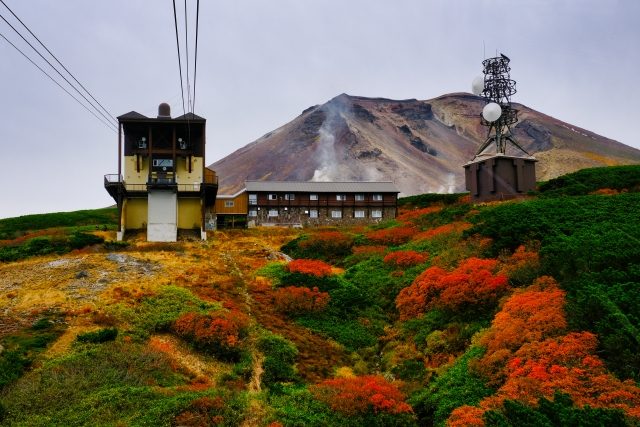
While Kyoto is still solid green and Tokyo hits a daily high of 26°C in late September, the summit of Mt. Kurodake in Sounkyo is already 4°C with a wall-to-wall sea of red maples running all the way to the volcanic crater rim. That's Daisetsuzan's unfair advantage: you can shoot the most dramatic autumn scenery in Japan three weeks before anyone else has even started thinking about leaves. This guide is for travelers who want to chase that first wave — covering Mt. Kurodake, Sounkyo Gorge, and Jozankei with a realistic 4-day route, budget, and booking timeline.
📍 Want to compare with the rest of Japan? Tohoku peaks mid-October, Kyoto late November, Kyushu mid-December — see the full nationwide timing map in Japan Autumn Foliage Complete Guide 2026. This article is the Hokkaido deep dive within that guide.
- 2026 has started: the Kurodake summit began coloring on Sept 2 (tenki.jp calls it slightly later than a normal year), and this autumn Hokkaido runs warm, so peak color may fall late
- As of September 26, Kurodake, Sounkyo Koyodani, Daisetsu Kogen Onsen, Ginsendai, Asahidake's Sugatami Pond and the Tokachidake Ryounkaku area were all already at peak colour — the high-country wave is happening now. Down at the onsen villages the official forecast is Sept 30 for Sounkyo Onsen and Sept 29 for Asahidake Onsen
- Must-do: Kurodake Ropeway + Lift combo (¥3,900 round trip), 6:00 first car for clear summit weather
- 4-day route: Sapporo in → Asahikawa → Sounkyo → Biei/Furano → Jozankei → Sapporo out
- Book Sounkyo onsen 6–8 weeks ahead — peak-week rooms sell out faster than Kyoto's during koyo
- Budget: ¥177,000–¥217,000 for a couple sharing a room (ground costs only, no flights — Japan domestic equivalent ≈ NTD 38,000–47,000)
📖 Article contents (click to expand)
- Why is Daisetsuzan Japan's earliest autumn?
- Mt. Kurodake: Japan's foliage starting line
- Sounkyo Gorge: basalt columns + red maple canyon
- Jozankei: Sapporo's hidden autumn pocket
- 4-day route: Sapporo → Asahikawa → Sounkyo → Biei → Jozankei
- Transit: JR Hokkaido Pass vs rental car
- Budget: real costs for a couple, 4 days
- FAQ
Why is Daisetsuzan Japan's earliest autumn?
Japan’s earliest foliage. Mt. Kurodake starts in late September, reaching Sounkyo and Jozankei by mid-October. These are historical-average windows — cross-check the WeatherNews spot pages two weeks before you travel (tenki.jp has not published a 2026 peak forecast; Walkerplus republishes WeatherNews).
Three compounding factors:
- Latitude. Central Hokkaido sits at 43–44°N — about a degree higher than Sapporo and ~5° higher than Kyoto. Each degree of latitude shifts seasonal onset by roughly a week.
- Elevation. The Kurodake ropeway reaches the 1,300m 5th station; the lift continues to the 1,520m 7th station (the 1,984m summit is on foot). Temperature drops about 0.6°C per 100m gained, so by early September the high stations are already below the 8°C threshold where maples turn.
- Volcanic terrain. Daisetsuzan is an active volcanic system — the ground retains less daytime heat than equivalent latitudes, advancing autumn onset by another week.
The three stack to make Kurodake the first stop on Japan's autumn foliage front. If you can take leave in late September, this is uniquely available — no other destination in Japan offers this view at that time.
Mt. Kurodake: Japan's foliage starting line
The 2026 season has already started here. In a forecaster commentary published at 16:02 on September 2, 2026, the Japan Weather Association (tenki.jp) reported that the earliest autumn color in Japan had begun near the Kurodake summit, where the alpine urashimatsutsuji is turning red. The same commentary calls it a slightly later start than a normal year. What follows is fixed: color works its way down from the summit over roughly a month and a half, and the association expects it to reach the Sounkyo gorge floor in early to mid-October 2026.
Read that carefully on two points. First, what the association dates is color arriving at Sounkyo, not peak color — the two are not the same thing. Second, the line worth remembering most: per the latest long-range outlook, Hokkaido temperatures this autumn are forecast above normal and peak color may run late. So treat the historical estimates below as something to slide later in 2026, and keep late-September dates flexible. The flip side, which the association also raises: a warm autumn advances slowly, which may mean more good-weather days for leaf viewing.
Where the colour actually was on September 26
The high country has already topped out. The table below is what the WeatherNews spot pages and the tenki.jp colour-status tracker showed on September 26, 2026 — two independent sources agreeing on the high spots. Colour status updates daily, so check it again before you go.
| Spot | WeatherNews (observed) | tenki.jp (Sept 26, 09:00) |
|---|---|---|
| Daisetsuzan, Ginsendai | 🟢 Peak (70–80% turned, Sept 25); leaf drop from Sept 26 | 🟢 Peak colour |
| Asahidake, Sugatami Pond area | 🟢 Peak (70–80%, Sept 24); leaf drop from Sept 28 | — |
| Mt. Kurodake | — | 🟢 Peak colour |
| Sounkyo Koyodani (Gorge of Maples) | — | 🟢 Peak colour |
| Daisetsu Kogen Onsen | — | 🟢 Peak colour |
| Mt. Tokachidake (Ryounkaku area) | 🟢 Peak (Sept 25) | — |
| Lake Shikaribetsu | 🟡 About half turned (Sept 25); peak forecast from Sept 27 | — |
| Sounkyo Onsen (village) | 🟡 Starting to turn (30%, Sept 25); peak forecast from Sept 30 | — |
| Asahidake Onsen (village) | 🟡 Starting to turn (30%, Sept 24); peak forecast from Sept 29 | — |
Note that “Sounkyo” is two different things here: the onsen village is forecast to hit peak from September 30, while the early-to-mid-October date above is for colour reaching the gorge itself. The two numbers do not contradict each other, and averaging them gives you nothing useful — which one matters depends on whether you are strolling the village or heading into the gorge.
In itinerary terms: if you want the “red leaves + leftover snow + volcanic terrain” frame, push straight for Ginsendai, Sugatami Pond and the Kurodake 7th station. If what you want is red maples outside your onsen window, aim for the end of September into early October instead.
Two official normals worth keeping as a frame: maple color normally arrives October 16 in Kushiro and November 7 in Muroran, and most of Hokkaido peaks between mid-October and early November. Mechanically, color only advances once minimum temperatures drop below 8°C, then takes about three weeks to finish — which is why a few hundred meters of elevation buys you days, and why the Kurodake summit can start in early September at all.
Kurodake (1,984m) is the most accessible high peak in the Daisetsuzan range. From Sounkyo Onsen, a 7-minute ropeway lifts you to the 1,300m "5th station," and a 15-minute lift continues to the 1,520m "7th station." From there:
- Observation-deck photography (no hiking): 10 minutes at the 7th-station deck gets you the foliage sea + crater view. Done.
- Loop trail (30–45 min): A gentle stone path circling the deck, hitting different angles of the same view.
- Summit climb (1.5 hr one-way): Requires real gear — hiking boots, gloves, thermal layers. Late-September summit hits 0–3°C, only experienced hikers should attempt.
Most visitors do the first two. "Take the 6:00 first ropeway" is the iron rule of Kurodake autumn. Summit visibility in late September is typically best between 6:00 and 9:00, before mountain clouds form. The crowd between the first and second car often increases by 10×. Tour buses start rolling up at 9:00, and the observation deck becomes a scrum.
Sounkyo Gorge: basalt columns + red maple canyon
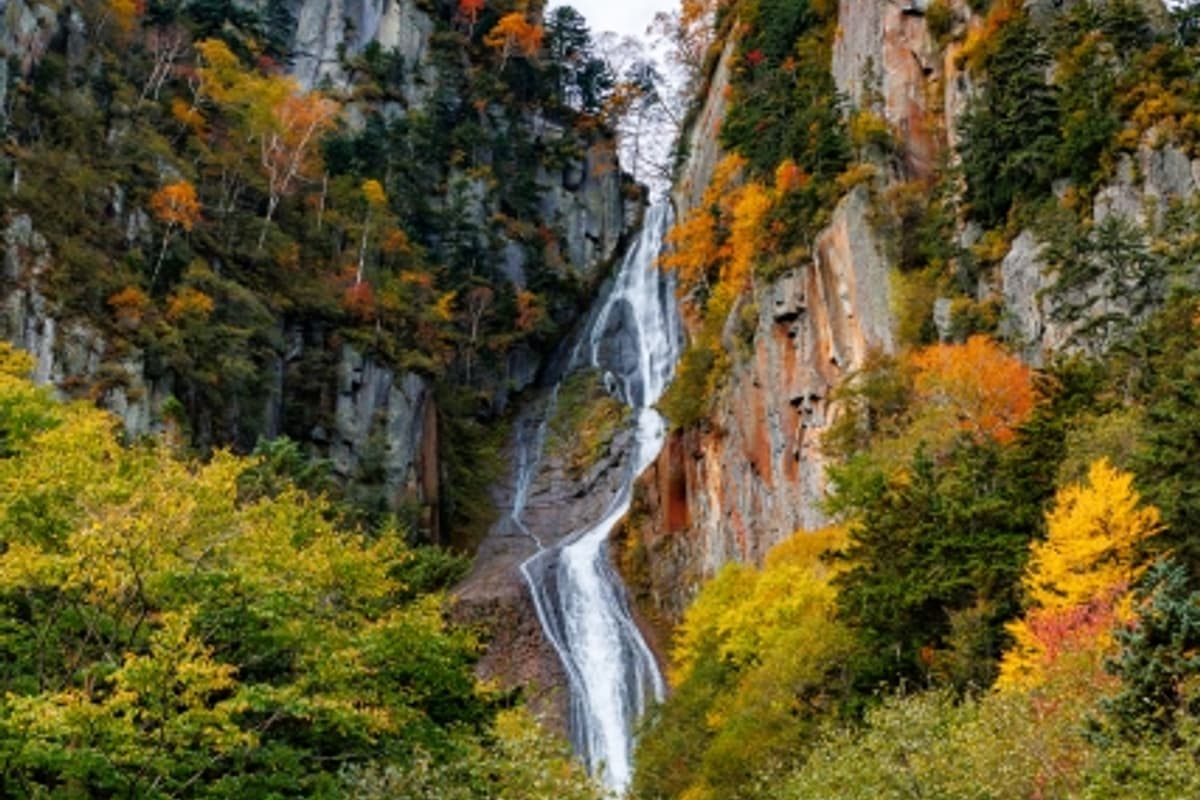
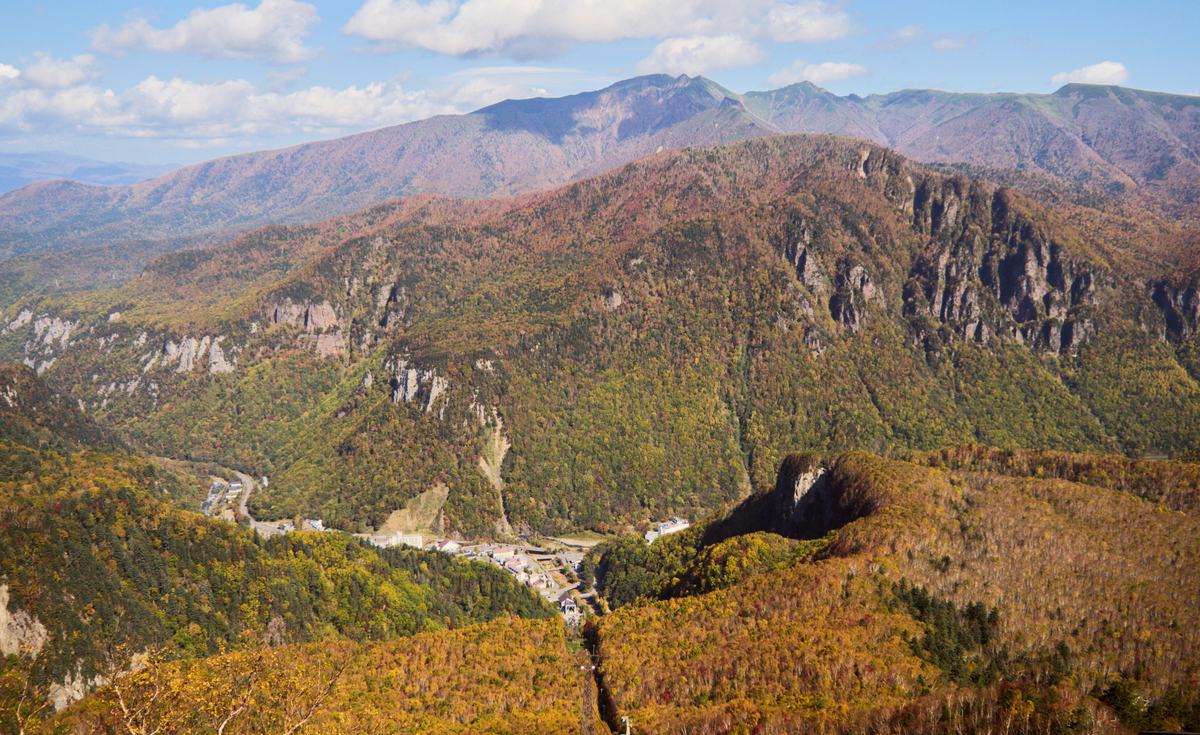
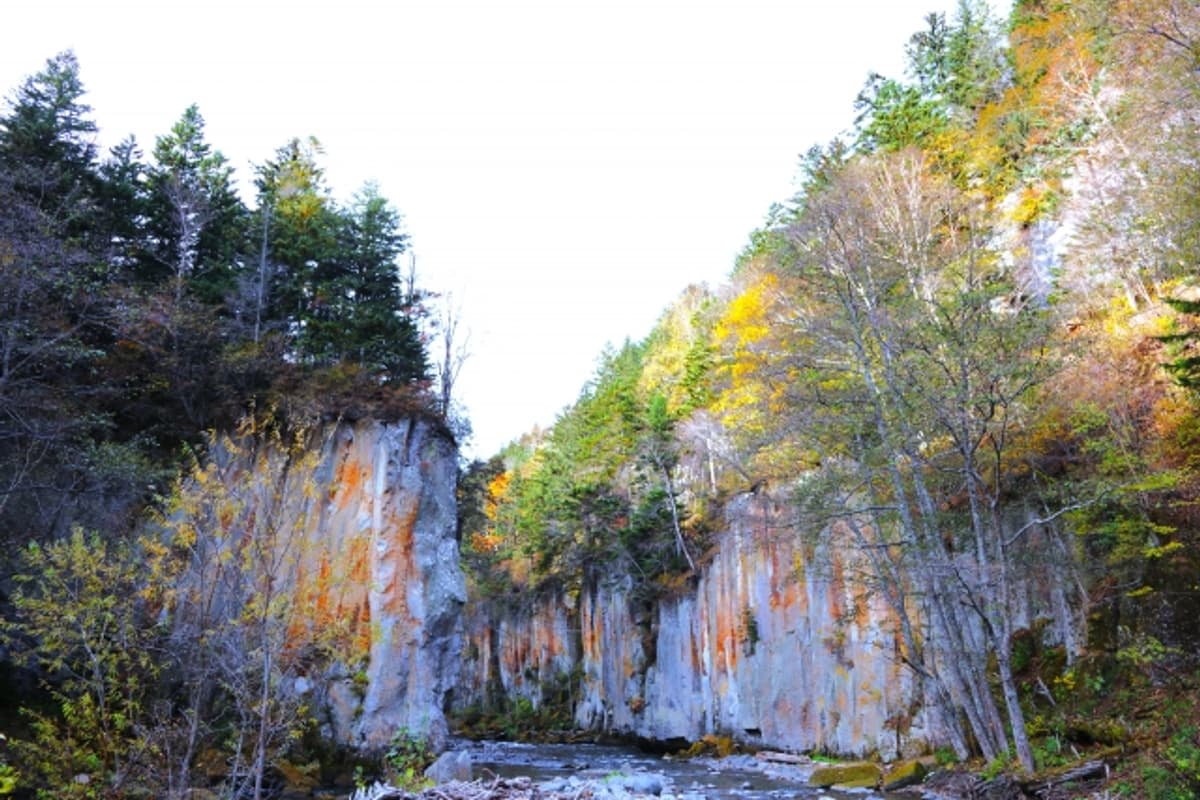
Once you're back from Kurodake, Sounkyo Onsen itself is a destination. A 1.5 km path along the Ishikari River reaches two waterfalls side by side: Ryusei (Shooting Star) Falls — one of Japan's 100 famous falls at 90m — and Ginga (Galaxy) Falls at 120m, where mist diffracts like a galaxy. Pair them with the basalt-column cliffs framing each side, all draped in autumn color: this is Sounkyo's signature composition.
5 km upstream is Ohbako — a more dramatic basalt cliff section, the gorge view sharpens once foliage layers in. Rent a bike at Sounkyo Onsen Street, or take the local sightseeing bus.
📍 This section covers the foliage season only. For the other three seasons in Sounkyo — the ice festival dates, the ropeway's month-by-month hours and its November maintenance shutdown, the day-use onsen list and the full Asahikawa bus timetable including the last departure — see the Sounkyo Gorge four-season guide.
Where to sleep in Sounkyo
Sounkyo Onsen has 12 ryokan. For peak week, three I recommend:
- Choyo-tei (¥18,000–25,000): Best cost-to-quality. Western-Japanese fusion buffet, outdoor onsen overlooking the gorge.
- Sounkyo Kanko Hotel (¥22,000–30,000): Fully renovated, family-friendly facilities.
- Sounkaku (¥28,000–40,000): Premium kaiseki, onsen view rooms.
Beyond those three, you can scan the Sounkyo onsen strip as a whole: Sounkyo on Booking.com or Sounkyo Onsen on Rakuten Travel. ⚠️ Both list pages open on today's date, not foliage season — change the dates to your trip before you compare.
If Sounkyo is fully booked and Sapporo has to be your base, be clear about the trade first: doing it yourself by JR and bus from Sapporo is brutally tight and I don't recommend it — you will not make the early ropeway, and the early ropeway is the whole point of this guide. If one day really is all you have, a coach tour is the more workable version: GetYourGuide runs a Kurodake Ropeway and Asahiyama Zoo autumn day tour from Sapporo (check the fare on the product page — it is priced in US dollars and moves with the exchange rate and platform promotions), meeting at 07:45 at the ANA Crowne Plaza, with both the ropeway and zoo admission included. Treat it as a compromise, not the recommendation: it gives Sounkyo 90 minutes, skips the onsen, skips the Ryusei and Ginga falls walk and never reaches Obako — almost everything the section above is about. Stay the night if you possibly can.
Jozankei: Sapporo's hidden autumn pocket
Jozankei Onsen is in Sapporo's south ward — 70 minutes by bus from Sapporo Station. Mid-October is peak, exactly when the Daisetsuzan window closes. Treat Jozankei as your "second wave" backup if you arrive in Hokkaido after Sounkyo has already passed peak.
⚠️ Read this before you plan the day: Futami Park is under construction from September 24, 2026 to the end of March 2027. The construction area inside the park is closed to entry (site boards read 「立入禁止」), but Futami Suspension Bridge is still reachable — a dedicated pedestrian detour (signed 「歩行者用迂回路」) opens October 1 and closes for the winter. Jozankei normally peaks in mid-October and the works span the whole season, so follow the site boards rather than cutting through the park.
Must-walk paths:
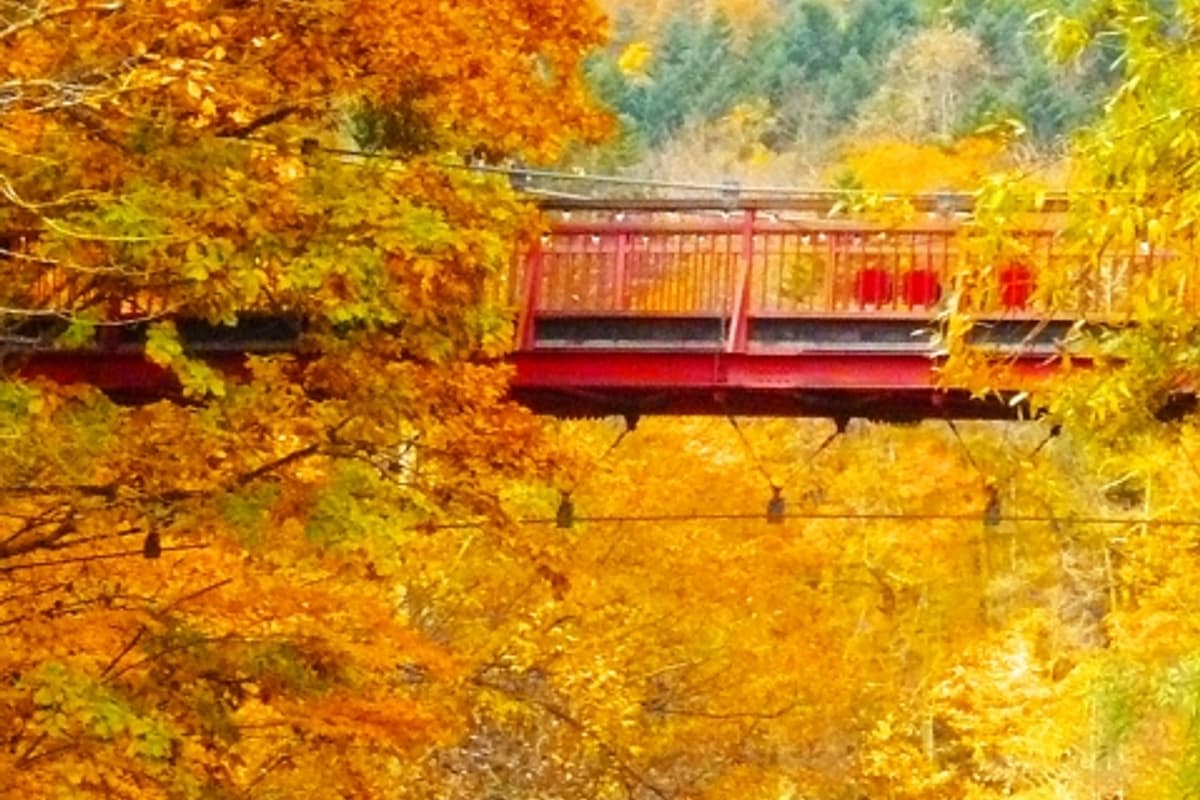
- Futami Suspension Bridge (10 min): Bridge view down into the Toyohira River gorge, Jozankei's signature photo spot. Use the pedestrian detour to get there this season.
- Futami Park → Kappa Pool trail (30 min): River-level walk, flat, no climbing. Multiple foliage photo angles. How far along it you can get during the works depends on the site boards.
- Jozankei Onsen Street footbath: Free, soak your feet while watching the foliage — peak relaxation.
Jozankei suits "I want autumn but don't want to commit to a long day trip" travelers. Stay at Jozankei Banseikaku Hotel Milione (¥18,000–26,000) for outdoor rotenburo + buffet breakfast and dinner.
4-day route: Sapporo → Asahikawa → Sounkyo → Biei → Jozankei
| Day | Plan | Stay | Travel time |
|---|---|---|---|
| Day 1 | Chitose Airport → Sapporo Station → Asahikawa (arrive evening, eat Asahikawa ramen) | APA Hotel Asahikawa Station, ¥9,000 | 3.5 hr |
| Day 2 | Asahikawa → Sounkyo (morning Kurodake Ropeway) → afternoon Ryusei/Ginga Falls trail → evening onsen | Choyo-tei Sounkyo, ¥22,000/person | about 2 hr |
| Day 3 | Sounkyo → Asahikawa → Biei (Blue Pond, Patchwork Road autumn) → Furano | Furano La Terre, ¥15,000 | 3 hr |
| Day 4 | Furano → Sapporo → Jozankei (Futami Bridge, half-day) → Chitose Airport | — | 4 hr |
⚠️ 2026 only: Day 3 Biei → Furano segment overlaps with the final running year of the Furano-Biei Norokko sightseeing train (JR Hokkaido announced the 28-year service ends September 23, 2026). Only September 5, 6, 12, 13 and the 19-23 holiday run are left. On those days you can ride Norokko 3 (Biei dep 13:08) down the flower-field belt to Furano for ¥1,800 / NT$335 — except on September 23, when a special timetable replaces every departure time. Full schedule and booking guide: Furano-Biei Norokko Final Year 2026.
Transit: JR Hokkaido Pass vs rental car
| Option | Cost | Best for |
|---|---|---|
| JR Hokkaido 5-day Pass | ¥22,000 | Non-drivers, itinerary includes Asahikawa/Hakodate |
| Sapporo–Asahikawa Limited Express Lilac one-way | ¥4,810 | Point-to-point, not worth a Pass |
| Rental car (4 days) | ¥18,000–25,000 + ¥6,000 fuel | Required for Biei/Furano; needs Japan driving permit translation |
🔴 One thing to know before you board with a Pass: JR Hokkaido limited expresses are now entirely reserved-seat. The official English page is explicit — "There are no non-reserved seats. Please make sure to receive a reserved seat ticket before boarding." A Rail Pass does not let you walk on and find a seat: collect a reserved-seat ticket at a Midori-no-Madoguchi counter or machine first (free with the Pass). Sapporo to Asahikawa fills up fast in foliage season, and in peak periods JR limits how many you can collect at once — so pick up the next day's tickets the moment you reach Sapporo.
My pick: JR + rental hybrid. Use JR Limited Express for Sapporo–Asahikawa (fast, no traffic), then rent a car in Asahikawa for Sounkyo + Biei + Furano (maximum freedom), then return to Sapporo and take the bus to Jozankei. Detailed Pass math: KKday JR Hokkaido Pass, and the full Hokkaido Pass comparison in JR Hokkaido Rail Pass complete guide. Sweep the rental half of that plan before you book, too — six or seven operators routinely quote at the same pickup point, and the DiscoverCars Japan page shows their daily rates in one view with free cancellation flagged. Asahikawa is one of the pickup points. It is an aggregator, not a rental company: the contract, deposit and CDW terms come from the local supplier, and the counter paperwork governs. If you'd rather skip the Pass entirely and drive the full loop (Sounkyo + Biei + Lake Shikaribetsu + Obihiro), see Hokkaido Central-East 5-Day Autumn Drive.
Budget: real costs for a couple, 4 days
Peak week (Sept 27 – Oct 4), couple sharing a room, ground costs only (no flights, estimated from each operator's published peak-week rate):
- 3 nights (Asahikawa APA + Sounkyo Choyo-tei + Furano La Terre): ¥90,000–¥110,000
- JR + rental car combo, 4 days: ¥45,000–¥55,000
- Food 4 days (Asahikawa ramen, Sounkyo kaiseki, etc.): ¥32,000–¥40,000
- Ropeway + admissions + onsen day visits: ¥10,000–¥12,000
- Ground total: ¥177,000–¥217,000 for the couple, before flights
Compared to a Kyoto autumn trip: lodging is roughly 40% cheaper (Hokkaido doesn't carry Kyoto's peak-week markup). Total ground cost is similar, but you get Japan's earliest foliage front. Late September flights to Chitose from Tokyo/Osaka don't see major holiday markup; book 8+ weeks ahead to lock dates.
Frequently Asked Questions
- Q1:When is the best time to see autumn leaves in Hokkaido?
- Mt. Kurodake summit peaks September 20–30 (the earliest in Japan), Sounkyo Gorge mid-slope reaches peak October 1–10, and Jozankei near Sapporo doesn't peak until October 15–25. The entire Hokkaido foliage front compresses into 30 days, so the earlier you go, the higher you can chase "red leaves + leftover snow + volcanic terrain" in one frame at the summit. In 2026 the actual start date was September 2 (reported by tenki.jp, which called it slightly later than a normal year); the same commentary says Hokkaido runs above normal temperature this autumn and peak color may fall late, and the WeatherNews first-round forecast published September 3 points the same way nationwide — peak color later than or slightly later than normal. Slide those historical dates later for 2026.
- Q2:How much is the Kurodake Ropeway? What's the best timing?
- The round-trip ropeway + lift combo is ¥3,900 per adult (¥2,400 one-way; ropeway-only round-trip ¥3,000, lift-only ¥1,200). Take the 6:00 first car — you'll beat the tour-bus crowds and have a far better chance of clear summit weather (clouds typically roll in after 9:00 in late September). Full round-trip including photos takes ~3 hours. Summit temperatures are 4–7°C in late September; bring gloves and a thermal layer. Note the lift runs only through Oct 15 in summer and the ropeway closes for maintenance Nov 9–30 — the foliage peak (late Sept–early Oct) falls within operating dates.
- Q3:How far in advance do I need to book Sounkyo onsen hotels?
- During peak week (Oct 1–10), book 6–8 weeks ahead. Weekday rates run ¥18,000–25,000 per person including breakfast and dinner; weekend rates add roughly 30%. Mid-tier choices like Choyo-tei (¥22,000/night) include outdoor onsen plus buffet breakfast — a strong cost-to-quality balance during foliage week.
- Q4:Can I do Daisetsuzan as a day trip from Sapporo?
- Technically yes, but I strongly advise against it. Sapporo → Sounkyo is 3.5 hours by bus or 4 hours via JR + bus. A round trip burns 7–8 hours of transit, leaving you only 3 hours on the mountain — and you'll miss both the dawn light and the early-evening glow, which are the two best photo windows. Stay at least one night in Sounkyo or Asahikawa.
- Q5:Is Daisetsuzan accessible for travelers who don't hike?
- Yes. The Kurodake Ropeway plus lift takes you all the way to the 1,520m observation deck — no required trails. The optional loop trail around the deck is paved and gentle (30–45 min). Down at Sounkyo, the Ginga and Ryusei Falls observation paths are level, and Jozankei's Futami Suspension Bridge is an easy level walk. Hokkaido autumn works for grandparents and families with strollers.
- Q6:How do I get to Jozankei without a rental car?
- From Sapporo Station, take a Jotetsu Bus. The reservation-based Kappa Liner express takes about 60 minutes (on the winter timetable that starts October 1, its last run back to Sapporo leaves Jozankei at 17:06). The regular route bus needs no reservation, takes about 80 minutes and costs ¥1,000 for adults from Sapporo Station — but since December 2025 most route-bus runs start from Makomanai subway station instead, so direct buses from Sapporo Station are few. The last route bus back to Sapporo Station leaves at 20:48 on weekdays and 20:40 on weekends and holidays. Some hotels run a Sapporo shuttle, but whether it is free and where it stops (some only go to Makomanai Station) differ by hotel, and they require a reservation — confirm with the hotel when you book.
Read next
Japan Autumn Foliage 2026: Peak Forecast & 5-Region Guide
Region-by-region peak-forecast map from late-September Hokkaido to mid-December Kyushu, with itineraries and booking timing.
Hokkaido JR Pass Complete Guide 2026
Five routes recalculated with 2026 fares — all-reserved limited expresses and the post-2024 Furano line closure change the math.
Furano-Biei Norokko Train Final Year 2026: Last Summer to Ride
JR Hokkaido has announced 2026 as the final year for the Norokko sightseeing train, with the last run on Sept 23 and daily service through the Sept 19-23 holiday. Timetable, fares, the last-day special diagram, and booking.
📊 See the 2026 Price Index (JR Pass, DPA, eSIM, Airport Transport) →