The limits for bringing your own medication into Japan are wider than most people assume: a one-month supply of prescription medicine and a two-month supply of OTC need no declaration and no paperwork at all. What genuinely gets travellers detained is a much shorter list — amphetamine ADHD drugs like Adderall may not be brought in even for treatment, and a legal prescription or an honest declaration changes nothing. This guide lays out how to count your supply, which medicines need paperwork in advance, the duty-free and cash limits, and the meat/fruit quarantine rules — so you can defuse the risk before you fly.
This guide covers bringing your own medication into Japan. The opposite direction — buying it once you are there — changed on 1 May 2026: how many boxes you may buy now has a number you can work out yourself, the restricted ingredient list went from six to eight, the age limit is 18, and buying a second box of a different brand still counts as going over. That side is covered in the guide to buying cold medicine in a Japanese drugstore.
Here's the order of priority: medication risk dwarfs the duty-free question. Go over the duty-free allowance and you pay some tax. Bring a banned drug and it's a legal problem. So this guide spends most of its length on medication, with allowances and prohibited goods further down. If you take ADHD medication or medical opioid painkillers, jump straight to the ADHD section.
- Count the supply first — 1 month of prescription medicine, poisons and deadly poisons; 2 months of other medicines and quasi-drugs; 24 units per item of external preparations and cosmetics. Inside those lines, walk the green channel.
- Ingredient, not brand — but the lines are high — Japan regulates preparations over 10% ephedrine-type content, and excludes codeine preparations at 1% or below from the narcotics schedule. Retail cold and cough medicines fall well below both.
- Three fates for ADHD meds — Adderall (pure amphetamine) may not be brought in even for treatment; Vyvanse needs advance permission from a Regional Bureau; Ritalin/Concerta need an import certificate at a one-month supply or more.
- Over the limit? — apply for a Yunyu Kakunin-sho: free, issued in 2-3 working days online or 3-4 on paper. Don't decant pills into a pill box — if the dosage can't be read off the packaging, you need the certificate.
- Duty-free — 3 bottles of alcohol (~760 ml each), 200 cigarettes (cut from 400 in 2021), 2 oz perfume, 200,000 yen of other goods.
- Cash over 1,000,000 yen; meat almost all banned — declare combined cash over the equivalent of 1,000,000 yen; jerky, sausage and meat-containing meals are quarantine targets.
📖 Contents (tap to expand)
- Why bringing medication to Japan is high-risk
- ADHD meds: three drugs, three different rules
- Pseudoephedrine and codeine: can you actually bring them?
- The Yakkan Shoumei import certificate
- Your pre-flight medication checklist
- Duty-free allowances: alcohol, tobacco, goods
- Cash declaration: the 1,000,000 yen rule
- Prohibited & restricted goods: meat, fruit, fakes
- How to declare: red/green channels & Visit Japan Web
- Quick-reference table: can I bring it?
- FAQ
Why bringing medication to Japan is high-risk
The instinct is "it's just my own medicine." But Japan's pharmaceutical and drug-control logic differs from that in the US, Canada, the UK or much of Asia in two key ways.
First, Japan regulates by active ingredient and concentration, not by brand or intended use. What the box says on the front, and what you take it for, are irrelevant; what counts is which schedule the ingredient lands on and at what content. Second, Japan is unusually strict on stimulants — a legacy of post-war drug problems — so the red line for amphetamine-type substances sits far lower than in most countries, and even legal, prescribed use is not waved through.
So "but I have a prescription" is not a universal free pass — it decides which document you need, not whether you can bring the drug. For Ritalin and Concerta below a one-month supply, a copy of the prescription is enough. For Vyvanse, you also need advance permission from a Regional Bureau of Health and Welfare. For pure amphetamine (Adderall), the prescription does not change the answer. That three-way split is the part of this guide worth reading closely.
ADHD meds: three drugs, three different rules
Only the pure amphetamines are genuinely un-importable; the other two have a route. This is the section with the most serious consequences, so if you or a travelling companion takes ADHD medication, read every line — and above all, don't treat the three as one thing.
| Medication | How Japan classes it | Can you bring it? |
|---|---|---|
| Adderall (amphetamine/dextroamphetamine), Dexedrine, other amphetamine and methamphetamine preparations | Stimulant (覚醒剤) | No. Not permitted even for treatment; a prescription and an honest declaration change nothing |
| Vyvanse / Elvanse (lisdexamfetamine) | Pharmaceutical stimulant raw material (the ingredient is approved in Japan) | Yes, carried personally with advance permission from the Regional Bureau of Health and Welfare — apply at least two weeks before your travel dates |
| Ritalin, Concerta (methylphenidate) | Class 1 psychotropic | Yes. An import certificate is needed at a one-month supply or more; below that, carry a copy of your prescription or a doctor's note |
The Adderall row has no room for exceptions. Under Japanese law, bringing in a stimulant can mean arrest, detention, deportation and prosecution, with penalties reaching several years in prison, and Japanese embassies and multiple foreign ministries publish explicit warnings to their own citizens. If you are on Adderall, the most useful pre-trip move is to ask your prescriber about a short-term alternative.
Pseudoephedrine and codeine: can you actually bring them?
Both ingredients are fine to carry at retail strengths — both legal thresholds sit far above what is in the box in your bathroom cabinet. They get talked about because each does have a line in law. The line is just nowhere near where most people place it.
Pseudoephedrine: the law covers preparations over 10%
Pseudoephedrine is the decongestant in many Western cold, sinus and allergy combinations. The schedule to Japan's Stimulants Control Act is written in systematic chemical names and covers preparations containing more than 10% ephedrine-type ingredients, explicitly excluding anything at 10% or below. A cold tablet or rhinitis tablet typically contains around 30 mg of pseudoephedrine — nowhere near that threshold.
The clearest evidence comes from Japan itself: MHLW has issued guidance to pharmacies on selling over-the-counter medicines containing pseudoephedrine (asking the purpose when someone buys in bulk or repeatedly), which means these products are legally on sale there. Seeing "pseudoephedrine" on a box is not a reason to leave it behind — count it as ordinary OTC and stay within the two-month supply.
Codeine: preparations at 1% or below are not narcotics in Japan
Schedule 1, item 78 of Japan's Narcotics and Psychotropics Control Act explicitly excludes preparations containing 10 parts per 1,000 (that is, 1%) or less of codeine or dihydrocodeine from the narcotics schedule; the same Act defines that category as "household narcotics". Retail cough medicines sold in Japan and elsewhere are almost all below that line, so they follow the ordinary one- or two-month supply rules. You do not need a permit for a bottle of cough syrup, and you certainly should not throw it away.
What does need advance permission is medical narcotics themselves — morphine, oxycodone, fentanyl and the like. Those require a permission from a Regional Bureau of Health and Welfare regardless of quantity, so don't pack them like ordinary OTC pills.
The Yakkan Shoumei import certificate
The "Yakkan Shoumei" is the well-known informal name; the official document is the Yunyu Kakunin-sho (Import Confirmation Certificate). It isn't a ban or a tax — it's a document confirming you've notified the health bureau in advance that you're carrying more than the personal-use limit of your own medication.
You need it above these amounts
| Category | Limit without certificate | Official worked example |
|---|---|---|
| Poisons, deadly poisons, prescription medicine | 1-month supply | One tablet a day = 30 tablets |
| All other medicines and quasi-drugs (OTC) | 2-month supply | One tablet a day = 60 tablets |
| External preparations (ointments, eye drops, patches) | 24 units per item | 24 boxes of patches |
| Cosmetics | 24 units per item | 24 lipsticks across all brands and shades |
| Injectables and syringes (e.g. insulin) | 1-month supply | — |
What counts is the dosage printed on the box or leaflet, not the number of boxes. MHLW's own example: if a bottle holds 40 tablets and your limit is 60, two bottles (80) puts you over. Splitting a supply into several packages doesn't help either — Japan counts the same person's total for the period (one month for prescription medicine, poisons and deadly poisons; two months for everything else). And if the dosage can't be read off the packaging, so the quantity can't be shown to be within the limit, you need the certificate — which is why decanting pills into a travel pill box is a bad idea.
How to apply (overview)
- Gather documents: medication details, prescription or doctor's letter (drug name, ingredients, dosage, course), passport copy, arrival info
- Complete the forms: the import-certificate application and an itemised medication list (quantity, ingredients), in MHLW's format
- File with the Regional Bureau of Health and Welfare covering your arrival airport: since July 2025, online filing through MHLW's import confirmation system is the standard route
- Wait for issue: 2-3 working days online, 3-4 working days on paper, counted from arrival of a complete application
- Carry it on arrival: keep the certificate with the medication and prescription in your carry-on and show it at customs
Your pre-flight medication checklist
Condensing the rules into what to actually do before you fly:
- Count the supply first: more than 1 month of prescription medicine? More than 2 months of OTC? More than 24 of any one patch, ointment or eye drop?
- Then check the ingredients: note each medication's generic name, not just the brand. The only things worth stopping for are amphetamines (Adderall, Vyvanse) and mail-order "supplements" for potency or weight loss
- Needs paperwork: over the limit → import certificate, 2-3 working days online; Vyvanse and medical narcotics → Regional Bureau permission, filed two weeks before your travel dates
- Adderall: talk to your prescriber about a short-term alternative; don't pack it
- Leave the packaging alone: original boxes, blister packs and leaflets, plus an English or Japanese prescription for prescription drugs — all in carry-on
- Minor ailments: consider buying headache/cold/stomach remedies at a Japanese drugstore instead of carrying them
Smooth out the whole entry process too — don't skip the online entry system. Most travellers now pre-fill the customs declaration on Visit Japan Web to speed up clearance; see our Visit Japan Web walkthrough. And for the small details first-timers tend to miss, we rounded them up in the most common first-trip mistakes in Japan.
Duty-free allowances: alcohol, tobacco, goods
With medication handled, here are the general allowances. Per Japan Customs, these apply to non-resident adults aged 20 and over:
| Category | Allowance | Notes |
|---|---|---|
| Alcohol | 3 bottles | About 760 ml each |
| Cigarettes | 200 | Cut from 400 on 1 Oct 2021 |
| Cigars | 50 | Combined total if mixing types |
| Heated tobacco | 10 packs | IQOS, glo, Ploom etc. |
| Other tobacco | 250 g | 250 g is the combined cap |
| Perfume | 2 ounces | About 56 ml |
| Other goods (excl. above) | 200,000 yen total value | Items under 10,000 yen each are excluded |
Easy things to get wrong: (1) the cigarette allowance is halved — many older articles still say 400; for non-residents it's been 200 since October 2021. (2) Under-20s get no tobacco or alcohol allowance and must pay duty. (3) The 200,000 yen threshold is total market value, not per item — value your high-end buys yourself, and declare over the line in the red channel. Most tourists' souvenirs, snacks and drugstore hauls won't come close; the things to watch are pricey alcohol, designer bags and electronics.
Cash declaration: the 1,000,000 yen rule
Japan has no cap on cash, but a declaration threshold: carrying more than the equivalent of 1,000,000 yen in cash and equivalents (foreign banknotes, traveller's cheques, certain securities and high-value precious metals) into or out of Japan must be declared.
- It's the combined total, not just yen: your TWD, USD, CNY and other banknotes are converted and added together
- Declaring is not confiscation: it's a registration — nothing is force-exchanged or held; but failing to declare when required can mean penalties or the cash being held
- Families: counted per individual traveller — you can't split one declaration to dodge it
In practice, few leisure travellers carry the equivalent of 1,000,000 yen (roughly a few thousand US dollars more than the figure suggests once converted), so most never hit it. But if you plan large cash purchases — luxury goods, expensive lodging — do the conversion, and declare over the threshold rather than gambling.
Prohibited & restricted goods: meat, fruit, fakes
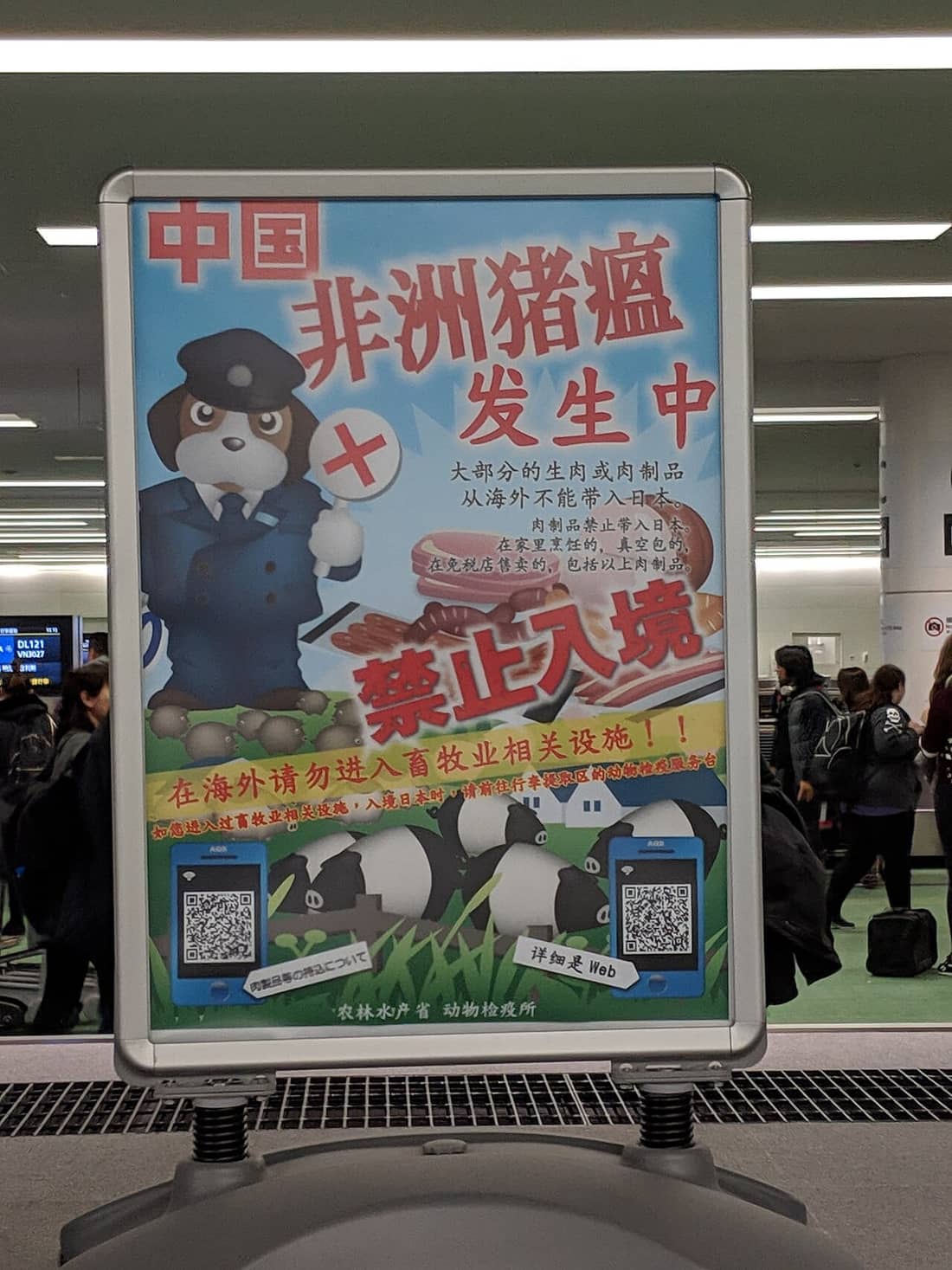
Beyond medication, two categories most often catch travellers. Getting stopped isn't always an offence, but it wastes time and your goods get seized.
Strictly prohibited
- Narcotics and stimulants (including the amphetamine ADHD meds above)
- Firearms, ammunition, explosives, chemical-weapon precursors
- Counterfeit currency, forged cards and securities
- Obscene material and child pornography
- Counterfeit and pirated goods — fake designer bags, fake watches and bootleg media are seized, with fines in serious cases
Quarantine-controlled (the most common trip-up)
- Meat and meat products: generally prohibited from import into Japan — vacuum-packed sausage, ham, jerky, pork floss, meat-containing instant noodles/ready meals, meat mooncakes. This is a priority check against African swine fever and foot-and-mouth disease, and "I just brought some jerky for snacks" is the classic mistake
- Fresh fruit, some vegetables, seeds, plants: subject to plant quarantine — mostly prohibited or requiring inspection
- Pets (cats, dogs, etc.): subject to a strict advance quarantine procedure — you can't just bring them
How to declare: red/green channels & Visit Japan Web
After baggage claim you reach customs, where the flow splits two ways:
- Green channel (nothing to declare): for travellers within the limits and carrying no prohibited/restricted goods — show your declaration and pass quickly
- Red channel (something to declare): over the duty-free allowance, carrying controlled/over-limit medication, cash over the threshold, or quarantine items — declare honestly
Japan now promotes Visit Japan Web, which lets you complete the customs declaration (and immigration data) online before arrival and clear via a QR code instead of a paper form. Filling it in before you fly is strongly recommended — full steps in our Visit Japan Web walkthrough. For basic communication and a few phrases if you get stopped, see our essential Japanese phrases guide. With your online declaration, medication proof and packing sorted, clearance is fast.
One core principle: when in doubt, declare — don't gamble by hiding things. Honest declaration usually ends in paying duty or discarding an item; deliberate concealment, if caught, escalates to fines or worse. It's also worth arranging travel and medical cover before you go, so that needing care or medication in Japan is one less worry — see our Japan travel insurance guide.
Quick-reference table: can I bring it?
| Item | Allowed? | Notes |
|---|---|---|
| Adderall (pure amphetamine ADHD meds) | ❌ Not importable | Not even for treatment; criminal risk — ask your prescriber about alternatives |
| Vyvanse / Elvanse (lisdexamfetamine) | ⚠️ Allowed with permission | Stimulant raw material; apply to a Regional Bureau two weeks before travel |
| Ritalin / Concerta (methylphenidate) | ⚠️ Allowed; paperwork at 1 month | Psychotropic; import certificate at a one-month supply or more |
| Cold and rhinitis tablets with pseudoephedrine | ✅ Fine at retail strengths | The law covers preparations over 10%; retail products don't reach it |
| Codeine cough syrup | ✅ Fine at retail strengths | Preparations at 1% or below are not narcotics under Japanese law |
| Medical narcotics (morphine, fentanyl) | ⚠️ Advance permission needed | Regional Bureau permission regardless of quantity |
| Mail-order potency / weight-loss "supplements" | ⚠️ Paperwork for even one | Named on an MHLW list; a certificate is required at any quantity |
| General prescription meds (chronic) | ✅ Up to 1 month, no certificate | Over 1 month needs an import certificate |
| General OTC meds (pain/stomach) | ✅ Up to 2 months, no certificate | Over that needs a certificate; buy minor meds in Japan |
| Patches, ointments, eye drops | ✅ Up to 24 per item | External preparations follow a count, not a month supply |
| Alcohol | ✅ 3 bottles duty-free | ~760 ml each; duty over that |
| Cigarettes | ✅ 200 duty-free | Cut from 400 in 2021 |
| Cash | ✅ No cap | Declare over the equivalent of 1,000,000 yen |
| Jerky / sausage / meat ready-meals | ❌ Generally prohibited | Quarantine target; quantity doesn't matter |
| Counterfeit / pirated goods | ❌ Banned | Seized; fines in serious cases |
One last thing
This page covers the arrival end — getting medication into Japan. On the way home, the same bottles face a different set of rules at security: liquid medicines under 100 ml don't need to go in the zip-lock bag, and contact lens solution has to be declared out loud. See our guide to Japan's airport security rules for power banks and liquids for that side of the trip.
If it were my trip, I'd do three things before flying: count the tablets in any prescription bottle to check it's under a month's supply, leave everything in its original packaging, and leave meat souvenirs at home. Japanese customs is genuinely friendly to ordinary tourists — the vast majority sail through with souvenirs, drugstore buys and snacks, and the remaining risk sits on a short list: pure amphetamine ADHD meds, mail-order potency supplements, and casually packed jerky and sausage.
One line to remember: count the supply first, check the ingredient second, and when in doubt declare rather than hide. Handle the medication question before you fly, not at the airport. Quantities, processing times and list versions change — check MHLW's personal-import pages and Japan Customs for the latest, and for any controlled medication, confirm with a Regional Bureau of Health and Welfare or the nearest Japanese embassy before you travel.
Frequently Asked Questions
- Q1:Can I bring my cold or allergy medicine into Japan?
- It depends on the active ingredient, not the brand — but the line sits much higher than most people assume. Japan's Stimulants Control Act covers preparations containing more than 10% ephedrine-type ingredients; a cold or sinus tablet typically holds around 30 mg of pseudoephedrine, nowhere near that threshold, and Japanese drugstores sell pseudoephedrine cold remedies themselves. Codeine cough syrup is not a blanket problem either: Japanese law explicitly excludes preparations containing 1% or less codeine or dihydrocodeine from the narcotics schedule, and retail cough medicines sit well below that. What actually matters is quantity — up to a two-month supply of OTC and a one-month supply of prescription medicine needs no paperwork; see the pseudoephedrine and codeine section.
- Q2:Is Adderall or Vyvanse banned in Japan even with a prescription?
- These are three different rules, not one blanket ban. Adderall (amphetamine/dextroamphetamine), Dexedrine and anything containing methamphetamine are stimulants (覚醒剤) in Japan and may not be brought in even for treatment — a valid foreign prescription and an honest declaration change nothing, and the penalties run to years' imprisonment. Vyvanse / Elvanse (lisdexamfetamine) is different: the ingredient is approved in Japan and classed as a pharmaceutical stimulant raw material, so you may carry it personally if you obtain advance permission from the Regional Bureau of Health and Welfare, applying at least two weeks before your travel dates. Ritalin and Concerta (methylphenidate) are psychotropics: you need an import certificate once you carry a one-month supply or more, and a copy of your prescription or a doctor's note below that. See the ADHD medication section for the full comparison.
- Q3:When do I need a Yakkan Shoumei (import certificate) for my medication?
- Under MHLW rules, you must obtain an import certificate (Yunyu Kakunin-sho, formerly "Yakkan Shoumei") in advance if you carry more than: (1) a one-month supply of poisons, deadly poisons or prescription medicine; (2) a two-month supply of other medicines and quasi-drugs; (3) 24 units per item of external preparations or cosmetics; or (4) a one-month supply of injectables and syringes. The certificate is free, online application has been the standard route since July 2025, and it is issued in two to three working days online, or three to four working days on paper — allow about two weeks once you add postage and any request for missing documents. Within the limits, and provided the ingredients are not controlled, you need no certificate — just pack the meds in your carry-on.
- Q4:What is the duty-free allowance for Japan — alcohol and cigarettes?
- Per Japan Customs, for non-resident adults (20 and over): 3 bottles of alcohol (about 760 ml each); 200 cigarettes, or 50 cigars, or 10 packs of heated tobacco (IQOS/glo/Ploom), or 250 g of other tobacco — combined, the cap is 250 g. Note the cigarette allowance was cut from 400 to 200 on 1 October 2021, so ignore older guides. Also 2 ounces of perfume (about 56 ml), and up to 200,000 yen total overseas market value for other goods (items under 10,000 yen each are excluded from the calculation). Anyone under 20 pays duty on all tobacco and alcohol. Over any limit, take the red (declaration) channel and pay the duty.
- Q5:How much cash can I bring to Japan without declaring it?
- There is no limit on how much cash you can carry, but you must declare amounts over the equivalent of 1,000,000 yen — this includes foreign currency, traveller's cheques, certain securities and high-value precious metals. Declaring it is just a registration; nothing is confiscated or force-exchanged. But failing to declare when required can lead to penalties, and the cash can be held. Important: the threshold is the combined total across all currencies, not just yen — your USD, TWD, CNY and so on are converted and added together. For families, the limit applies per individual traveller, so you cannot split one declaration to dodge it.
- Q6:What is banned at Japanese customs — can I bring meat or fruit?
- Two categories trip travellers up. Strictly prohibited: narcotics and stimulants (including the amphetamine ADHD meds above), firearms and ammunition, explosives, counterfeit currency, obscene material, child pornography, and counterfeit/pirated goods (fake designer bags and watches are seized and can carry fines). Quarantine-controlled: almost all meat and meat products — vacuum-packed sausage, ham, jerky, meat-containing instant noodles and ready meals — are prohibited from import into Japan to guard against African swine fever and foot-and-mouth disease, and "a small bag of jerky" is one of the most common slip-ups. Fresh fruit, some vegetables, seeds and plants require plant quarantine and are mostly restricted. Simple rule: if a food contains meat or is fresh produce, leave it at home — and if unsure, take the red channel and declare it rather than hiding it.
Read next
Visit Japan Web Guide 2026
Immigration in ten minutes. The tax-free QR stands in for your passport in the shop — it is not what the airport kiosk reads.
Japan First-Timer Mistakes 2026: 10 Things to Avoid
What ruins a first Japan trip isn't getting lost — it's cramming the itinerary, buying a JR Pass that no longer pays, assuming cards work everywhere, and not pre-booking the sell-outs. Ranked by how much they actually hurt.
Japan trip prep checklist
eSIM, Visit Japan Web, tax-free, insurance — done in one read.