A 100-yen, ten-minute community bus from Dazaifu Station takes you to a shrine whose origins reach back to 664 AD and which thousands of visitors now call "the Demon Slayer shrine": Homangu Kamado Shrine. Here is the sentence that has to come first, though — the shrine has never officially claimed any connection to Demon Slayer. The link is a fan inference built on a shared surname and an author from Fukuoka, and the shrine sells no character merchandise at all. Get that expectation right and the visit works, because what Kamado Shrine actually offers is something else: a matchmaking cult around the deity Tamayori-hime, the eyes-closed stone-touching ritual of Aikei-no-Iwa, an amulet office designed in 2012 by one of Japan's leading contemporary designers, and several hundred maples that peak in late November. This guide covers the officially announced Tanabata evening opening, the free opening hours, the honest state of goshuin information, the real bus access, and where Mount Homan fits in.
⏰ Timely for 2026: the Tanabata special period, Aug 1 (Sat) – Aug 7 (Fri)
Per the shrine's official July 2026 notice, these seven days follow the old lunar Tanabata and bring special projection mapping from 18:30 to 22:00, a love-fulfilment prayer rite (reception 9:00–21:30, offering 5,000 yen), and a Tanabata special goshuin at 800 yen. Kamado Shrine normally closes its grounds at 17:00, so this is a limited-period evening opening — seven days a year. Check the official Kamado Shrine site for details and any changes.
📍 Kamado Shrine is usually stop two on a half-day Dazaifu route — for the main shrine, the approach street food (those umegae-mochi) and the wider access picture, see the Dazaifu Tenmangu guide; to slot Dazaifu into a full Fukuoka itinerary, see the Fukuoka travel guide.
- The Demon Slayer link is fan inference, not endorsement: shared surname kanji plus a Fukuoka-born author — the shrine has never claimed it, and sells no character goods
- 2026 Tanabata evening opening: Aug 1–7, projection mapping 18:30–22:00, special goshuin 800 yen, love-fulfilment rite 5,000 yen (reception 9:00–21:30)
- Grounds free, 9:00–17:00: amulet office 8:30–18:00, prayer reception 10:00–16:00 (from 5,000 yen), paid car park with about 100 spaces
- Matchmaking is the real business here: the deity Tamayori-hime is said to draw people together, backed by three concrete rituals — Aikei-no-Iwa, the reunion tree, and the musubi-no-ito charm
- Access is easy: Mahoroba-go community bus, Uchiyama line, flat 100 yen, about 10 minutes; walking takes 40 minutes and is genuinely uphill — skip it at midday in summer
📖 Table of Contents (click to expand)
- What Kamado Shrine actually is: a 1,350-year-old site with two identities
- The Demon Slayer question: never officially claimed (read first)
- The 2026 Tanabata period: seven evenings a year
- Matchmaking: Tamayori-hime, Aikei-no-Iwa and the reunion tree
- Goshuin: the seasonal edition and the standard one
- Design: the 2012 amulet office and the view deck
- Practical visiting: hours, fees and prayer rites
- Mount Homan: the summit shrine and a Shugendo peak
- Access: bus vs walking vs taxi
- Seasons: autumn peak and the annual rites
- Food and shopping, honestly: only the amulet office
- Is Kamado Shrine worth a special trip?
- FAQ
What Kamado Shrine actually is: a 1,350-year-old site with two identities
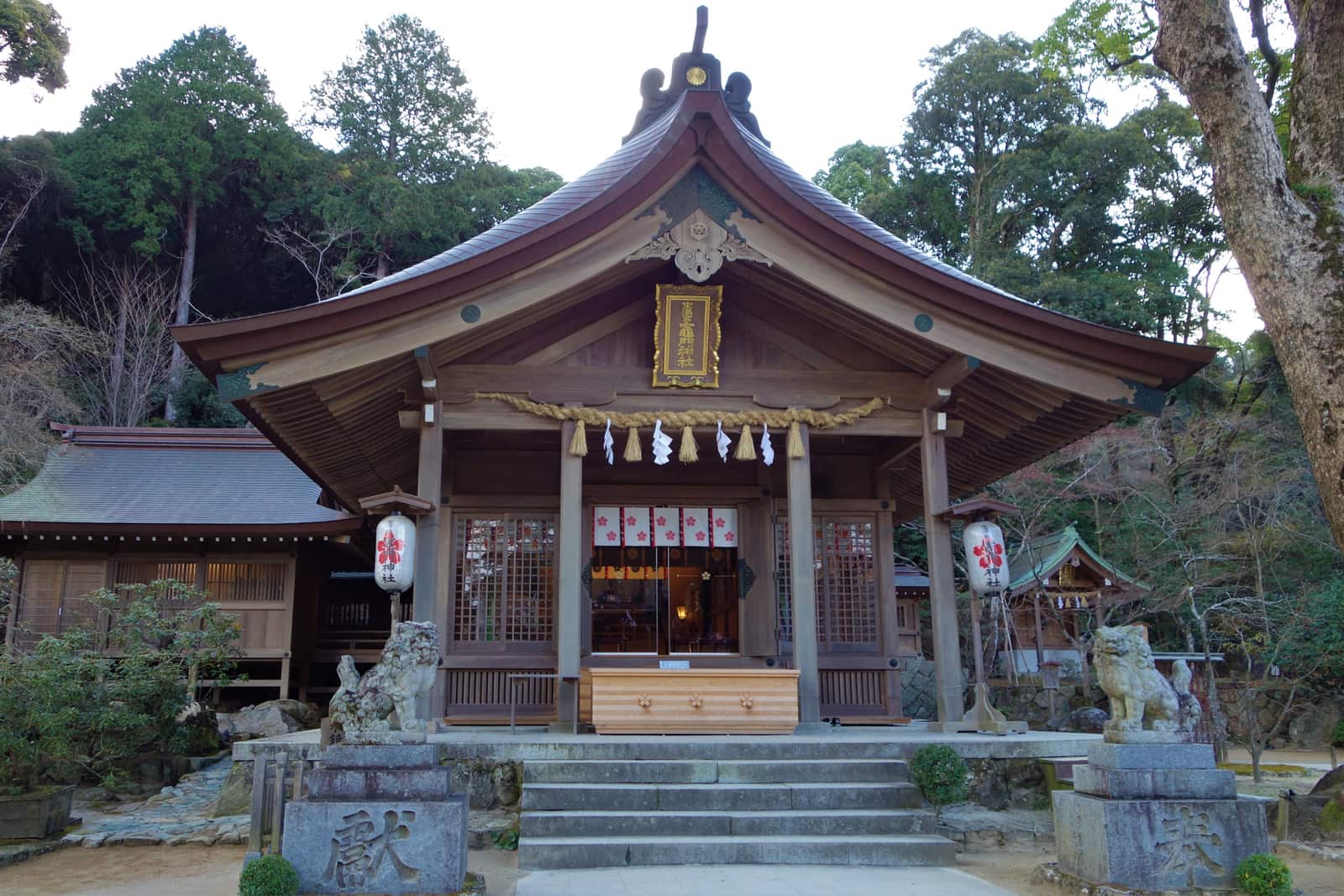
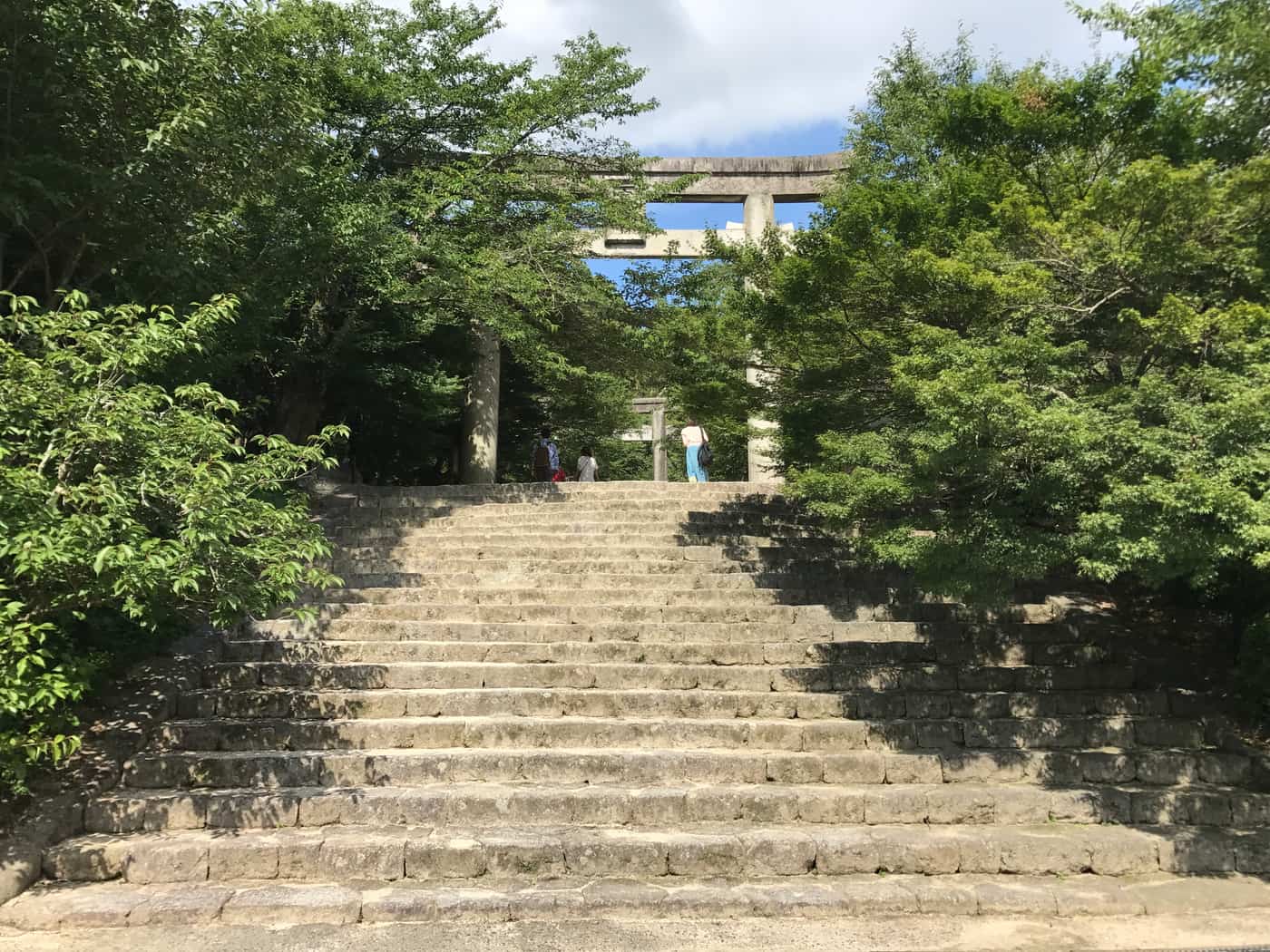
Homangu Kamado Shrine sits in Dazaifu City, Fukuoka Prefecture, roughly a 30-minute walk further inland from Dazaifu Tenmangu. Most visitors today arrive because of one word in its name, but that association is by far its youngest layer. What actually holds this place up is thirteen and a half centuries of history.
Per the shrine's official history page, its founding comes in two stages, and stating it that way is far more precise than the vague "over 1,350 years old":
- 664 AD (Tenji 3): when the Dazaifu government seat was established, rites to guard the kimon — the inauspicious northeast "demon gate" — were held at the foot of Kamado Mountain, today's Mount Homan. In other words, the shrine's original job was to guard a direction on behalf of the state.
- 673 AD (Tenmu 2): the founding monk Shinren Shonin, in ascetic practice on the mountain, received an oracle in which Tamayori-hime appeared, and the court ordered a summit hall — the upper shrine — to be built. That is when the shrine proper took shape.
It then climbed the ranks. Per the official history page, it received junior fifth rank in 803, rose to the top first rank in 1106, and was listed as a minor imperial shrine in the Meiji era. That progression tells you something useful: Kamado Shrine was never a small local site but one the state-level ritual system took seriously. (Those rank years come from the official history page as summarised; if you want to cite the era names precisely, check the original text.)
So a visit here actually puts you in front of three layers at once: an ancient role guarding the state's directional gate, a living matchmaking cult around Tamayori-hime, and an anime association bolted on only in the 2020s. They do not contradict each other, but keeping them separate in your head is what stops the visit feeling like a letdown.
The Demon Slayer question: never officially claimed (read first)
This is the section where the position has to be stated cleanly, so I am not going to fudge it.
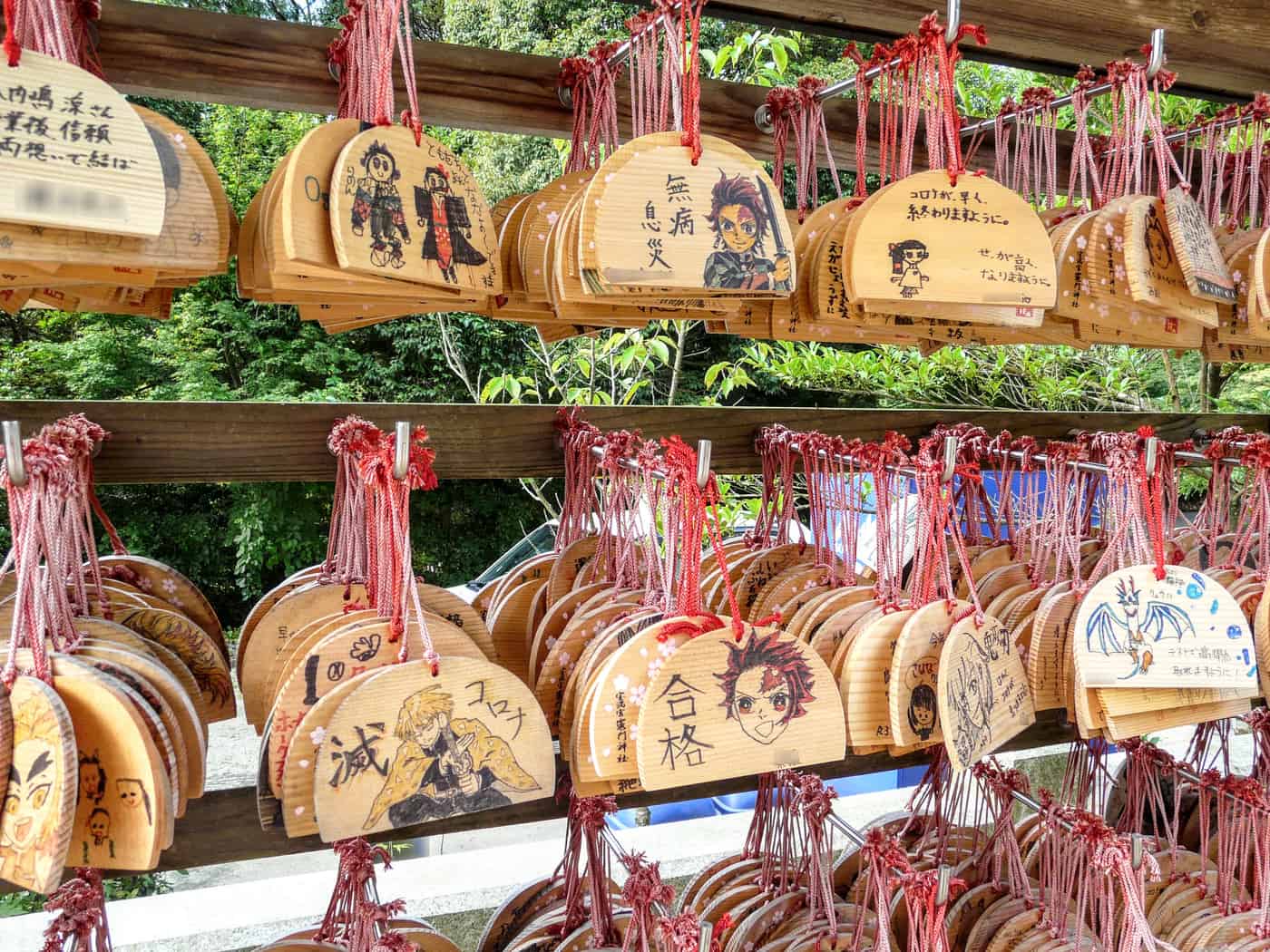
Kamado Shrine has never officially claimed to be the model, the setting, or a sanctioned pilgrimage site for Demon Slayer. Fans adopted it for two reasons. First, the protagonist Tanjiro Kamado carries a surname written in exactly the same kanji as the shrine. Second, the author Koyoharu Gotouge comes from Fukuoka Prefecture. Those coincidences were enough, and from around 2020 readers began making the trip and hanging ema plaques with wishes tied to the series. The shrine treats that affection as a connection worth honouring — but that is a different thing from an official endorsement.
The simplest way to verify it is to look at what the shrine sells. The amulet office stocks only the shrine's own original designs — omamori, ema, hamaya arrows — and no merchandise printed with Tanjiro, Nezuko or any other character. If a licensed partnership existed, the shelves would not look like that. There are no series displays, standees or official tie-in installations on the grounds either.
Is it still worth going? Yes, but for a different reason. Think of it this way: a manga is why a lot of people finally discovered a thousand-year-old shrine that was always worth knowing about. The anime is the doorway, not the content. What stays with you is the air at the foot of the mountain, the eyes-closed walk between two stones, the wall of ema packed with handwritten wishes, and the maples in late November. Come expecting an exhibition and the gap will be jarring; come because you liked the series and wanted to see where that name comes from, and the trip has real flavour.
The 2026 Tanabata period: seven evenings a year
If your trip lands in early August 2026, this is the most time-sensitive information in the guide.
Per the shrine's official notice from July 2026, the Reiwa 8 Tanabata special period runs Saturday August 1 to Friday August 7, following the old lunar calendar. Three things happen across those seven days:
| Item | Time | Offering | Detail |
|---|---|---|---|
| Special projection mapping | 18:30–22:00 | — | Evening presentation for the old-calendar Tanabata festival |
| Love-fulfilment prayer rite | Reception 9:00–21:30 | 5,000 yen | Tamagushi offering at the Ogatama tree said to house the deity, with a limited special charm |
| Tanabata special goshuin | During the period (per on-site notice) | 800 yen | Officially framed as a token of your visit |
There is one practical point people routinely get wrong here: Kamado Shrine's grounds normally close at 17:00, which means on an ordinary day you simply cannot shoot this place after dark. But during the Tanabata period reception runs to 21:30 and the projection to 22:00, so those seven days are a limited-period evening opening — not a standing arrangement, and not a hint that turning up at dusk on other dates will get you in. If the projection mapping is what you want, your dates have to sit inside August 1 to 7.
Two cautions. First, this is the current-year (Reiwa 8) announcement and the weekdays check out — August 1, 2026 is indeed a Saturday — but details can still shift for weather or other reasons, so look at the official notice again before you travel. Second, evening return services on the Mahoroba-go bus are thinner than daytime ones. If you plan to stay until the projection ends, sort out your return leg in advance or budget for a taxi, rather than starting to think about it at 22:00.
Matchmaking: Tamayori-hime, Aikei-no-Iwa and the reunion tree
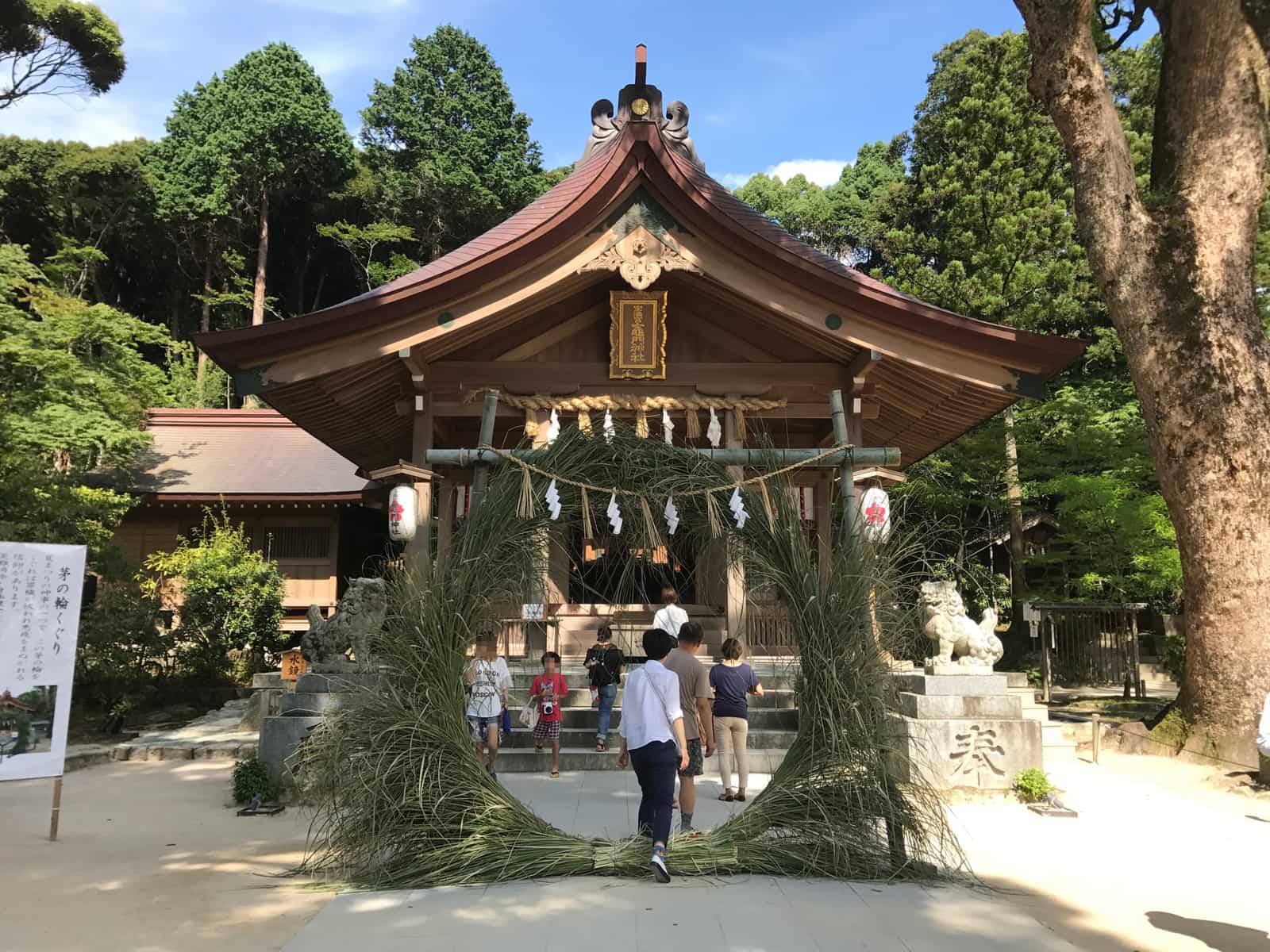
Set the anime aside and Kamado Shrine is, on its own terms, one of Kyushu's best-known matchmaking shrines — and that reputation is not a marketing overlay. It grows straight out of the deity enshrined here.
Tamayori-hime-no-Mikoto is the mother of Emperor Jimmu and the daughter of the sea deity. She is said to hold the power to draw people together. Worth noting: the Japanese concept of enmusubi is not restricted to romance — it covers connections between people, to work, and to places. That is exactly why the shrine's amulet range includes a shigoto-musubi charm for work connections alongside the romantic ones.
Three concrete "tools of connection" sit on the grounds, and they are the part of the visit most worth slowing down for:
- Aikei-no-Iwa (per the official grounds page): two stones stand facing each other. You close your eyes, hold in mind the person or the match you are hoping for, and walk unaided from one stone to the other until you touch it. Succeeding is read as a sign the wish will be granted. This is the shrine's most distinctive experience, so leave time to actually do it rather than photographing it in passing.
- Saikai-no-Ki, the reunion tree (legend framing): Empress Jingu is said to have climbed Mount Homan before her campaign across the strait, planted a saikachi (honey locust) tree, and vowed to meet again here on her return — which is why the tree is associated with wishes for reunions, reconciliations and good matches. Enjoy it as folklore rather than documented shrine history — the official pages do not record it verbatim.
- Musubi-no-Ito and koyori (per the official amulet page): the Koi-mamori Musubi-no-Ito charm is shaped after the honey locust pod, with its designated return spot at the koi-mikuji tying rack; the Enmusubi Koyori is a twisted paper strip you write a wish on and tie to a tree, which the priests then include in daily prayers. These two are the signature items here.
The official amulet page also lists a fine-weather charm, a strawberry charm, the Homan-sama Hakata-doll-style figure of the deity, the kamado ema, and a paired zodiac ema. Prices are not listed page by page, so check on site. If you want the correct order of a shrine visit first — the purification basin, two bows two claps one bow, how to handle ema and charms — read our Japanese shrine etiquette guide; knowing the sequence makes the Aikei-no-Iwa ritual land better.
Goshuin: what is official and what is only reported
The thing that matters most for collectors: the offering amount and reception hours for the standard goshuin are not published — the official amulet page covers omamori only. The only half you can pin down in advance is the seasonal edition.
Seasonal limited-edition goshuin are announced with a price. The current example is the one flagged earlier — the Tanabata special goshuin, officially announced at 800 yen, for August 1 to 7, 2026, described as a token of your visit. That establishes two things: Kamado Shrine has a habit of issuing seasonal editions, and when it does, the amount appears in the official notice. So if you collect limited designs, checking the official announcements before your trip is the most reliable move.
The offering for the standard goshuin, and for a goshuin book, is posted at the goshuin desk and the amulet counter on the day — bring coins.
One practical note: if your route is Tenmangu first and Kamado Shrine second, the goshuin desk becomes one of your hard deadlines for the day, so do not amble up here after 16:30. For collecting fundamentals — choosing a book, the correct order of praying then receiving the seal — see our Japan goshuin collecting guide; for the Tenmangu side of the day, including its own seals and the approach street, see the Dazaifu Tenmangu guide.
Design: the 2012 amulet office and the view deck
This is the most underrated part of Kamado Shrine, and the most photogenic. Walk past the vermilion traditional halls and you reach a white contemporary building that looks nothing like shrine architecture at all: the ofuda and omamori amulet office.
Per a 2013 report by the Japanese design outlet JDN and the shrine's own grounds page, the amulet office was completed in December 2012, designed by Masamichi Katayama of Wonderwall, around the concept of a building that will still be loved a hundred years from now. The interior uses pale-pink marble imported from Portugal, which sits between the green of the mountain and the vermilion of the halls in a way you rarely see at a shrine. Separately, the stone seating on the shrine's view deck was designed by the British product designer Jasper Morrison, in Aji granite.
Why single this out? Because it produces Kamado Shrine's most distinctive visual contrast: a shrine over 1,350 years old whose amulet office and furniture were handled by front-rank contemporary designers. That combination is genuinely uncommon in Japan. On the ground, give yourself a few minutes inside the amulet office and then sit on the view deck, which also looks out toward the Dazaifu townscape. For travellers who care about architecture and design, this carries as much weight as the anime story does.
Practical visiting: hours, fees and prayer rites
All the hard information in one place, per the shrine's official pages (verified July 25, 2026):
| Item | Detail |
|---|---|
| Visiting the grounds | Free, open 9:00–17:00 |
| Amulet office (omamori, ofuda) | Reception 8:30–18:00 (opens earlier and closes later than the grounds) |
| Prayer rite reception | 10:00–16:00 |
| Prayer offering tiers | 5,000 / 8,000 / 10,000 yen and above (separate threshold from 10,000 yen for groups and companies) |
| Telephone | 9:00–17:00 (092-922-4106) |
| Parking | Paid shrine car park, about 100 spaces |
| Tanabata special period (2026) | Aug 1–7; projection 18:30–22:00, love-fulfilment rite reception 9:00–21:30 |
A few scheduling calls worth making:
- Budget 40 minutes to an hour for the grounds. The lower shrine is compact, but if you want to do Aikei-no-Iwa properly, look around the amulet office, sit on the view deck and queue for a goshuin, an hour is the comfortable figure.
- If you want a formal prayer rite, 16:00 is your wall (the Tanabata love-fulfilment rite, received until 21:30, is the exception). A rite is not required — dropping an offering and doing two bows, two claps, one bow is a complete visit.
- Do not arrive at 17:00. The grounds close then; the amulet office runs to 18:00, but by that point the main areas are no longer somewhere you can properly look around. On a half-day Dazaifu route, aim to be here by 15:30 at the latest.
Mount Homan: the summit shrine and a Shugendo peak
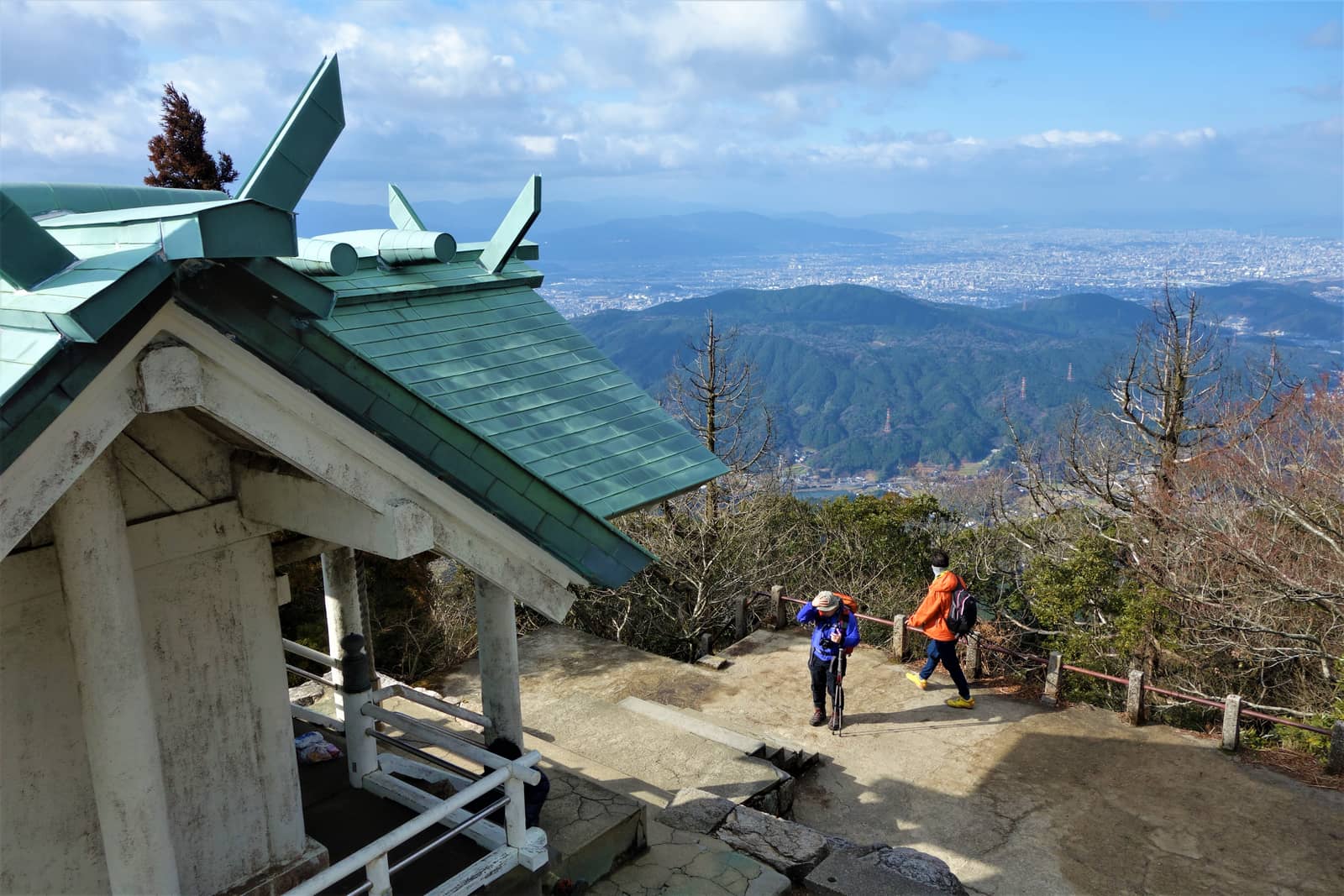
Kamado Shrine is not only a shrine — it is also the trailhead for Mount Homan. I will keep this short, because this is not a hiking guide, but the mountain deserves to be on your radar.
- The upper shrine stands at the 829-metre summit, its hall facing north as a symbolic gaze toward the Asian continent. The summit area also holds the Bateiseki (horseshoe stone) and Kamado rock.
- National Historic Site (October 2013): per the city announcement, Mount Homan was designated a National Historic Site — the third mountain in Japan designated specifically as a sacred peak, after Mount Chokai and Mount Fuji. It is also a component cultural property of the Dazaifu Japan Heritage story on ancient Japan's western capital and its links across East Asia.
- A major Shugendo site: from the medieval period the mountain was bound up with ascetic mountain practice, and in the late Heian era it is said to have held some 370 monastic quarters. The 1868 separation of Buddhism and Shinto broke that tradition, until the Homanzan Shugen Association revived it in 1982; rites are still held every May.
- The envoy connection: per the shrine's Mount Homan page, Saicho and others prayed here for safe passage before their voyages to Tang China. Picture that for a moment — in an era without modern navigation, people about to cross the East China Sea came to this mountain first. It is one of the most vivid images in the shrine's history.
The conclusion is simple: if you came for a matchmaking prayer, a goshuin, or the autumn leaves, the lower shrine is entirely enough. Do not force a summit push just because an upper shrine exists. Climbing Mount Homan is a separate trip needing its own gear, timing and fitness planning — look up dedicated hiking information for that, rather than treating it as an add-on to a shrine visit.
Access: bus vs walking vs taxi
Kamado Shrine's access is far simpler than its reputation suggests, which is one reason it is friendlier than most mountain-edge shrines. The short version: take the Mahoroba-go community bus on the Uchiyama line from Dazaifu Station — 100 yen, about 10 minutes.
| Method | Time | Cost | Best for |
|---|---|---|---|
| Mahoroba-go (Uchiyama line) | about 10 min | flat 100 yen | The right answer for almost everyone |
| Walking (Dazaifu Stn → shrine) | about 40 min (about 2 km) | free | Cool seasons, if you like walking the route |
| Walking (Tenmangu → shrine) | about 30 min | free | Half-day chaining, decent fitness |
| Cycling | about 15 min | rental rates apply | If you already hired a bike in Dazaifu |
| Driving | — | paid car park, about 100 spaces | Driving out from central Fukuoka |
Mahoroba-go, the practical details
Per the Dazaifu City official community bus page (updated April 1, 2026):
- Where to board: the Fukuoka Ginko-mae stop in front of Dazaifu Station (look for the white building with the pale blue sign), on services bound for Uchiyama; the Uchiyama terminus is at the shrine.
- Fare: a flat 100 yen across the whole network for elementary-school age and up, paid when you alight; infants free (up to two per accompanying adult). A one-day free pass exists too, with some facility discounts, worth considering if you are hopping around Dazaifu.
- Payment: cash and transit IC cards such as nimoca both work; with IC you tap once boarding and once alighting.
- Operating days: runs every day. But Obon (Aug 13–15) and Dec 29–31 switch to the weekend and holiday timetable, and the entire network is suspended January 1 to 3 — worth knowing if you were planning to bus up here for a New Year visit, because there are no services on those three days.
- Timetable: check the current departures on the Dazaifu City official Mahoroba-go page; this guide does not invent frequencies. Live approach information is available through the Nishitetsu bus navigation service.
The honest version of walking it
You will often read "it is only 30 minutes on foot from Tenmangu." That is true, and it leaves out half the story: the route has real gradient and is not flat. In spring and autumn it is a pleasant walk through Dazaifu's residential edge with the mountain ahead of you. But I would not walk it at midday in high summer — Kyushu afternoons in July and August routinely pass 33°C, and 30 to 40 minutes of uphill will cost you more than it saves, especially with more walking waiting on the grounds. The pragmatic version: take the 100-yen bus up, then decide on the walk back down toward the Tenmangu approach only if the weather and your legs agree.
One more thing: weekends and the autumn peak bring longer queues at the bus stop, so leave earlier and allow waiting time. Checking live bus approach times, the timetable, or calling a taxi at short notice all need data — if you do not have Japanese connectivity, a compare the five Japan eSIM options that works on landing removes a lot of friction; for how the main options compare, see the Japan eSIM guide.
Kamado Shrine vs Dazaifu Tenmangu: how they differ
A common question is whether the two are much the same. They are not, and this table should settle whether you want both:
| Comparison | Dazaifu Tenmangu | Homangu Kamado Shrine |
|---|---|---|
| Main devotion | Deity of learning (Sugawara no Michizane) | Matchmaking (Tamayori-hime) |
| Approach and food | Full shopping street, umegae-mochi and more | Almost no shops — only the amulet office |
| Suggested time | 1.5–2 hours including the approach | 40 min–1 hour |
| Crowds | Very busy, year-round | Relatively quiet, except autumn and the August Tanabata week |
| Signature draw | Exam prayers, the approach experience | Aikei-no-Iwa, contemporary-design amulet office, mountain views |
In other words the two shrines are complementary rather than redundant: Tenmangu supplies the bustle, the street food and the exam prayers; Kamado Shrine supplies quiet, matchmaking and mountain scenery. Doing both in half a day is the most layered way to spend time in Dazaifu. For the Tenmangu side in detail, see the Dazaifu Tenmangu guide.
Seasons: autumn peak and the annual rites
Kamado Shrine is a well-known autumn spot in Fukuoka, but this section has to be written in "typical year" terms, because the 2026 dates are not out yet.
Peak foliage (per the shrine): colour typically begins in mid-November, with peak viewing from late November into early December. The grounds hold several hundred maples and ginkgo trees (the official page does not state an exact count, so this guide will not fix a number).
Past momiji illumination runs, useful for understanding the pattern:
| Year | Period | Hours |
|---|---|---|
| 2023 | Nov 18 (Sat) – Dec 3 (Sun) | sunset–21:00 |
| 2025 | Nov 22 (Sat) – Dec 7 (Sun) | sunset–21:00 |
| 2026 | not yet announced (typically published mid-to-late October) | — |
⚠️ Do not copy last year's dates for the 2026 autumn events. As of this guide's verification date (July 25, 2026), no 2026 momiji festival or illumination dates had appeared in the official announcements. Based on past practice the shrine publishes them in mid-to-late October. If evening foliage is the point of your trip, check the official announcements after late October before booking flights and accommodation.
The annual cycle of rites (structure per the shrine's annual calendar; treat dates as typical and confirm the current year officially): spring brings a cherry blossom festival, a spring matchmaking grand rite and blossom illumination; summer brings the summer festival and chinowa ring rite, the mountain-opening rite and a Tanabata festival; autumn brings the autumn matchmaking grand rite and the annual grand festival; the year closes with the New Year's Eve great purification. Note that in July 2026 the shrine posted a notice cancelling the summer climbing safety rite, which shows that summer mountain events do change year to year — so never assume a festival is definitely running this year, and check the official site before you go.
For anyone specifically seeking a relationship blessing, the two matchmaking grand rites in spring and autumn are the most thematically appropriate windows, and worth aiming for if your dates are flexible. For the wider Kyushu autumn picture and how to choose between spots, see the Kyushu autumn guide.
Food and shopping, honestly: only the amulet office
A cold-water moment first, so you do not plan the day wrong: there are no restaurants on the grounds of Kamado Shrine, and essentially no shopping street nearby. What you can buy on site is limited to the amulet office — omamori, ema, hamaya arrows and similar. What you can eat on site is, effectively, nothing.
That makes it the exact inverse of Dazaifu Tenmangu, which has a busy approach lined with umegae-mochi stalls, cafes and souvenir shops all the way to the torii. Kamado Shrine is quiet enough to feel like a different world. So the correct routing is: do your eating and shopping on the Tenmangu approach, and keep Kamado Shrine for praying, photographs and goshuin. What is worth eating on the approach and how to dodge the crowds is covered in detail in the Dazaifu Tenmangu guide, so this piece does not repeat it.
And to restate the point that bears repeating: you cannot buy Demon Slayer character goods here. The amulet office carries only the shrine's own original designs. That is not a shortcoming — it is what consistency looks like. The shrine never claimed to be a sanctioned pilgrimage site, so it does not sell character merchandise either. Save that shopping for the specialty stores in central Fukuoka.
Is Kamado Shrine worth a special trip?
The practical question, answered by traveller type rather than fudged.
- Demon Slayer fans: yes, with adjusted expectations. You are not visiting a themed attraction; you are visiting a thousand-year-old shrine that happens to share the name. Once that clicks, the trip becomes genuinely interesting — the ema wall covered in fans' handwritten wishes, the actual origin of that name, and the reason the shrine does not sell character goods. It is 100 yen and ten minutes from Dazaifu Station, so adding an hour costs your itinerary almost nothing. For fans there is essentially no reason to skip it.
- Matchmaking seekers and goshuin collectors: yes, and give it an extra half-hour. This is the shrine's core business. Aikei-no-Iwa, the reunion tree, the musubi-no-ito charm and the koyori together make up a complete matchmaking visit rather than a photo stop, and adding a goshuin and any seasonal edition on top, I would budget one to one and a half hours here rather than squeezing it.
- General sightseers: treat it as the extension of a Tenmangu visit. If anime means nothing to you and you are not seeking a match, do not frame Kamado Shrine as a standalone destination. Chain it after Dazaifu Tenmangu, ride the 100-yen bus up, spend 40 minutes seeing the very un-shrine-like contemporary amulet office and looking out over the Dazaifu townscape from the view deck. That weighting is about right, and it makes a half-day in Dazaifu considerably more layered than Tenmangu alone.
One 2026-only addition: if your dates land in the first week of August, the Tanabata evening projection mapping (Aug 1–7) is a one-off this year — those seven days keep the grounds open until 22:00, a version of the shrine you simply cannot see otherwise. Miss it, and the next event worth reshaping dates around is the autumn evening illumination in late November to early December, remembering that the exact 2026 dates only appear in mid-to-late October. For how to structure the rest of Fukuoka and which day Dazaifu belongs on, see the Fukuoka travel guide.
Frequently Asked Questions
- Q1:Is Kamado Shrine really the Demon Slayer shrine? Has the shrine confirmed it?
- No. This needs saying plainly: Kamado Shrine has never officially claimed to be the model, setting, or sanctioned pilgrimage site for Demon Slayer. Fans adopted it because the protagonist Tanjiro Kamado shares the shrine name in exactly the same kanji, and because the manga author Koyoharu Gotouge is from Fukuoka Prefecture. Those two coincidences were enough for readers to make the connection, and people began visiting and hanging ema plaques with series-related wishes. The shrine treats that affection as a welcome connection, but it has issued no official endorsement, and there are no licensed displays on the grounds. The accurate description is: a fan-adopted namesake site, not an officially certified anime pilgrimage stop. Come with that understanding and you will enjoy it; come expecting an exhibition and you will be disappointed.
- Q2:Can you buy Demon Slayer merchandise at Kamado Shrine?
- No. The amulet office sells only the shrine's own original goods — omamori charms, ema plaques, hamaya arrows and similar items — and does not stock merchandise printed with Tanjiro, Nezuko or other anime characters. That follows logically from the shrine never claiming an official tie-in. If you want character goods, buy them at anime specialty stores in central Fukuoka rather than turning up here and finding nothing. The flip side is that the shrine sells things you cannot get anywhere else: the Koi-mamori Musubi-no-Ito charm shaped after the pod of the honey locust tree, the Enmusubi Koyori paper twist you write a wish on and tie to a tree, plus the kamado ema and the Homan-sama figure of the enshrined deity. For anyone actually seeking a relationship blessing, those matter more.
- Q3:What happens during the 2026 Tanabata special period, and what are the hours?
- According to the shrine's official July 2026 notice, the Reiwa 8 Tanabata special period runs Saturday August 1 to Friday August 7, following the old lunar calendar. Three things happen. First, special projection mapping from 18:30 to 22:00. Second, a Renai Joju Kigansai love-fulfilment prayer rite, reception 9:00 to 21:30, offering 5,000 yen, performed with a tamagushi offering at the Ogatama tree said to house the deity, and including a limited special charm. Third, a Tanabata special goshuin seal for 800 yen. The crucial point: Kamado Shrine normally closes its grounds at 17:00, so this evening access is a limited-period opening, not the usual schedule. If you want to photograph the projection mapping, your dates must fall inside those seven days, and you should re-check the official site before you travel.
- Q4:How do you get to Kamado Shrine from Dazaifu Station? Can you walk?
- The easiest way is the Dazaifu community bus, Mahoroba-go, on the Uchiyama line. Board at the Fukuoka Ginko-mae stop in front of Dazaifu Station, take the bus bound for Uchiyama, and get off at the Uchiyama terminus right by the shrine. The ride is about 10 minutes and the fare is a flat 100 yen across the whole network for elementary-school age and up, paid when you get off; cash and transit IC cards such as nimoca both work, with IC tapped once boarding and once alighting. It runs every day, but the entire network is suspended January 1 to 3, and the Obon period August 13 to 15 plus December 29 to 31 switch to the weekend and holiday timetable. Check the Dazaifu City official timetable page for exact departures. On foot it is about 2 km and 40 minutes from Dazaifu Station, or about 30 minutes from Dazaifu Tenmangu, but the route is genuinely uphill in places, so walking at midday in high summer is not advised. Cycling takes about 15 minutes, and drivers have a paid car park with roughly 100 spaces.
- Q5:Is there an admission fee at Kamado Shrine, and what time does it close?
- Visiting the grounds is free, open 9:00 to 17:00. You only pay for things you actively request. The amulet office selling omamori and ofuda is open 8:30 to 18:00, which is both earlier and later than the grounds themselves. Formal prayer rites are received 10:00 to 16:00, with offerings tiered at 5,000 yen, 8,000 yen, and 10,000 yen and above, with a separate threshold from 10,000 yen for groups and corporate bookings. Goshuin seals and other items are charged individually. The shrine telephone line is answered 9:00 to 17:00. The car park holds about 100 cars and is paid. In short, if you simply want to walk around and take photographs, this is a shrine with no entry cost at all.
- Q6:How much is the goshuin at Kamado Shrine, and when can you get it?
- The answer comes in two halves. The offering amount and reception hours for the standard goshuin are not published — the official amulet page lists only omamori items — so read the notice at the goshuin desk on the day and bring coins. What you can pin down in advance is the seasonal edition: the 2026 Tanabata special goshuin is announced at 800 yen for the period August 1 to 7. For how goshuin collecting works in general, see our Japan goshuin guide.
- Q7:Why is Kamado Shrine a matchmaking shrine, and how does the Aikei-no-Iwa ritual work?
- The enshrined deity, Tamayori-hime-no-Mikoto, is the mother of Emperor Jimmu and daughter of the sea deity, and is said to hold the power to draw people together. That is the root of the shrine's enmusubi, or bond-tying, reputation, which in Japanese covers not only romance but also connections to work, places and people generally. The best-known ritual on the grounds is Aikei-no-Iwa: two stones stand facing each other, and you close your eyes, hold the person or the connection you are hoping for in mind, and walk unaided from one stone to the other until you touch it. Succeeding is taken as a sign the wish will be granted. There is also the Saikai-no-Ki, or reunion tree, said to date from Empress Jingu planting a honey locust before her campaign and promising to meet again on her return, making it a tree for wishes about reunions, reconciliations and good matches. That legend comes from secondary sources rather than the official pages, so treat it as folklore rather than documented fact.
- Q8:When are the autumn leaves best at Kamado Shrine, and what are the 2026 illumination dates?
- Per the shrine, the leaves typically begin turning in mid-November and peak from late November into early December, with several hundred maples and ginkgo trees on the grounds. Past momiji illumination runs give a sense of the window: November 18 to December 3 in 2023, and November 22 to December 7 in 2025, both running from sunset to 21:00. However, the exact 2026 momiji festival and illumination dates had not been announced as of this guide's verification date, and the shrine usually publishes them only in mid-to-late October. So plan around the general late-November to early-December window, then confirm the current-year announcement on the official site before booking, rather than copying last year's dates.
- Q9:Do you have to climb a mountain to visit Kamado Shrine?
- No. The shrine most visitors mean is the lower shrine at the foot of the mountain: flat, easy to walk, and free, and 40 minutes to an hour is plenty including photographs. The climb applies only to the upper shrine on the 829-metre summit of Mount Homan, which is a proper hike requiring gear, time and fitness, and is a completely different undertaking from dropping in to pray. Mount Homan itself carries real weight: designated a National Historic Site in October 2013, the third mountain in Japan to be designated specifically as a sacred peak after Mount Chokai and Mount Fuji, and one of the component cultural properties of the Dazaifu Japan Heritage story. It was also a major Shugendo training ground from the medieval period onward. But if you came for a matchmaking prayer, a goshuin or the autumn leaves, the lower shrine is entirely sufficient.
Read next
Dazaifu Tenmangu Guide 2026: Main Hall Reopened, Museum & Access
Head shrine of the god of learning, its 124-year main hall restoration now complete — museum, umegae mochi and a half-day from Fukuoka.
Goshuin Guide: Collecting Japan Shrine Stamps
How to start collecting goshuin: books, etiquette, fees, and a first-timer route.
Fukuoka Travel Guide 2027: Yatai, Hakata Ramen & Dazaifu
Kyushu's gateway and one of Japan's best food cities — yatai, Hakata ramen, and Dazaifu and Mojiko day trips.
📊 See the 2026 Price Index (JR Pass, DPA, eSIM, Airport Transport) →