In Kotohira, Kagawa, locals call it "Konpira-san" — formally Kotohira-gu, a shrine that has been the god of seafarers and safe sea passage for centuries, so revered in the Edo period that visiting "Konpira" once in a lifetime was an ordinary person's dream. Its signature is the stone-step approach: 785 steps to the main hall, and 1,368 steps all the way to the inner shrine (Okusha / Izutama Shrine). Let me clear up the two things people most often get wrong before they go. First, most visitors only need the 785 steps to the main hall — you do not have to grind out all 1,368. Second, the old hand-carried palanquin that used to ferry tired pilgrims ended in January 2020; there is no ride up anymore, so wear good shoes and climb slowly. This guide walks the whole approach (the Great Gate, the Konpira dog, the Asahisha, the main-hall view, the yellow charm), then extends to Kanamaruza — Japan's oldest surviving kabuki playhouse — Kukai's birthplace at Zentsuji, the non-negotiable Sanuki udon and the udon taxi, and how to chain it all with Takamatsu.
- 785 steps to the main hall, 1,368 to the inner shrine: most people should stop at 785 — worship is free
- The palanquin (kago) ended in January 2020 — no ride up; bring good shoes, avoid midday, borrow a bamboo stick
- Kanamaruza, ¥500: Japan's oldest kabuki playhouse (1835), with the under-stage machinery open to tour
- Zentsuji: Kukai's birthplace, Pilgrimage Temple No. 75; the dark Kaidan-meguri + museum set ticket is ¥500
- Sanuki udon runs ~¥230–380 a bowl, self-serve shops are most authentic; the udon taxi is real; base in Takamatsu and day-trip
📖 Contents
- 1. What Konpira-san is, and why go
- 2. The 785-step approach (Gate → Asahisha → main hall)
- 3. The 1,368-step inner shrine: push on or not?
- 4. The palanquin's end & how to actually climb
- 5. Kanamaruza, Japan's oldest kabuki playhouse
- 6. Zentsuji: Kukai's birthplace, Temple No. 75
- 7. Sanuki udon & the udon taxi
- 8. Access, lodging & pairing with Takamatsu
- 9. A one-day plan
- 10. FAQ
What Konpira-san is, and why go
Kotohira-gu sits on the slope of Mt. Zozu, enshrines the deity Omononushi, and has long been venerated as the "god of the sea" — the guardian of sea travel, fishing, and safe voyages, where sailors and fishermen came to pray. With travel so hard in the Edo period, making the journey to worship "Konpira Daigongen" once was a milestone, and a nationwide faith grew up around the "Konpira pilgrimage." People who could not make the trip themselves even sent a dog to worship on their behalf — which is the origin of the much-loved Konpira dog statue you pass on the approach. To this day it is Kagawa's single most iconic sight, better known than any onsen or museum in the prefecture.
Its core experience, honestly, is the climb itself — up from the shopping street of the gate town, past culturally important shrine halls, the study halls, and the ema pavilion hung with seafaring votive plaques and ship models, to a wide-open view over the Sanuki plain at the top. So here is my framing: Konpira-san is not a drive-up photo stop; it is a half-day hike with ritual built in. Embrace the steps as part of the experience and you will get a lot out of it; want to be driven to the gate for a quick snap and it is not your kind of place.
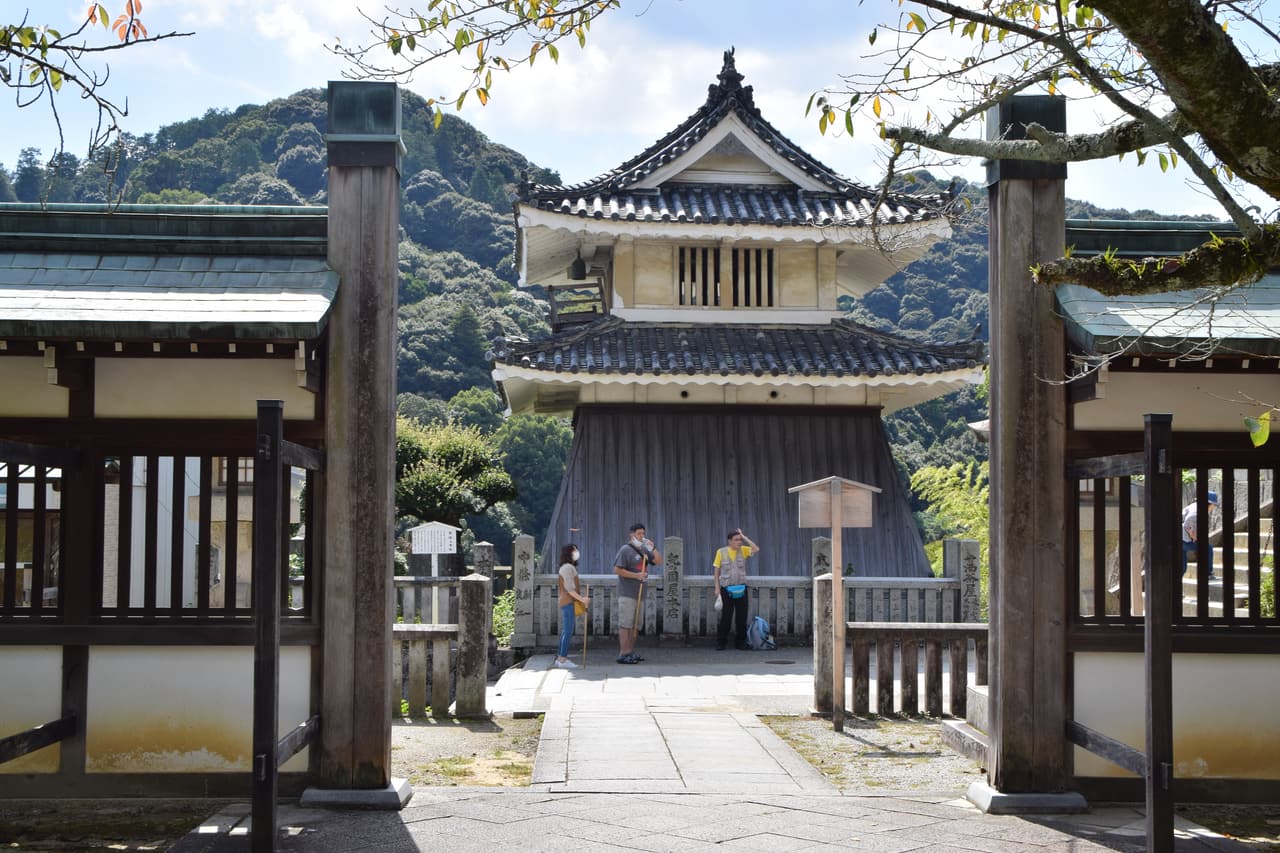
The 785-step approach (Gate → Asahisha → main hall)
It is 785 steps from the gate town to the main hall — a daunting number, but in practice you climb it in stages, with shops and sights along the way, not as one 785-step ladder. Fix a few key landmarks in your head and it falls into a rhythm:
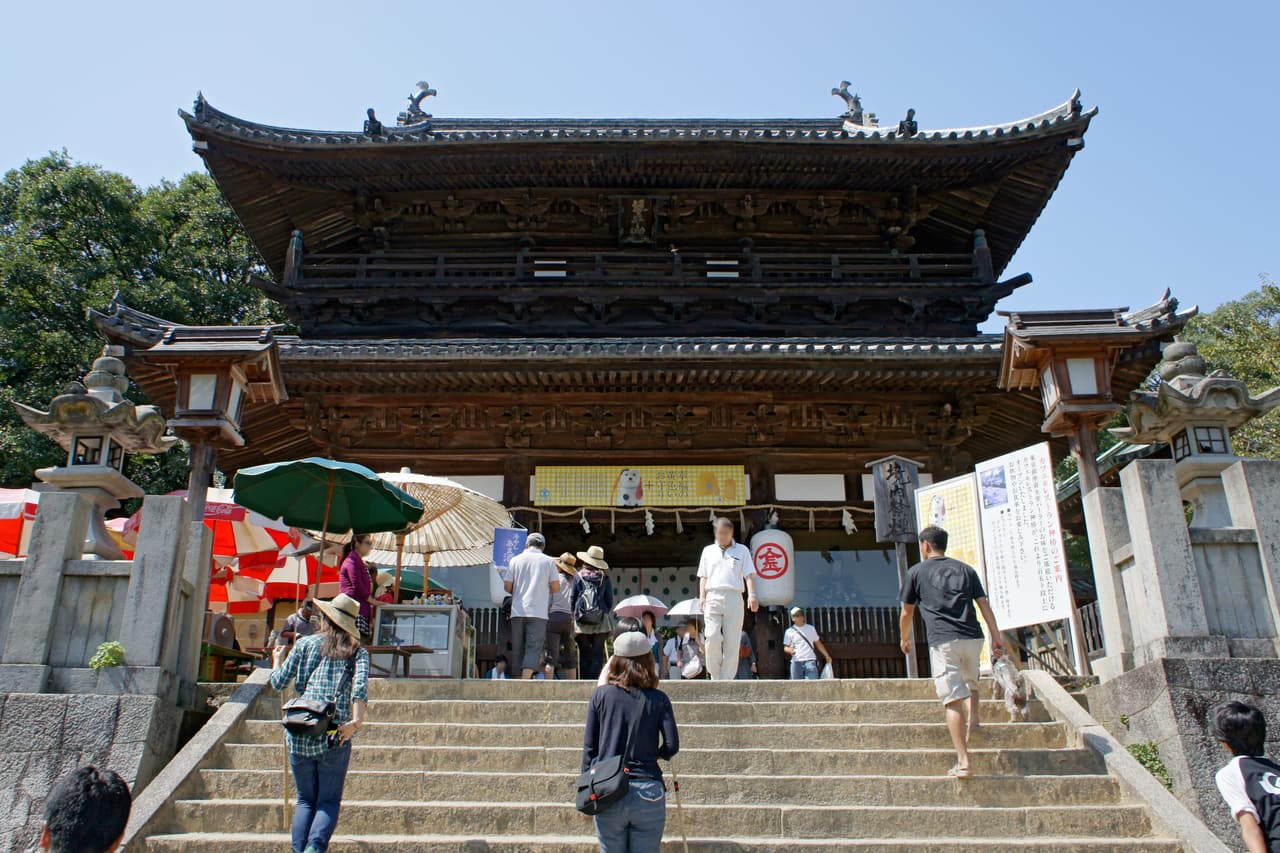
- Steps 1–365: shopping street → the Great Gate (Daimon). The liveliest stretch, lined with souvenir stores, udon shops, teahouses, and the local "kyu-man" sweet. At the 365-step Great Gate, this vermilion gate marks the entrance to the sacred precinct — past it you are inside Kotohira-gu proper.
- Inside the gate: the Gonin Byakusho and the Konpira dog. Just past the gate are the five vendors ("Gonin Byakusho") licensed to sell candy within the precinct, and soon the famous Konpira dog statue — a must-shoot.
- Around step 431: the study halls. The Omote-shoin holds wall paintings by Maruyama Okyo (separate admission); worth it if Japanese art is your thing.
- Step 628: the Asahisha. An imposing two-tier hall often mistaken for the main shrine — it is actually the Asahisha, ornate and worth a pause, but do not stop here; the main hall is still above you.
- Step 785: the main hall (Go-Hongu). The finish. Worship at the main shrine, take in the Sanuki plain and "Sanuki Fuji" (Mt. Iino) from the observation deck, and pick up the yellow "happiness" charm — yellow is Konpira's signature color, and this charm is the keepsake to get.
Worship itself is free, and 40–60 minutes one way is realistic with photos and rests. One thing to remember: save a little in the tank for the descent — those stone steps are actually harder on the knees going down.
The 1,368-step inner shrine: push on or not?
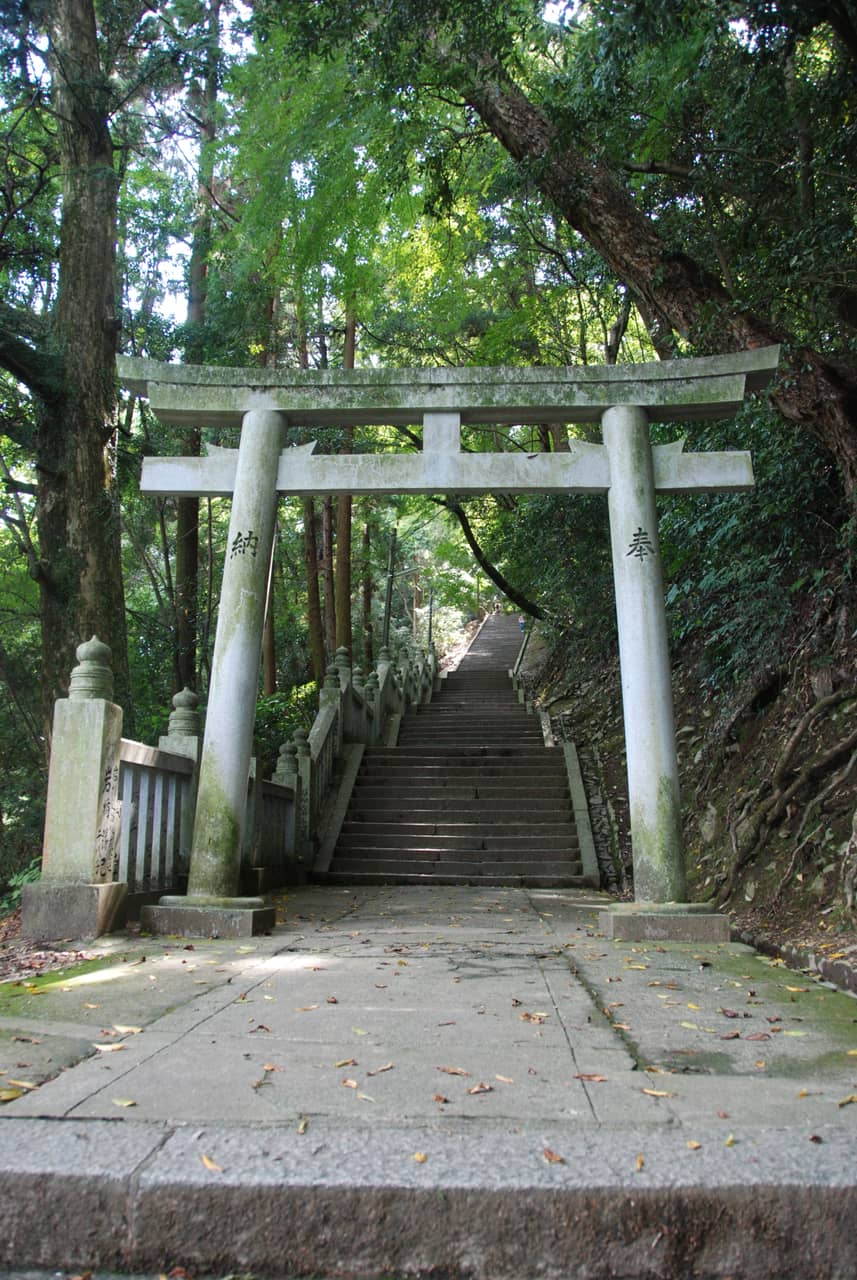
From the main hall (785) you can push on to the innermost Okusha (Izutama Shrine) at 1,368 steps total — that is another ~583 steps and roughly 30–40 minutes one way. Here is the verdict up front: I would not list this as a must. The reason is practical: above the main hall it turns into a forest trail, the views are more enclosed than at the main hall, and the payoff is mostly the quiet of thinning crowds and the sense of completion — there is a carved relief of the Tengu and Karasu-tengu on the cliff behind Okusha as a small bonus.
My split is plain: if your legs are average and you mainly came for views and photos, stop at the 785-step main hall; if you enjoy hiking, want to escape the crowds, or are walking the pilgrimage and want the full circuit, push on to Okusha. If you do go up, budget the time and energy — figure 2.5–3 hours round trip including the main hall — and note Okusha closes earlier than the main hall, so do not chase it late in the day.
The palanquin's end & how to actually climb
This needs spelling out, because plenty of older write-ups still say "you can take a palanquin if you cannot climb": Konpira-san's hand-carried palanquin (kago) service ended in January 2020, with no carriers left to take it over. So there is no longer any ride up — do not plan around it, and brace anyone in your group who was counting on it, especially if you are traveling with older relatives.
If your legs are a worry, here are the practical workarounds:
- Climb in stages: the first shopping-street stretch is full of shops and teahouses, so it is naturally suited to going slow; break the 785 into small chunks and most people manage it.
- Borrow a bamboo stick: shops near the approach offer bamboo walking sticks to rent or borrow (returned on the way down), and they help a lot on the steps.
- Set a turnaround point: if you have to, turning back at the Great Gate (365) or the Asahisha (628) is no failure — the point is not to overheat or hurt your knees.
- Pick your timing and gear: avoid midday heat, wear proper trainers, and carry water — all worth more than any ride. In summer especially, climb in the morning.
Kanamaruza, Japan's oldest kabuki playhouse
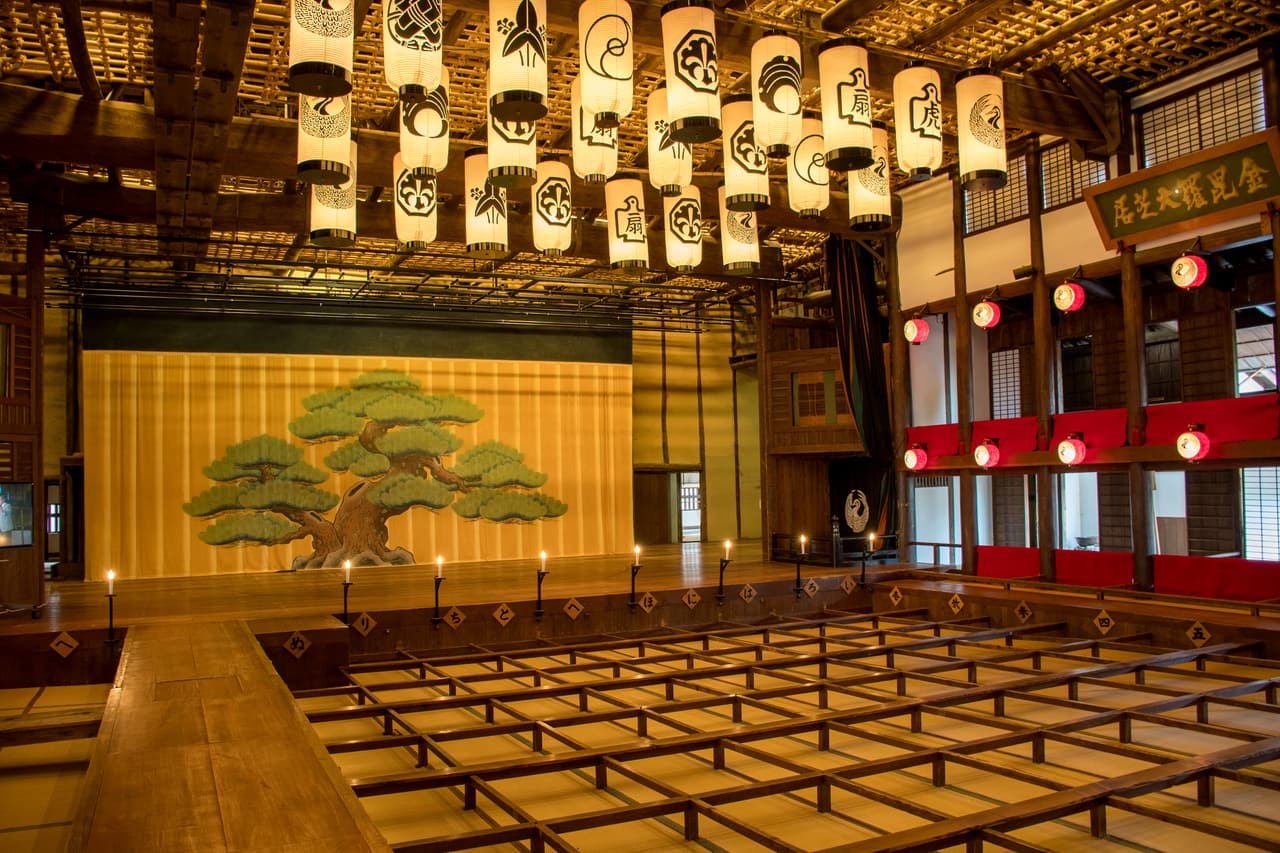
Back down from the steps, do not rush off — near the gate town, Kanamaruza (the old Konpira playhouse) is Kotohira's most underrated treasure. Per official sources, it is the oldest surviving kabuki playhouse in Japan, built in 1835, and the all-wooden theatre keeps its Edo-era form. The best part is that on days with no performance it is open to tour: you can step onto the stage, the backstage, and the hanamichi runway, and even go down to the "naraku" beneath the stage to see the hand-powered revolving stage and the lifts — a behind-the-scenes view you simply do not get at a modern theatre, and a real treat for anyone into architecture, theatre, or mechanics.
The practicals: general admission is ¥500 adults, ¥300 junior/senior high students, ¥200 elementary, open 9:00–17:00 (last entry 16:30). Keep one thing straight — each April there is the "Shikoku Konpira Kabuki" festival, when star kabuki actors actually perform; that is a separate ticketed event (from around ¥12,000, and very sought-after), entirely different from the everyday ¥500 tour. To catch a performance, watch ticket sales months ahead; to simply see the theatre itself, come on a normal day and buy the ¥500 ticket.
Zentsuji: Kukai's birthplace, Temple No. 75
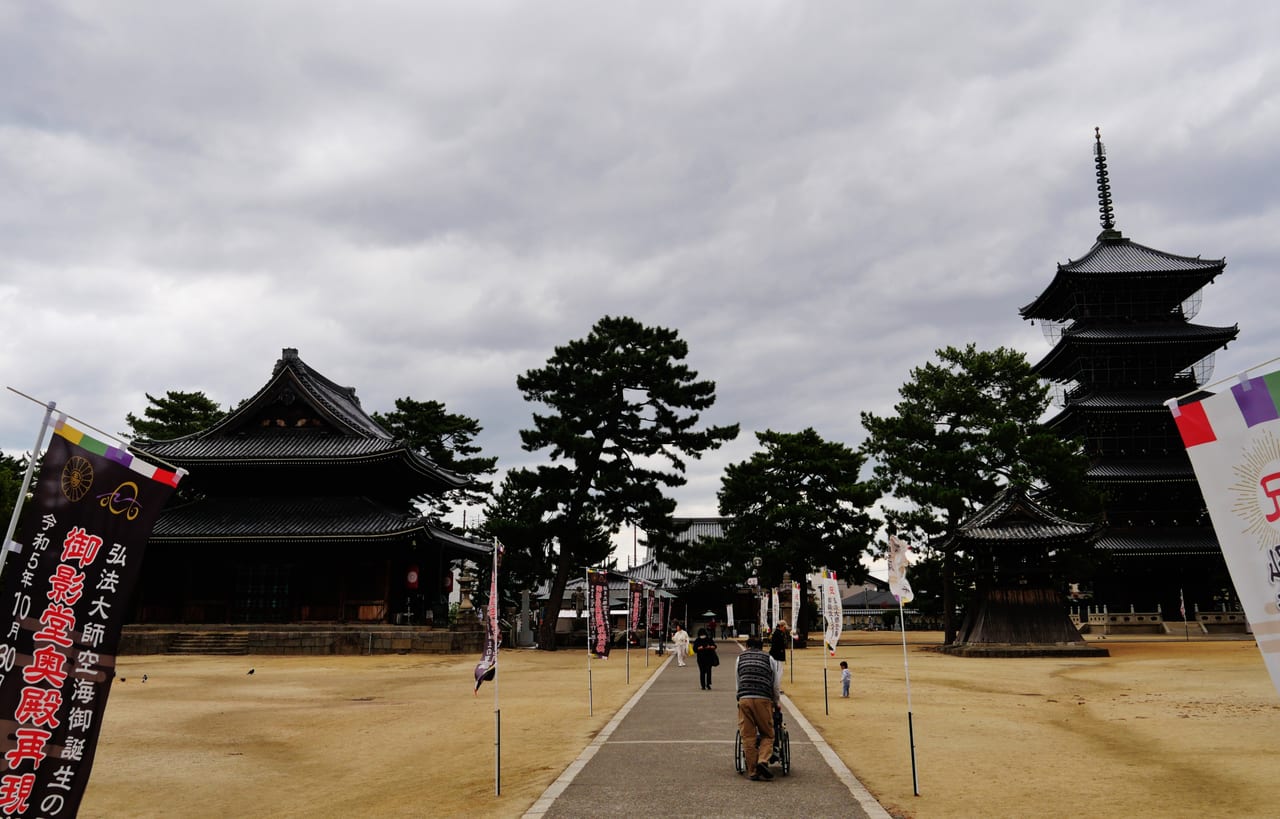
If you have energy left in Kotohira, Zentsuji to the north is well worth adding. Its standing in Shikoku is hard to beat — Zentsuji is the birthplace of Kobo Daishi (Kukai) and Temple No. 75 of the Shikoku 88-temple pilgrimage. Per official sources, Kukai was born here in 774, the temple is named after his father "Yoshimichi," and it stands alongside Mt. Koya's Kongobu-ji and Kyoto's To-ji as one of the "three great Kukai sites." For anyone into Japanese Buddhist history, the Kukai faith, or the pilgrimage itself, it is not to be skipped.
The grounds split into the East Precinct (the garan) and the West Precinct (the birthplace hall), with the soaring five-story pagoda and main hall as landmarks. Entering the grounds is free, but the "Kaidan-meguri" beneath the Mieido hall is special: a roughly 100-meter, pitch-black underground passage you walk with a hand on the wall, said to be centered on the room of Kukai's mother — a meditative "face yourself" exercise. The Kaidan-meguri and treasure museum are a set ticket at ¥500 adults, ¥300 students. I would spend the ¥500 — walking in total darkness is the most memorable thing about Zentsuji. From Kotohira it is a stop or two on the JR Dosan Line, ideal for the same day.
Sanuki udon & the udon taxi
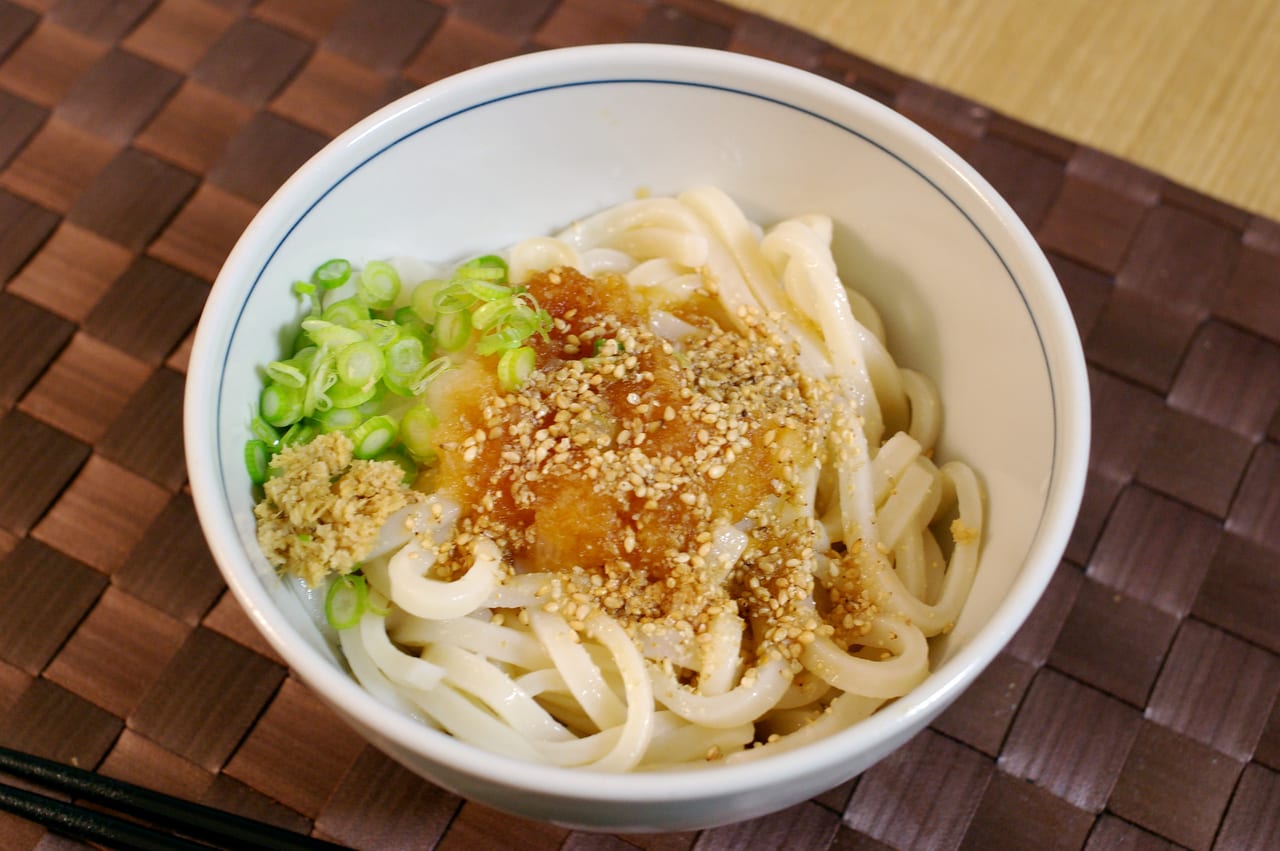
Coming to Kagawa and skipping Sanuki udon is barely coming at all. Kagawa calling itself "Udon Prefecture" is well-earned — under a million people yet hundreds of udon shops, with firm, springy noodles, a clean broth, and prices that are almost absurd: a basic plain "kake udon (small)" commonly runs about ¥230–380 a bowl, some of the best-value food in all of Japan. My advice: do not settle for the tourist udon at a hotel or station — go to a "self" (serufu) shop for the real thing.
The self-serve flow is fun: grab a tray, tell the noodle counter how many portions ("ichi-tama," "ni-tama"), ladle on the hot broth, then add your own scallions, ginger, and tempura before paying. It runs cafeteria-style, but the noodles often beat the sit-down restaurants. There are plenty of self-serve standouts around the Kotohira gate town and in central Takamatsu, easy to find on your own.
And the "udon taxi" everyone has heard of is real — a registered service from Kotosan Bus / Kotobus Taxi, with dedicated drivers who have passed a written and practical udon exam to take you to famous shops public transport cannot reach, handling the route and the queueing intel along the way. Many of Kagawa's top shops are tucked out in the rice fields with no easy access, and that is exactly where the udon taxi earns its keep. Not into chartering a car? Stick to the self-serve shops in Kotohira and central Takamatsu and you will still eat very well.
Access, lodging & pairing with Takamatsu
Kotohira, where Konpira-san sits, is small, with limited lodging and dining, so I strongly recommend pairing it with Takamatsu: base in Takamatsu and day-trip to Kotohira is the smoothest plan. From Takamatsu there are two routes:
- JR Dosan Line to "Kotohira Station": south from Takamatsu, about 50 minutes by limited express (local a bit longer). The station is a 10–15 minute walk from the approach.
- Kotoden (Takamatsu-Kotohira Electric Railroad) Kotohira Line: from Takamatsu-Chikko Station to the terminus Kotoden-Kotohira, about an hour, cheaper than JR, and closer to the approach on arrival — the budget-friendly pick.
Coming in from Okayama / Honshu, take the JR rapid "Marine Liner" across the Seto Ohashi bridge to Takamatsu or Sakaide, then transfer to the JR Dosan Line south to Kotohira. Zentsuji is on that same Dosan Line between Kotohira and Takamatsu (Zentsuji Station), so it is right on the way. To judge whether a rail pass (such as the Shikoku-area passes) pays off for your route, run the math with our JR Pass guide.
Lodging: Kotohira does have the Kotohira Onsen ryokan if you want a relaxed soak and an early, crowd-free climb the next morning — staying a night there is a treat. But for dining, transport, and flexibility, basing in Takamatsu is far more convenient: it is Shikoku's biggest city, dense with places to stay and eat, and its sights (including the island-hop to Naoshima) are in our Takamatsu & Naoshima guide. To extend west across Shikoku, Matsuyama's Dogo Onsen is in our Matsuyama & Dogo Onsen guide. For pre-trip weather and packing — especially shoes and breathable layers for the steps — see our Japan packing & weather guide.
A one-day plan
Built around "base in Takamatsu, day-trip to Kotohira," shaped into a route that flows:
- Morning: Takamatsu to Kotohira by JR Dosan Line or Kotoden (early, fewer crowds, cooler) → start up the Konpira-san steps from the gate-town shopping street, through the Great Gate, snap the Konpira dog, see the Asahisha → up to the 785-step main hall for the Sanuki-plain view and the yellow charm (push on to Okusha if you love a hike).
- Midday: down to a self-serve Sanuki udon shop in the gate town or nearby (or take the udon taxi to a rural standout if the tourist shops feel too tame).
- Afternoon: pick one — tour Kanamaruza (¥500), Japan's oldest kabuki playhouse and its under-stage machinery; or ride a stop or two to Zentsuji for the Kaidan-meguri and the five-story pagoda.
- Evening: back to Takamatsu, and round it off with another bowl of udon or local fare in the city.
If you would rather stay a night in Kotohira and soak at Kotohira Onsen, slow the pace: arrive in the afternoon, walk the gate town and Kanamaruza first, then climb the steps early the next morning before the day-trippers arrive — fewest crowds, best air. Konpira-san plus Takamatsu plus Zentsuji makes a tidy two-day Kagawa itinerary.
FAQ
- Q1:Do you have to climb all 1,368 steps to the inner shrine, or is 785 to the main shrine enough?
- Honestly, for nine out of ten visitors, the 785 steps to the main hall (Go-Hongu) are plenty. Go-Hongu is the main shrine and the best viewpoint — its observation deck looks out over the whole Sanuki plain and the cone of "Sanuki Fuji" (Mt. Iino), and it is where you buy the famous yellow "happiness" charm. Pushing on to the inner shrine (Okusha / Izutama Shrine) at 1,368 steps means another ~583 steps and a 30–40 minute one-way climb through forest trail, with views that are actually more enclosed than the main hall. My call is blunt: if your legs are average and you came for the view, stop at the 785-step main hall; only push to Okusha if you like quiet hiking or want the sense of completion. Do not force a "summit" — the main hall is already the highlight.
- Q2:I cannot climb 785 steps — is the old palanquin (kago) still running?
- The key thing first: the traditional hand-carried palanquin (kago) service ended in January 2020 because there were no carriers left to take it over, so there is no longer any ride up at Konpira-san — do not plan around it. If you are unsure about your legs, the practical approach is: the steepest first stretch is lined with shops and teahouses where you can rest in stages, and most people make it up by taking it slow; the approach has bamboo walking sticks (usually free to borrow, returned on the way down) that genuinely help; and there is no shame in turning back at the Great Gate (step 365) or around the Asahisha if you need to. Proper shoes, avoiding midday heat, and carrying water beat any ride.
- Q3:Is Kanamaruza (the old Konpira playhouse) worth entering, and how much is it?
- If you have any interest in historic architecture or kabuki, very much so — Kanamaruza (Kyu-Konpira-Oshibai) is, per official sources, the oldest surviving kabuki playhouse in Japan, built in 1835. On days with no performance it is open to tour, and you can walk onto the stage, the backstage, and the hanamichi runway — and even descend into the "naraku" beneath the stage to see the hand-powered revolving stage and trapdoor machinery, a behind-the-scenes view you never get at a modern theatre. General admission is ¥500 adults, ¥300 junior/senior high students, ¥200 elementary, open 9:00–17:00 (last entry 16:30). Note that the "Shikoku Konpira Kabuki" festival each April — when real kabuki stars perform — is a separate ticketed event (from around ¥12,000, and hard to get), not the same as the ¥500 day-time tour.
- Q4:What is Zentsuji, and how do I combine it with Konpira-san?
- Zentsuji is the birthplace of Kobo Daishi (Kukai) and Temple No. 75 of the Shikoku 88-temple pilgrimage. Per official sources, the temple is named after Kukai's father, "Yoshimichi," and ranks with Mt. Koya's Kongobu-ji and Kyoto's To-ji as one of the three great Kukai sites — it carries real weight. It sits just north of Kotohira near Zentsuji Station on the JR Dosan Line, a stop or two from Kotohira, so it slots into the same day. The grounds are free to enter, but the underground "Kaidan-meguri" — a pitch-black 100-meter passage beneath the Mieido hall — paired with the treasure museum is a set ticket at ¥500 adults, ¥300 students. Feeling your way along the wall in total darkness as a meditative exercise is the most memorable part of Zentsuji; I would do it. For anyone walking the pilgrimage, it is essential.
- Q5:You have to eat Sanuki udon in Kagawa — how does it work, and is the "udon taxi" real?
- Kagawa calling itself "Udon Prefecture" is no gimmick — Sanuki udon is cheap and superb, with a plain "kake udon (small)" commonly running about ¥230–380 a bowl, some of the best value food in all of Japan. The most authentic way is the "self" (serufu) shops: you grab a tray, tell the counter how many portions you want, add your own scallions, ginger, and tempura, then pay — it runs like a cafeteria but the noodles outclass most sit-down restaurants. And yes, the "udon taxi" is real — a registered service from Kotosan Bus / Kotobus Taxi whose drivers pass a written and practical udon exam and ferry you to famous shops (including rural ones no public transport reaches) while handling the queueing intel. If you would rather not charter a car, there are plenty of self-serve shops around Kotohira and central Takamatsu to find on your own.
- Q6:How do I get to Konpira-san, and can I combine it with Takamatsu?
- Yes — and I strongly recommend pairing Konpira-san with Takamatsu. From Takamatsu there are two routes: the JR Dosan Line to Kotohira Station (limited express about 50 minutes, local a bit longer); or the Kotoden (Takamatsu-Kotohira Electric Railroad) Kotohira Line from Takamatsu-Chikko to Kotoden-Kotohira, about an hour, cheaper, with the terminus close to the approach. Coming from Okayama / Honshu, take the JR rapid "Marine Liner" across the Seto Ohashi bridge to Takamatsu or Sakaide, then transfer to the Dosan Line south to Kotohira. The smoothest plan is to base in Takamatsu and day-trip to Kotohira: climb in the morning, udon at midday, Kanamaruza or Zentsuji in the afternoon. To weigh the rail passes, see our JR Pass guide; Takamatsu and Naoshima are in our Takamatsu & Naoshima guide.
Related reading:
Takamatsu & Naoshima Guide 2026: Ritsurin & Art Island
55 minutes from Okayama over the Seto Ohashi to Takamatsu, then a ferry to Naoshima for Ando's Chichu Art Museum and Kusama's pumpkins — Ritsurin, Sanuki udon, ferries and a two-day plan.
Matsuyama & Dogo Onsen Guide 2026: Honkan, Castle, Train
Dogo Onsen Honkan fully reopened in July 2024 (bathing from ¥700), and Matsuyama Castle is one of Japan's 12 original keeps — plus Asuka-no-Yu, the castle ropeway, the Botchan train, and access from Okayama.
JR Pass 2026: Is It Still Worth It?
Four real routes calculated, six alternatives that may beat the Pass.