The single most useful anchor for a Kyushu foliage trip is Mifuneyama Rakuen's autumn festival — officially confirmed for 2026 as November 6 to December 6, billed as Japan's largest-scale foliage illumination. With that hard date, the whole trip gets a spine. But the real difficulty with Kyushu foliage is not "where's pretty" — it's that the spots are scattered and many have almost no weekday transit. Unzen Nitadake sits high enough that it reddens in late October; the lowland spots — Mifuneyama, Yabakei, Kikuchi Gorge — don't turn until mid-November; and several famous places have so few weekday buses that you'll wish you'd rented a car. This guide skips the "everything's wonderful" routine: I'll lay peak timing, cost, transit difficulty, and whether you need a car into one table, then work through Mifuneyama's day-versus-night call, whether to start Unzen from Nagasaki or Fukuoka, and how to handle that one Dazaifu spot that may leave you at a locked gate. For the full five-region timing map, start with the Japan Autumn Foliage 2026 guide; this is the Kyushu deep-dive.
- Mifuneyama Rakuen 2026 festival is set for Nov 6–Dec 6: Japan's largest foliage illumination, combo ticket adult ¥900 (day-only or night-only ¥600)
- Peak splits into two layers: high-elevation Unzen Nitadake late Oct–early Nov (earliest); lowlands and gorges mid-Nov into early Dec (historical average, not a 2026 forecast)
- Mifuneyama has no free weekday shuttle: the free shuttle runs weekends and holidays only — on weekdays it's the infrequent JR Kyushu bus, a car, or a taxi
- Kokonoe Yume bridge is still ¥500/¥200 in 2026: the new scheme starts Jan 1, 2027 — no "price hike" panic; Kikuchi Gorge ¥500, closes Nov 30
- Spots are scattered with thin weekday transit: to string Mifuneyama + Unzen + Yabakei, a car or charter saves the most time; rail-only Fukuoka + Dazaifu + Yufuin also works
📖 Table of Contents (click to expand)
- Peak timing: why Kyushu foliage runs late Oct into early Dec
- The master table: peak × cost × transit difficulty × need for a car
- Mifuneyama Rakuen: the most time-sensitive draw (day vs night)
- Unzen Nitadake: Kyushu's earliest foliage, Nagasaki or Fukuoka
- Yabakei and inland Oita: gorge foliage and the Kokonoe Yume bridge
- The Fukuoka orbit: Akizuki, Raizan Sennyoji, and an honest Dazaifu note
- Getting around: car vs transit, and a 2–3 day route from Fukuoka
- FAQ
Peak timing: why Kyushu foliage runs late Oct into early Dec
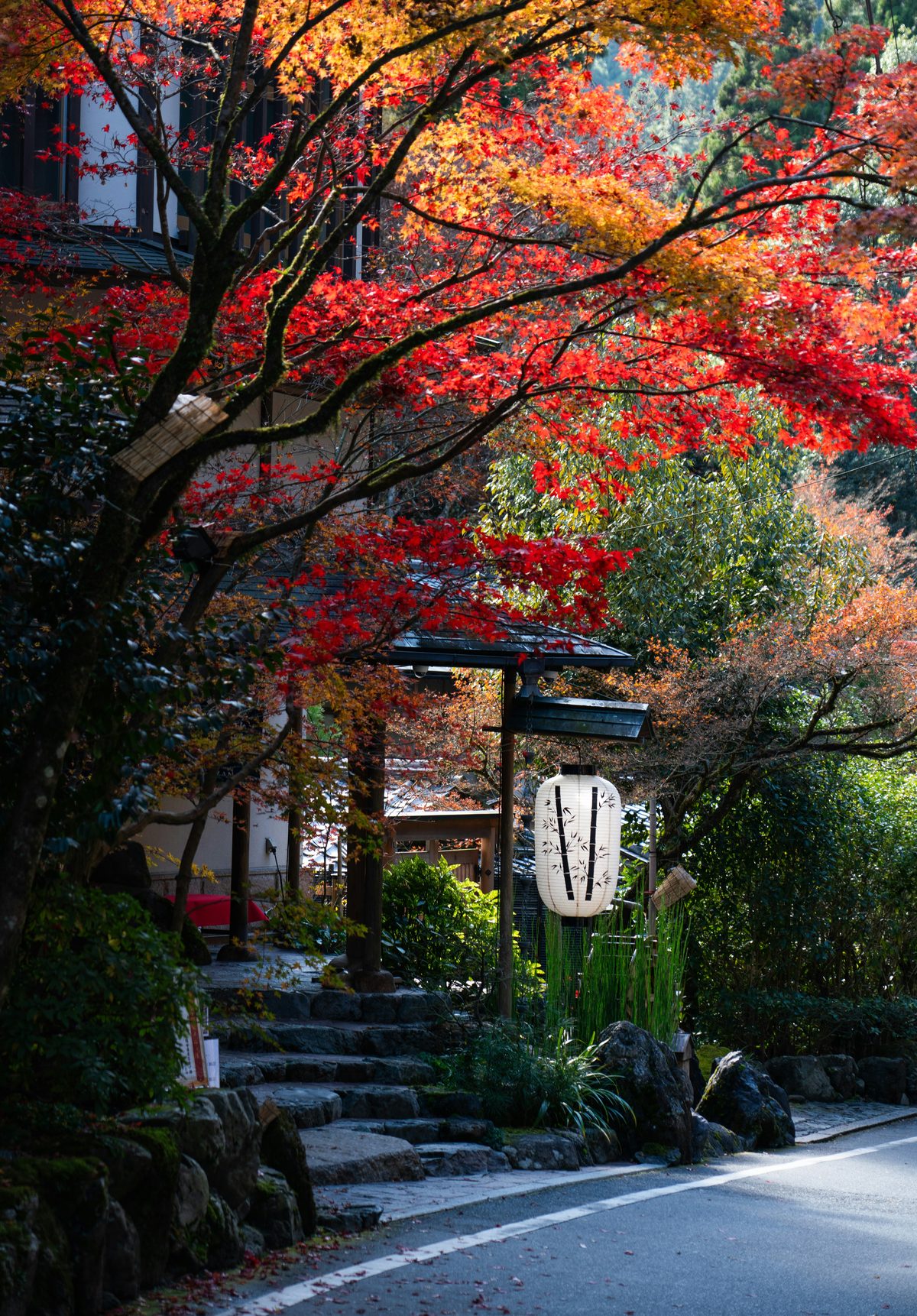
Many people assume Kyushu, being farther south, must turn late. In fact its peak is split into two layers by elevation. The earliest is Unzen Nitadake on the Shimabara Peninsula — at roughly 1,300 meters, the cold arrives first and the maples turn first, usually late October to early November, making it one of the first places you can see foliage on the Kyushu mainland. The second layer is the lowlands and inland gorges: Mifuneyama Rakuen, Yabakei's Hitome Hakkei, Akizuki, Kikuchi Gorge, and the Dazaifu area, most of which don't get their turn until mid-November into early December.
One honest caveat: all of the above are historical conventions, not a 2026 official forecast. The precise peak each year shifts a few days with how early the cold arrives — a warm autumn pushes everything later, an early-cold year pulls it earlier. The first 2026 forecast is out: WeatherNews published its first round on September 3, 2026, and nationwide peak color runs later than or slightly later than normal, driven by a warm autumn. On leaf condition, Kyushu is the single national exception — a hot summer with little rain left Kyushu foliage in poorer shape, while every other region is better than last year. Factor that in: the color here may be less vivid than usual. For a single spot's 2026 forecast date, open the WeatherNews spot page, not the calendar page (2004–2025 averages). The Japan Weather Association (tenki.jp) has published no 2026 peak-foliage forecast — its forecast page still carries the 2025 third round even though the URL says 2026, which is easy to misread — and offers only a daily colour-status tracker, so there is one forecast on the table and nothing to cross-check against. Walkerplus is not a third source: its peak-timing forecast republishes the WeatherNews first round, and its spot pages give historical averages plus a daily color report, not 2026 per-spot forecast dates. The practical move: use these historical windows to book transport and lodging in broad strokes, then recheck the current-year forecast about two weeks out; don't just paste last year's dates on. The one hard date you can bank on is the Mifuneyama Rakuen festival — an official event window (Nov 6–Dec 6 in 2026), not the same as the natural peak but close to it, and the best possible spine for the whole trip.
Official 2026 dates now exist for five of the major spots, and they line up exactly with the two-layer split above. These are the per-spot forecasts from the WeatherNews spot pages (checked September 26, 2026; these values do get revised, so check again two weeks out).
| Spot | 2026 peak starts | 2026 leaf drop starts |
|---|---|---|
| Unzen (Nitadake) | Nov 3 | Nov 17 |
| Kikuchi Gorge | Nov 14 | Nov 25 |
| Mifuneyama Rakuen | Nov 22 | Dec 11 |
| Takachiho Gorge | Nov 26 | Dec 8 |
| Akizuki Castle Town | Nov 29 | Dec 9 |
From Nitadake on Nov 3 to Akizuki on Nov 29, Kyushu spreads its start dates across almost four weeks. If you want to see several places on one trip, late November is the only window that strings Mifuneyama, Takachiho and Akizuki together. If Nitadake is the reason you came, go in early November instead — the lowlands will still be green that week.
The master table: peak × cost × transit difficulty × need for a car
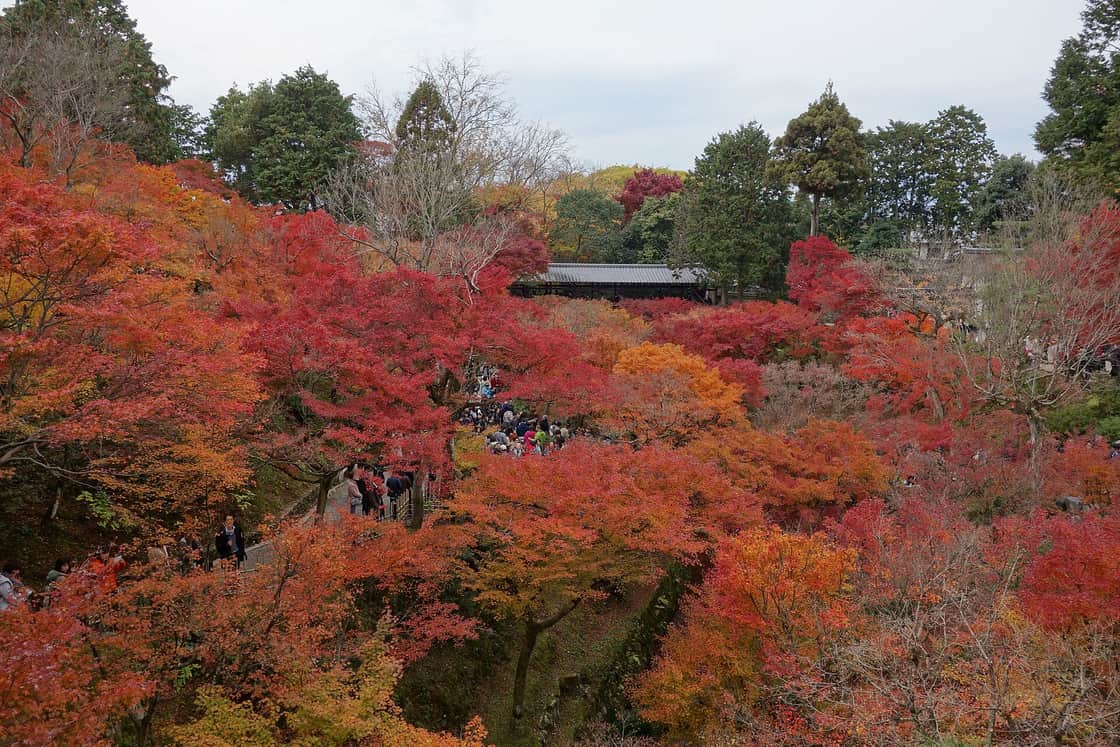
Kyushu foliage spots are scattered with big transit gaps, so a side-by-side table helps you decide. Peaks below are historical averages (not a 2026 forecast); costs are the current official rates verified July 2026; transit difficulty means "without a car on a weekday":
| Spot | Prefecture | Average peak | Cost | Weekday transit difficulty | Need for a car |
|---|---|---|---|---|---|
| Unzen Nitadake (ropeway) | Nagasaki | Late Oct–early Nov | Ropeway round trip adult ¥1,500 | High (few direct buses) | High |
| Mifuneyama Rakuen | Saga | Festival Nov 6–Dec 6 | Day or night ¥600 / combo ¥900 | Medium (shuttle only on festival-period weekends, north exit) | Medium (higher on weekdays) |
| Yabakei Hitome Hakkei | Oita | Early–late Nov | Free | Medium-high (weekday-only buses) | High |
| Kokonoe Yume bridge | Oita | Mid–late Nov (mountain analog) | ¥500 / ¥200 | High (little direct transit) | High |
| Kikuchi Gorge | Kumamoto | Mid–late Nov (closes Nov 30) | ¥500, parking free | Medium-high | High |
| Akizuki castle ruins (Kuromon) | Fukuoka | Late Nov–early Dec | Free | Medium (Amagi railway + bus) | Medium |
| Raizan Sennyoji Daihioin | Fukuoka | Early–mid Nov | ¥500 inside the hall; ¥200 grounds-only in Nov (free under 15) | Medium-high (weekday reservation bus) | Medium-high |
| Kamado Shrine (Dazaifu orbit) | Fukuoka | Mid–late Nov | Free | Low (walk/shuttle from Dazaifu Tenmangu) | Low |
The point isn't the numbers; it's the gap in the last two columns. The deeper you go into mountains and gorges — Unzen, Kokonoe, Kikuchi, Yabakei — the more you need a car; the closer you stay to the metro area and rail lines — Dazaifu, Akizuki, weekend Mifuneyama — the more transit carries you. So plan by first answering one question: is this trip renting a car or not? That answer all but decides which spots you can slot in. The sections below follow that dividing line and unpack the ones worth your time. For Kikuchi Gorge specifically — opening season, rain closures and the no-car reality — there's a dedicated Kikuchi Gorge deep-dive.
Mifuneyama Rakuen: the most time-sensitive draw (day vs night)
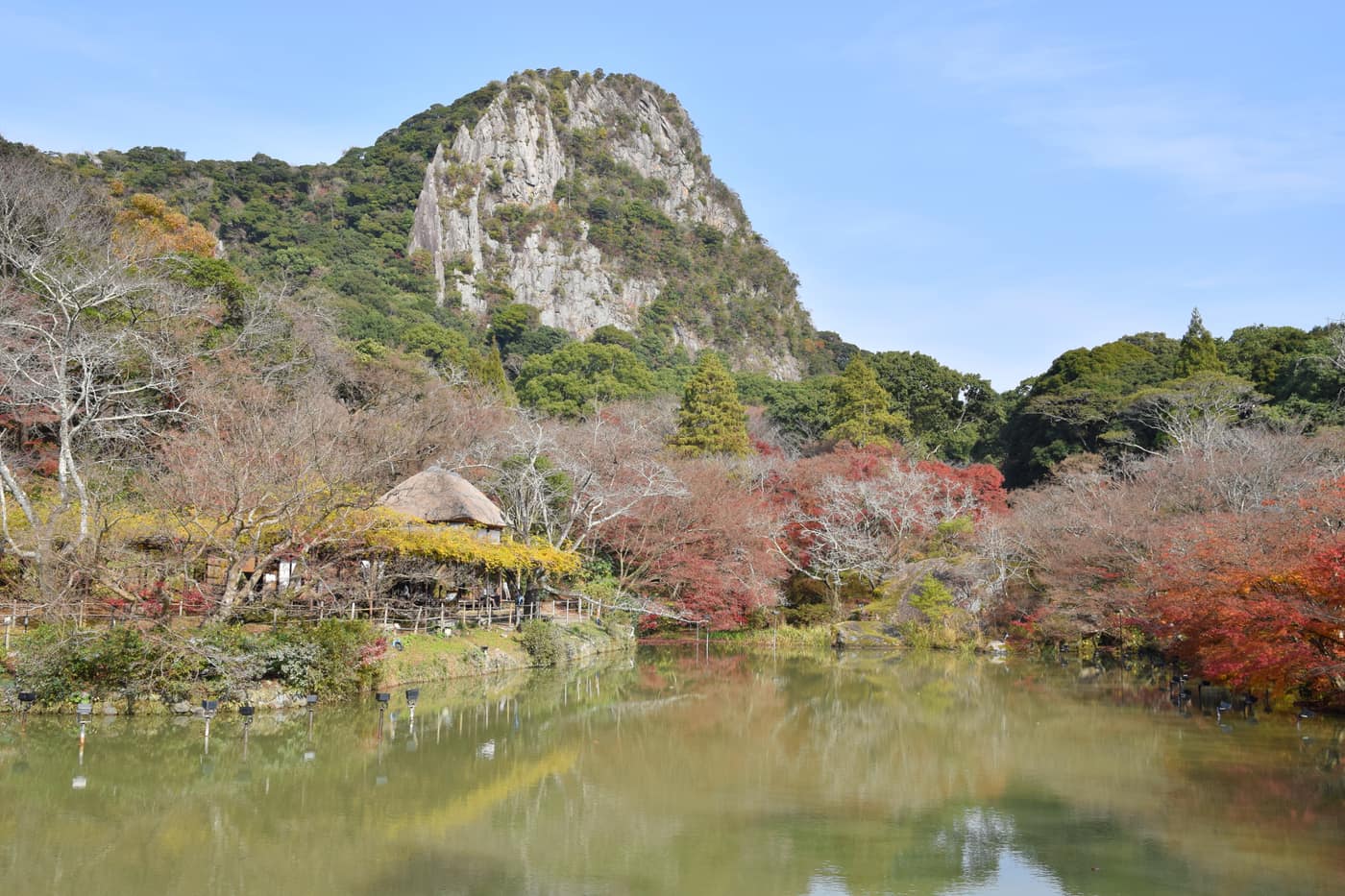
If I could pick just one highlight for a Kyushu foliage trip, it would be Mifuneyama Rakuen (Takeo, Saga) — for a simple reason: it's the best-verified spot in this guide and it has a firm official date. The 2026 autumn festival is officially Nov 6 to Dec 6, across 13 hectares with 170-year-old maples and the Kagami-ike pond reflection, which the garden promotes outright as Japan's largest-scale foliage illumination. Hours are 8:00–17:30 by day and 17:30–22:00 at night, open in rain.
Three ticket tiers, and here's how I'd choose. Day-only or night-only is ¥600 adult (¥300 elementary); the day-and-night combo is ¥900 adult (¥400 elementary). My call: come for the illumination if you're choosing one, but if your schedule has room, just buy the combo. Daytime shows the terrain and the layered old maples; night is Mifuneyama's real signature — lit maples mirrored in the pond, the thing that sets it apart from every other Kyushu spot. The combo costs only ¥300 more than a single session and lets you arrive at dusk to catch both natural light and illumination. Guests at the Mifuneyama Rakuen ryokan or Chikurintei get in free.
But one weekday pitfall must come first: Mifuneyama has no weekday shuttle. The free bus from JR Takeo-Onsen Station north exit runs only on Saturdays, Sundays, and national holidays (8:00–22:00, about 3 per hour, no reservation), and stops entirely on weekdays. Weekday alternatives, per a July 2026 re-check: JR Kyushu Bus's regular Ureshino line has paid weekday services stopping near the garden entrance (roughly ¥160–170, a 5–10-minute ride, infrequent), or drive or take a taxi (a 10-minute ride; a sightseeing-taxi plan is about ¥10,200 for a small car for 2 hours). The weekend-versus-weekday gap is still stark — check the return times before a weekday night visit so you are not stranded after the lights. Takeo is itself an onsen town, so ending the night with a stay at a hot-spring inn nearby is a smooth combination. For the full four-season calendar, spring azaleas, and the honest teamLab status, see our dedicated Mifuneyama Rakuen guide.
Unzen Nitadake: Kyushu's earliest foliage, Nagasaki or Fukuoka
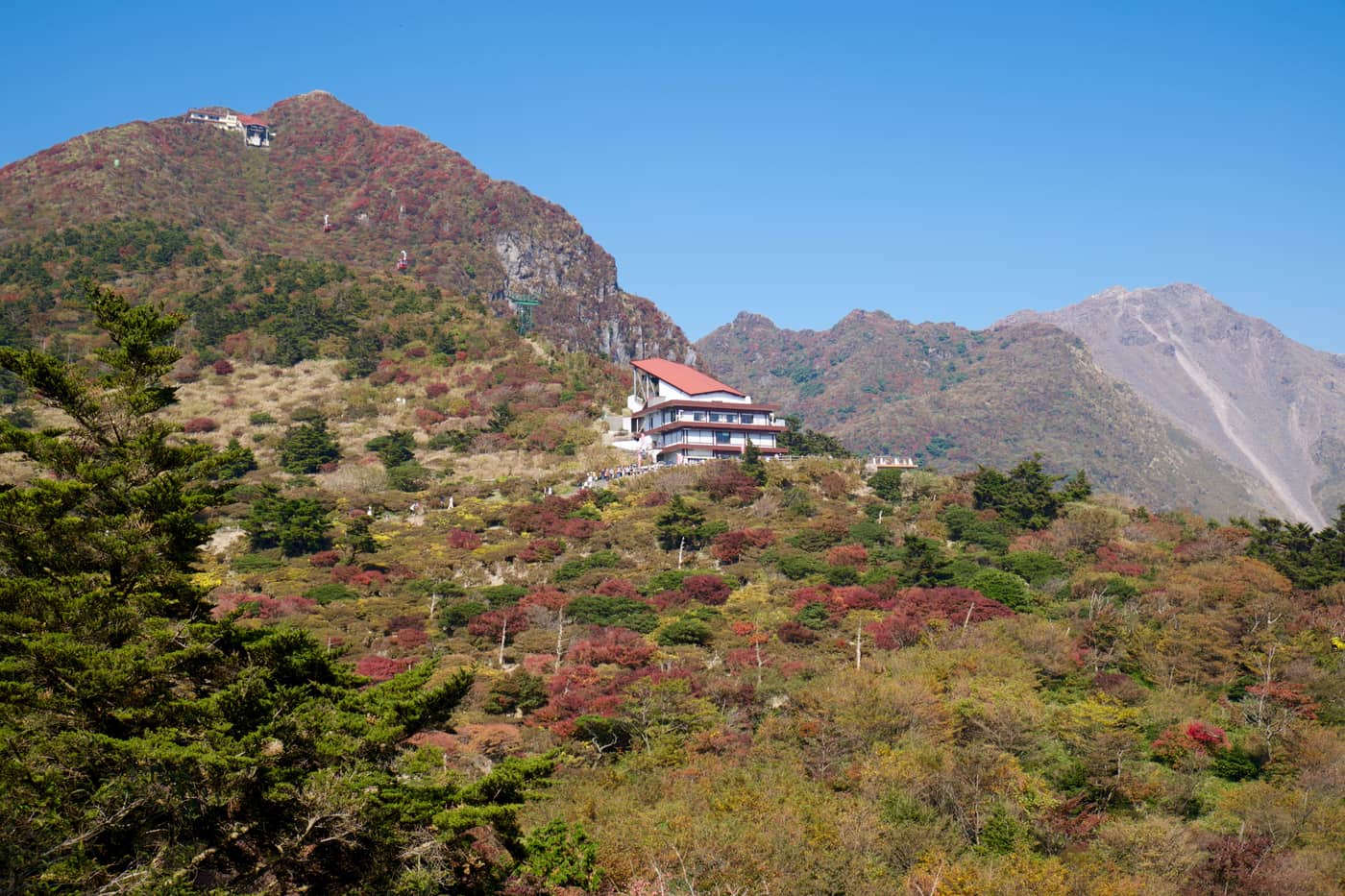
Unzen Nitadake (Shimabara Peninsula) is the opening act of Kyushu's foliage calendar. At roughly 1,300 meters it peaks late October to early November — nearly a month ahead of the lowlands — so if you're traveling in late October, when the base is still green, weight your trip toward Unzen. From Nitadake you can ride the Unzen Ropeway up toward the Myokendake overlook: round trip is ¥1,500 adult (¥750 child), one way ¥830 adult. One note: the ropeway was suspended June 15–25, 2026 for electrical upgrades — that's summer maintenance and does not affect autumn, but it's a reminder to check the operator's status page before visiting a mountain facility.
The Nitadake loop road itself is free to drive; a staffed booth asks for an environmental cooperation fee of ¥100. What actually matters is the closing time: 8:00–18:00 from April to October, 8:00–17:00 from November to March, and the downhill gate is locked 45 minutes after that — go up after 17:00 in winter and you will be shut in on the mountain. The ropeway stops even earlier: from November the last car up is 16:51 and the last car down 17:11, so work backwards if you want the evening light. Overnight parking at the Nitadake lot is not allowed.
Where to start? That's the key decision for an Unzen day. From central Nagasaki it's far closer — the Shimabara Peninsula is within Nagasaki Prefecture, so this suits anyone already overnighting in Nagasaki. From Fukuoka it's clearly a long haul; a same-day round trip is rushed, better folded into a "Fukuoka to Nagasaki" travel day or done with a Nagasaki overnight. Either way, direct public transit on the Shimabara Peninsula is sparse; this guide did not verify segment-by-segment bus times, so a car or charter is the least stressful option. If you do go by bus, rely on the Nagasaki Kenei Bus or Shimatetsu Bus official timetables at the time rather than copying someone's old schedule.
Yabakei and inland Oita: gorge foliage and the Kokonoe Yume bridge
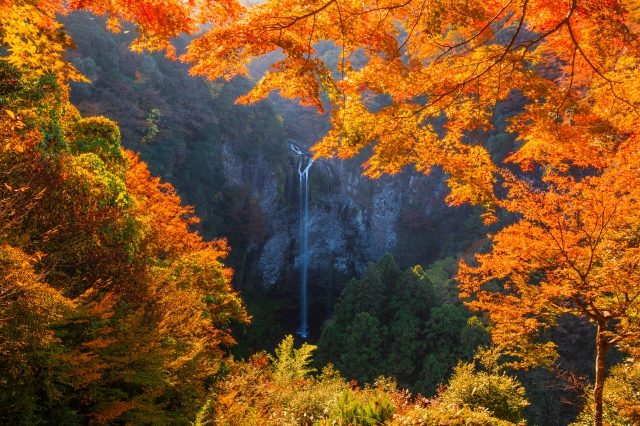
Yabakei (Nakatsu, Oita) and its Hitome Hakkei viewpoint are the archetype of Kyushu inland gorge foliage — sheer rock spires against a valley of red maples, the kind of scene rated among Japan's great scenic spots. The site is free (no admission system), with an average peak around early to late November (running into early December some years — historical convention, not a 2026 forecast). On night illumination, the 2025 Kutou Momiji light-up ran Nov 1–Dec 1, 17:00–21:00, but the 2026 dates are not yet announced; recheck the Nakatsu-Yabakei tourism association nearer autumn rather than reusing last year's dates.
Transit is Yabakei's weak point: from JR Nakatsu Station you take a Daiko Hokubu bus, transfer at Kakizaka to reach Hitome Hakkei, roughly 1.5 hours total — and that route runs weekdays only in a limited pattern. Exact departures weren't verified here, so confirm with the Nakatsu-Yabakei tourism association or the official timetable before relying on a bus, or you can get stranded at the transfer. Honestly, Yabakei and Oita's Kokonoe Yume suspension bridge are both "a car beats transit by a mile" spots.
The Kokonoe Yume bridge is a 173-meter-high pedestrian span overlooking the Naruko River gorge foliage. Admission in 2026 is ¥500 for junior-high and up, ¥200 for elementary, and free for preschoolers. Let me clear up a common misconception: yes, there's an official notice of a new pricing scheme, but it takes effect January 1, 2027, and it's mainly added discounts (free for town residents, 10 percent off for groups of 30+, ¥300 for school trips and disabled visitors) — the general-visitor rate is unaffected across the whole 2026 autumn. So don't frame it as "about to get pricier, go now" — today's ¥500 is the 2026 autumn price. The bridge sits in the Handa-kogen highlands with little direct transit, so again, a car or charter is the move.
The Fukuoka orbit: Akizuki, Raizan Sennyoji, and an honest Dazaifu note
Basing yourself in Fukuoka, the metro area has a few distinctive spots. Akizuki castle ruins (Asakura), dubbed "the little Kyoto of Chikuzen," has about 20 maples around its Kuromon gate, where the black gate against the red leaves is the draw, with vendors along the Sugi-no-baba approach for a stroll. The ruins are free (no admission), average peak late November to early December. Access is Amagi railway to Amagi Station, then the Amagi sightseeing bus Akizuki line about 20 minutes to "Hakubutsukan-mae"; frequency and last-bus times weren't verified segment by segment, so reconfirm on the spot or the official page.
Raizan Sennyoji Daihioin (Itoshima) is known for a roughly 400-year-old great maple, a Fukuoka Prefecture natural monument, with the fan-shaped tree in front of the main hall as the signature shot, The official peak is early to mid November, and the grounds hold roughly 200 more maples that stay good through the month. There are two separate tickets, not one with a surcharge: ¥500 for adults to go inside the hall, where a monk walks you through it in 15 to 20 minutes, and ¥200 in November for the grounds and the great maple only — enough if you just want the photograph. Both are free for junior-high age and under. Reception 9:00–16:30, around 120 parking spaces. One easy way to waste a trip: the 17th of each month is the principal image's feast day, with goma rites at 9:00, 11:00 and 12:30, and general visits are not accepted while they run — and November 17 falls inside the peak. On transit, the regular weekday route bus is now a reservation-only community bus (sign up as a member first, then book each ride), and it runs rarely; in the 2025 foliage season a temporary direct bus ran three times daily on weekdays between Chikuzen-Maebaru Station south exit and Raizan Kannon-mae from Nov 17 to 28, but whether 2026 repeats it depends on the Itoshima tourism association.
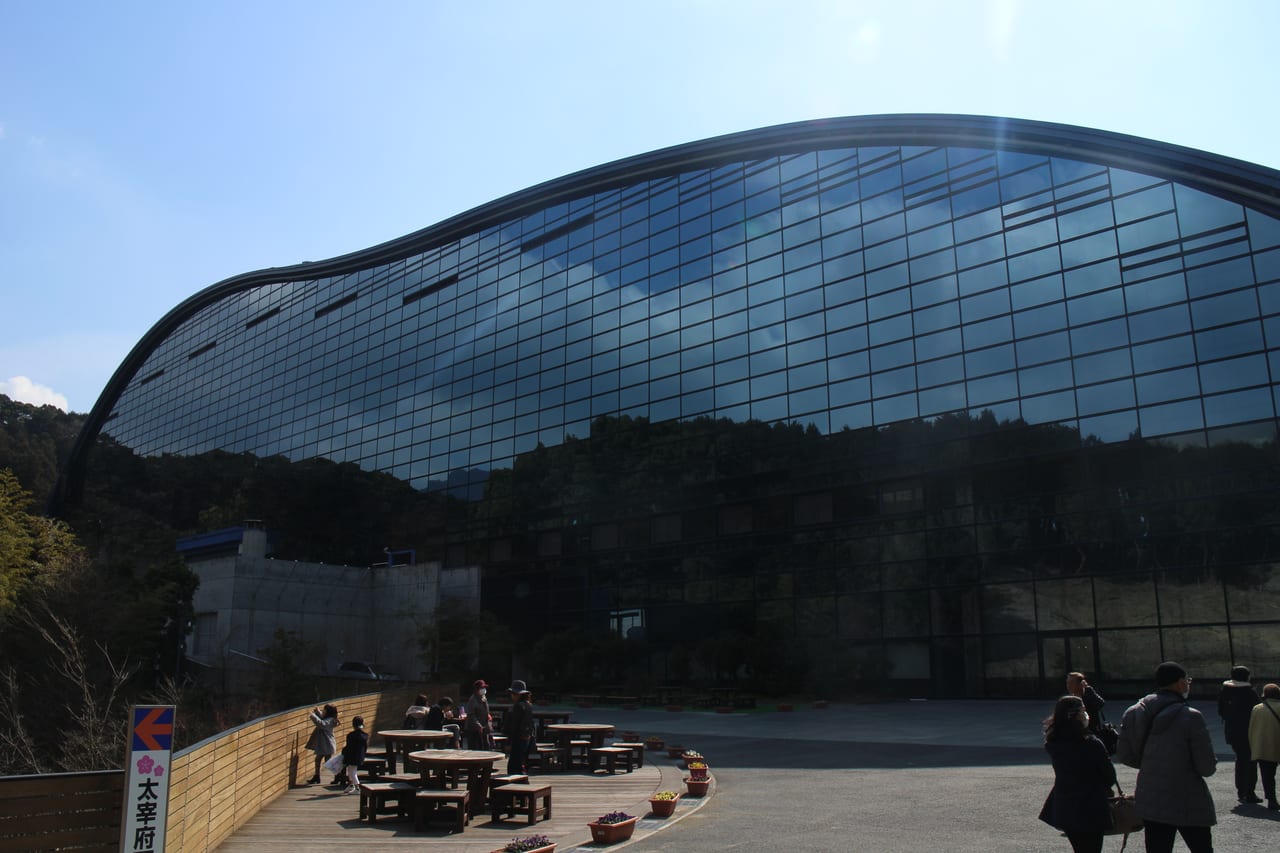
Finally, the Dazaifu orbit, where I must be candid. The "Komyozenji front-garden foliage" you'll see circulating online has an unstable viewing status in recent years — several sources (Japanese Wikipedia, specialist garden media) point to a long-term suspension since around 2018–2020 for interior renovation, and it was never on a fixed schedule; the Dazaifu city foliage page doesn't even list it, and I found no primary source confirming whether it opens in autumn 2026. So don't route it as a must-see; if you really want to try, call the temple (092-922-4053) or the Dazaifu tourism association first. For the Dazaifu orbit I'd steer you to Kamado Shrine (Homangu Kamado Jinja), which the city actually promotes — around 500 maples, average peak mid-to-late November, not far from Dazaifu Tenmangu on foot or by shuttle, a reliable choice that won't leave you at a locked gate. Dazaifu itself is about 33–44 minutes and around ¥400 from Nishitetsu Fukuoka (Tenjin) via a transfer at Nishitetsu Futsukaichi — an easy half-day out of Fukuoka.
Getting around: car vs transit, and a 2–3 day route from Fukuoka
Sum up the transit facts from every spot above and you get a clear conclusion: Kyushu foliage's dividing line is "do you rent a car or not." Mifuneyama has no weekday shuttle, Raizan Sennyoji switches to a reservation bus on weekdays, Yabakei buses run weekdays only, and Unzen and Kokonoe have thin direct transit — the shared fact is that weekday public options are thinner than on weekends. But I won't tell you "no car means no go," because most spots still have taxis or walking alternatives, and rail-reachable Dazaifu and Yufuin need no car at all.
So route by two traveler types. If you drive or will charter: start in Fukuoka and run a gorge-plus-onsen combo like "Mifuneyama (Saga) → Unzen (Nagasaki)" or "Yabakei + Kokonoe (Oita) → Beppu/Yufuin onsen" — a full 2–3 days. If you're rail-only: weight the trip toward the Fukuoka metro area — a half-day at Dazaifu (Kamado Shrine foliage plus Dazaifu Tenmangu), a rail day trip toward Yufuin, and hit Mifuneyama on a weekend using the free shuttle to dodge the weekday no-car trap.
Rail travelers covering several northern-Kyushu cities can consult the JR Kyushu Northern 3-day pass itinerary — the Northern Kyushu pass covers JR lines across Fukuoka, Saga, Nagasaki, Oita, and northern Kumamoto, from ¥15,000(成人 3-day) (the official over-the-counter price differs; the online booking system may show other discount fares, so go by the site at the time). Whether to buy is a simple trade-off: skip it for a Fukuoka-suburbs-only trip; it pays off once you're chaining cross-prefecture moves like Fukuoka + Nagasaki + Yufuin — list your target cities and compare against the sum of point-to-point fares.
To skip planning the Oita-direction rail and transfers yourself, there's an off-the-shelf day-tour option: a Yufuin-no-Mori scenic-train day trip from Fukuoka on Trip.com strings the popular sightseeing train, Yufuin, and Dazaifu into one line — good for anyone who wants several stops in a day without driving, with the autumn mountain colors along the route as a bonus. One very practical last note: Kyushu's mountains have many tunnels and patchy signal, and checking live status or rerouting on the fly all need data, so set up an unlimited eSIM before you fly and connect on landing — I use a KKday Japan eSIM; for how the five main eSIMs compare see the Japan eSIM guide. To compare inland-gorge foliage elsewhere, extend to the Korankei foliage guide, and for national timing return to the Japan Autumn Foliage guide.
Frequently Asked Questions
- Q1:When is Kyushu autumn foliage at its best in 2026?
- Kyushu is not a one-date destination, because elevation splits the peak into two layers. By historical convention (not a 2026 official forecast): Unzen Nitadake, at roughly 1,300 meters, is the earliest layer to turn, usually late October to early November; the lowlands and inland gorges (Mifuneyama Rakuen, Yabakei, Akizuki, Kikuchi Gorge, the Dazaifu area) mostly peak mid-November into early December. To catch the most in one trip, aim for mid-to-late November, when the lowlands are at full color and Unzen is at its tail. Remember these are averages, not a current-year forecast. The first 2026 forecast landed on September 3, 2026, when WeatherNews published its first round: nationwide, peak color runs later than or slightly later than normal, and on leaf condition Kyushu is the one exception — a hot, dry summer left Kyushu foliage in poorer shape this year, while the rest of Japan is better than last year. This year's official per-spot dates: Unzen Nitadake Nov 3, Kikuchi Gorge Nov 14, Mifuneyama Rakuen Nov 22, Takachiho Gorge Nov 26, Akizuki Nov 29 (WeatherNews spot pages, checked September 26, 2026) — so “aim for mid-to-late November” still holds this year. tenki.jp has published no 2026 peak-foliage forecast (its forecast page still shows the 2025 third round); only its daily colour-status tracker is live. Recheck about two weeks before you travel.
- Q2:When is the Mifuneyama Rakuen autumn festival in 2026, and is night or day better?
- The 2026 Mifuneyama Rakuen autumn festival runs November 6 to December 6, officially announced — the most solid, most time-sensitive fact in this guide. Daytime hours are 8:00–17:30 and night hours 17:30–22:00, open even in rain. Admission comes in three tiers: day-only or night-only is ¥600 adult / ¥300 elementary; a day-and-night combo ticket is ¥900 adult / ¥400 elementary. Which to choose? Mifuneyama's signature is what it bills as Japan's largest-scale foliage illumination, with lit maples mirrored in Kagami-ike pond — that is the night draw. Daytime shows the 13-hectare grounds and 170-year-old maples in full detail. If your schedule allows, I'd just buy the ¥900 combo, arrive around dusk, and see both natural light and the illumination for only ¥300 more.
- Q3:Does Mifuneyama Rakuen have a shuttle bus on weekdays?
- This is the easiest trap to fall into, so it goes first: the free shuttle from JR Takeo-Onsen Station north exit to Mifuneyama Rakuen runs only on Saturdays, Sundays, and national holidays (8:00–22:00, about 3 per hour, no reservation) — there is no free shuttle on weekdays at all. Weekday alternatives: JR Kyushu Bus's regular Ureshino line has paid weekday services stopping near the garden entrance (roughly ¥160–170, a 5–10-minute ride, infrequent), or drive or take a taxi (about a 10-minute ride; a sightseeing-taxi plan is roughly ¥10,200 for a small car for 2 hours). The weekday-versus-weekend gap is still large, so check return times before a weekday night visit, or simply schedule Mifuneyama on a weekend. Guests of Mifuneyama Rakuen ryokan and Chikurintei enter free.
- Q4:Do I have to drive to see Kyushu foliage, or can I reach it without a car?
- It is not that you cannot get there without a car, but Kyushu foliage spots are spread out and weekday public transit is noticeably thin, so a car adds a lot of flexibility. Two situations exist. In one, weekday transit is limited but alternatives remain: Raizan Sennyoji's regular weekday bus is replaced by a reservation-only community bus (advance sign-up required), Mifuneyama has no weekday shuttle but does have taxis, and the Yabakei buses run on weekdays only in a limited pattern. In the other, mountain spots (Unzen Nitadake, the Kokonoe Yume suspension bridge) have few direct public routes, so a car or charter is the practical call. If you only do the Fukuoka metro area plus rail-reachable spots like Dazaifu and Yufuin, no car is entirely feasible.
- Q5:How much is admission to Kikuchi Gorge and the Kokonoe Yume bridge — is a price hike coming?
- First, clear up a misconception: the Kokonoe Yume suspension bridge currently charges ¥500 for junior-high and up, ¥200 for elementary, and free for preschoolers, and this rate applies through the entire 2026 autumn, including the November peak. There is an official notice of a new pricing scheme, but it takes effect January 1, 2027, and it mainly adds discounts (free for town residents, 10 percent off for groups of 30+, ¥300 for school trips and for disabled visitors) — the general-visitor rate is not affected in 2026, so do not read it as "prices are about to rise, hurry." Kikuchi Gorge is ¥500 for high-school age and up (new scheme from April 17, 2026), with parking free from 2026. One key deadline at Kikuchi: the annual season closes on November 30, so finish your foliage visit before then.
- Q6:Can I still see the Dazaifu Komyozenji foliage?
- Honestly, I cannot give you a definite yes, so please do not build it into your route as a must-see. Komyozenji's front-garden foliage was once famous, but several recent sources (Japanese Wikipedia, specialist garden media) point to a long-term suspension of viewing since around 2018–2020 due to interior renovation, and it was never on a fixed opening schedule; the Dazaifu city tourism foliage page does not even list it anymore, and I found no primary source confirming whether it opens in autumn 2026. If you want to try, call the temple (092-922-4053) or the Dazaifu tourism association first. For the Dazaifu area I'd rather steer you to Kamado Shrine (Homangu Kamado Jinja), which the city actually promotes — around 500 maples, average peak mid-to-late November, reachable on foot or by shuttle from Dazaifu Tenmangu, and it won't leave you at a locked gate.
Read next
Japan Autumn Foliage 2026: Peak Forecast & 5-Region Guide
Region-by-region peak-forecast map from late-September Hokkaido to mid-December Kyushu, with itineraries and booking timing.
Kyushu 3-Day Rail Itinerary 2026
Yufuin no Mori + Aso Boy chain Hakata → Yufuin → Beppu → Kumamoto → Aso. JR Kyushu Pass saves ~¥2,500 post-hike.
Fukuoka Travel Guide 2027: Yatai, Hakata Ramen & Dazaifu
Kyushu's gateway and one of Japan's best food cities — yatai, Hakata ramen, and Dazaifu and Mojiko day trips.
📊 See the 2026 Price Index (JR Pass, DPA, eSIM, Airport Transport) →