In 1845, Nabeshima Shigeyoshi — the 28th lord of the Takeo domain — spent about three years building a 500,000-square-meter (150,000-tsubo) stroll garden at the western foot of Mount Mifune, a 210-meter peak in Takeo, Saga. That is Mifuneyama Rakuen. It holds some 200,000 azaleas, a wisteria of roughly 170 years, and in autumn what the garden officially bills as "Japan's largest" maple illumination. But the thing that makes it genuinely tricky — and where visitors get caught out — is that it runs seven official seasonal windows and four separate ticket systems: the same garden costs different money and shows different things depending on whether you come in spring, in autumn, or on an ordinary day. This guide lays out the 2026 official season calendar and each season's prices, tells you honestly whether the summer teamLab show is even happening in 2026 (it is not yet announced, and I will not guess), and covers the Takeo-Onsen gate worth pairing, the Rakan-no-yu hot spring, and a direct answer on whether it's worth the trip from Fukuoka. For the wider Kyushu foliage picture, start with the Kyushu autumn foliage guide; this is the single-spot deep dive on Mifuneyama.
- Four ticket systems, don't mix them up: off-season adult ¥500; spring festival adult ¥700; autumn day-or-night ¥600, day-and-night combo ¥900; summer teamLab is separately ticketed
- 2026 Momiji Festival: Nov 6–Dec 6 (officially set): day 8:00–17:30, night 17:30–22:00, billed as Japan's largest maple illumination
- teamLab "A Forest Where Gods Live" 2026 is unannounced — historically mid-July to early November; check teamlab.art before you go and ignore third-party dates and prices
- The free shuttle runs only on festival-period weekends, from the north exit: otherwise take the JR Kyushu Bus from the south exit (¥240, 8 min) or a taxi (3 km, 5 min)
- Pair the Takeo-Onsen romon gate: designed by Tatsuno Kingo in 1915; its four zodiac ceiling carvings complete the twelve with Tokyo Station's
📖 Table of Contents (click to expand)
- The 2026 season calendar: what to see when, and each price
- Momiji Festival 2026: day maples vs night illumination
- teamLab "A Forest Where Gods Live": the honest 2026 status
- History: Nabeshima Shigeyoshi and a nationally designated scenic spot
- Access: from Hakata, and two ways from Takeo-Onsen Station
- Mifuneyama Rakuen Hotel and Rakan-no-yu
- Eat and shop: the Takeo-Onsen gate and Saga beef
- Beating the crowds and a direct "is it worth it" answer
- FAQ
The 2026 season calendar: what to see when, and each price
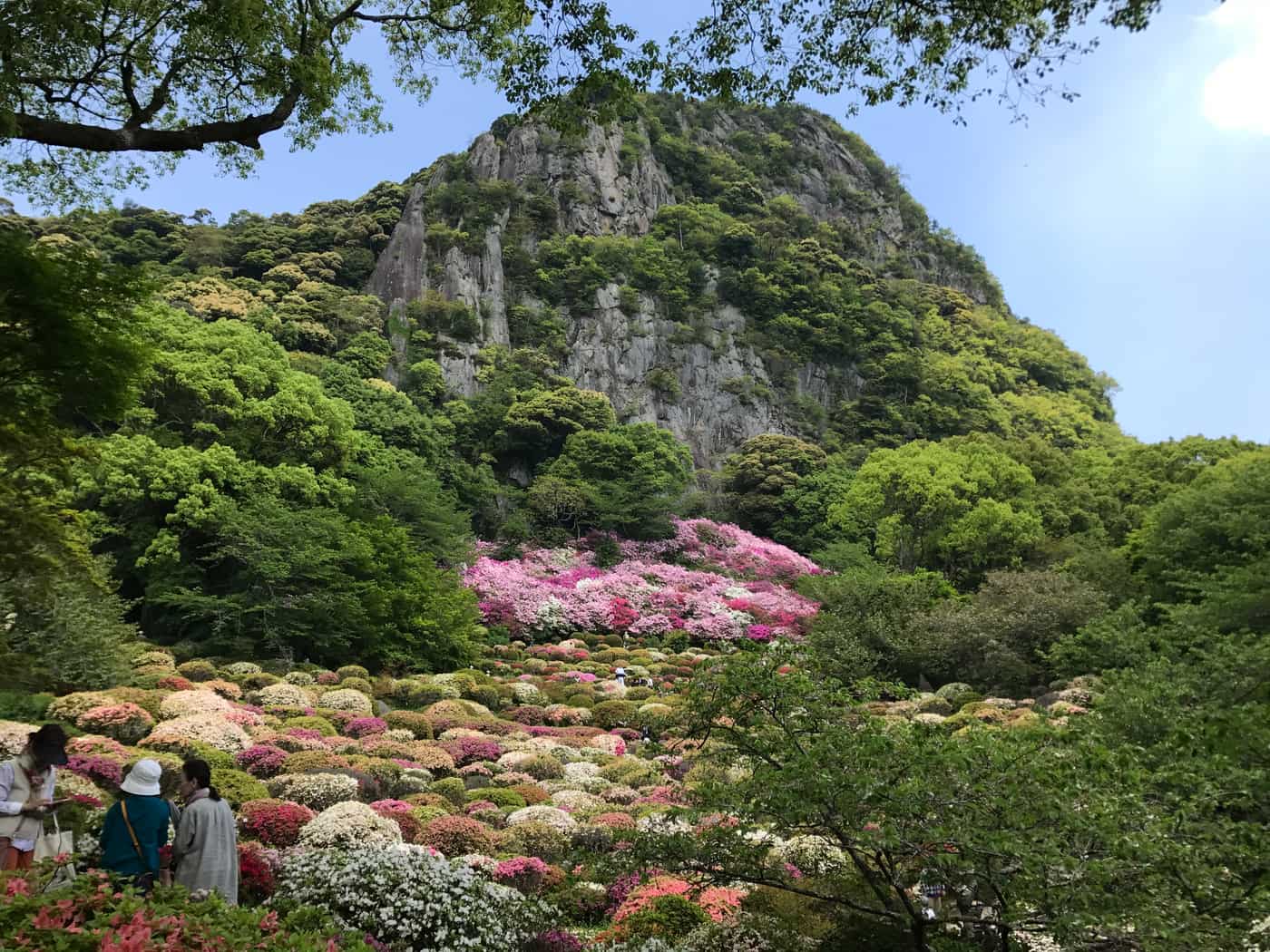
Here is the practical thing to grasp first: Mifuneyama Rakuen is not "a spot," it is a garden that changes skin with the seasons. For 2026 the operator has split the year into seven windows, each with its own star attraction, opening hours, and price. If all you found was "autumn ¥900" and you book on that, you may turn up on an ordinary off-season day and never need that ticket. Here is the official 2026 calendar:
| Window | 2026 official dates | Highlight |
|---|---|---|
| Cherry blossom festival | Mar 13–Apr 5 | The early-spring run of about 2,000 cherry trees |
| Flower festival (azaleas, wisteria, spring maples) | Apr 6–May 6 | ~200,000 azaleas plus a ~170-year wisteria; the main spring window |
| Reverse-reflected maples and satsuki | May 7–May 31 | Fresh green mirrored in the Kagami pond, satsuki azaleas closing out |
| Rainy reflections and hydrangea | Jun 1–Jul 17 | Rainy-season hydrangea and reflections in the wet |
| Early autumn "water moon and insect song" | Nov 5 | A single early-autumn day before the maple run |
| Momiji Festival | Nov 6–Dec 6 | Japan's largest maple illumination; the main autumn window |
| Winter dormancy | Dec 7–Mar 11, 2027 | The quiet, bare-branch winter garden |
Matching the prices: off-season (outside any festival window) is adult (junior-high and up) ¥500, elementary ¥300, open 8:00–17:00; the spring flower festival is adult ¥700, elementary ¥450, open 8:00–18:30, no closing days and open in rain; the autumn Momiji Festival has a more complex ticket, covered next. Notice one detail: on the calendar, the Jul 18–Nov 4 stretch is a gap with no listed flower window — historically the teamLab summer run. You can treat that as circumstantial evidence the slot may be reserved, but it does not prove a 2026 edition (see the teamLab section).
My take is simple: the two genuine peaks worth traveling for are spring azaleas and autumn night maples; the other windows (fresh green, hydrangea, winter dormancy) suit people already staying in Takeo Onsen who want a stroll, not a special trip. Match your date to the table above before deciding which ticket to buy.
Momiji Festival 2026: day maples vs night illumination
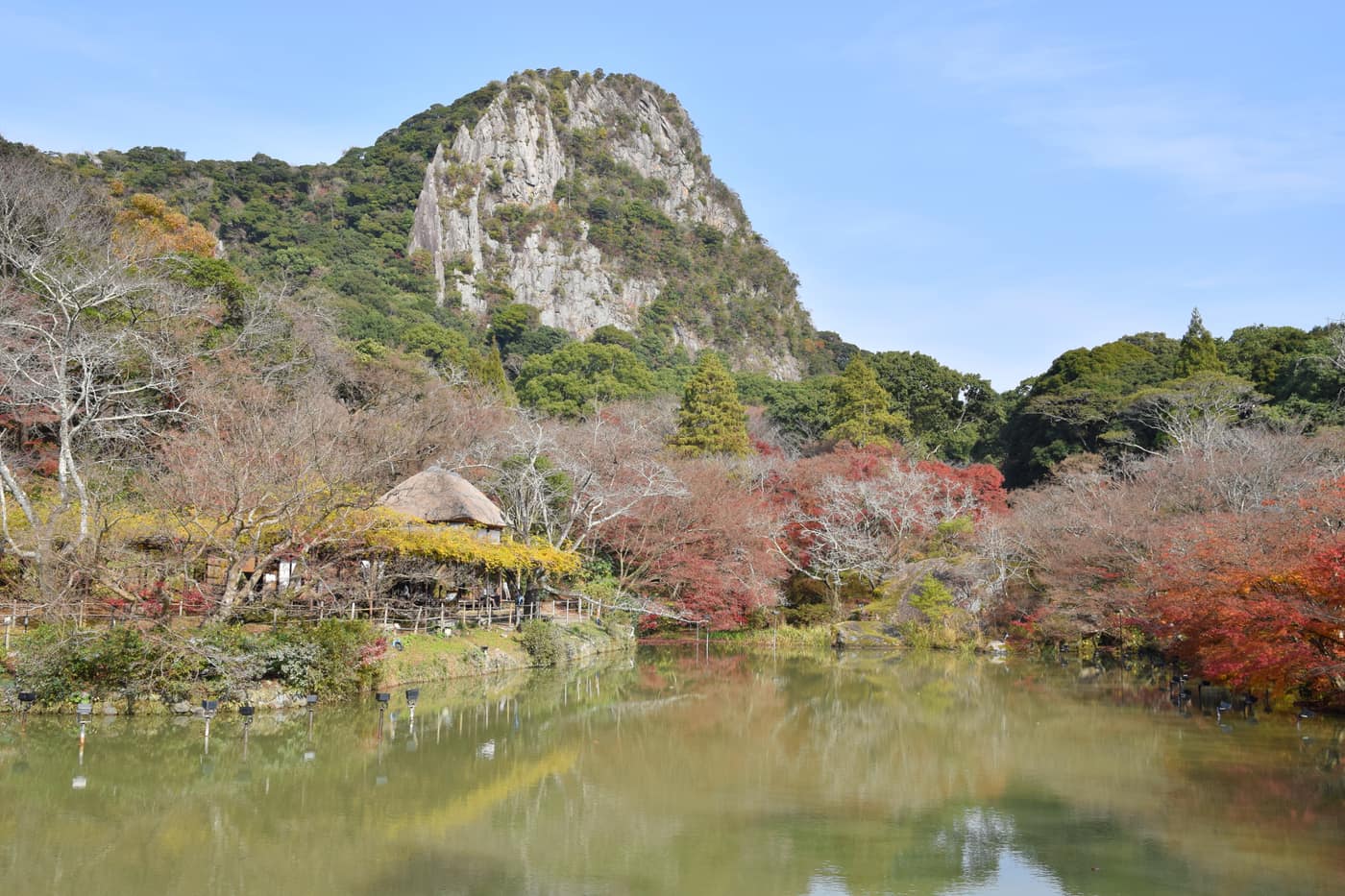
The 2026 Momiji Festival is officially set for November 6 to December 6, and it is the garden's most time-sensitive, most trip-worthy window. Opening runs in two blocks: day 8:00–17:30, night 17:30–22:00, open in rain. The operator promotes it directly as "Japan's largest maple illumination" — floodlit maples mirrored in the Kagami pond, with the sheer Mount Mifune cliff behind, a composition that sets it apart from other Kyushu foliage spots.
There are three ticket options; here is how I'd choose. A single day or night ticket is adult (junior-high and up) ¥600, elementary ¥300; the day-and-night combo is adult ¥900, elementary ¥400. My call: if you're here for the illumination pick night, and if your schedule allows, just buy the combo. Daytime shows you the garden's terrain, the old maples' layers, and the wisteria trellis; night is Mifuneyama's true signature. The combo costs only ¥300 more than a single ticket but lets you enter around dusk at the day-night boundary and catch both natural light and illumination in one visit — the best value if you've traveled to get here.
One caveat: peak color and festival dates are not quite the same thing. Nov 6–Dec 6 is the official event period, but the days of fullest color shift a few days each year with how early the cold arrives — same as foliage everywhere in Japan — so recheck the current-year forecast about two weeks before you go. For the wider Kyushu timing (Unzen colors first, the lowlands later), see the Kyushu section of the Japan autumn foliage guide.
teamLab "A Forest Where Gods Live": the honest 2026 status
Much of Mifuneyama's recent international fame comes from teamLab's nighttime digital-art show "A Forest Where Gods Live" — turning the whole centuries-old garden into a canvas of light and interactive installations. A lot of people discover Mifuneyama through it. But I have to layer this honestly, because teamLab had announced nothing for 2026 when I checked.
The confirmed facts first: as of July 21, 2026, teamLab's official exhibition list shows the most recent "A Forest Where Gods Live" entry as "2025.7.18–11.03, ENDED," and neither the "on view" nor the "upcoming" lists include a 2026 session. In other words, teamLab has not yet announced whether 2026 will happen. Historically the show falls roughly mid-July to early November (the 2025 actual dates were Jul 18–Nov 3), and the Jul 18–Nov 4 gap in the season calendar above aligns with that slot — but that is only circumstantial, and cannot be used to declare a 2026 edition confirmed.
A specific warning: if you find concrete-looking "2026, Jul 18–Nov 3, weekday ¥1,200 / weekend ¥1,600" figures, compare them with the paragraph above — those are the 2025 dates and the 2025 prices, relabelled. Do not copy them. There is only one correct move: before you travel, check teamlab.art (or mifuneyamarakuen.jp) for the current official notice to confirm whether it runs this year and at what dates and prices. The teamLab show is a separately ticketed night event apart from daytime garden admission; whether you also need a daytime ticket is likewise per the official ticketing page.
One reassuring thing I can state plainly: even if the summer run doesn't happen, the garden also holds a permanent teamLab work, "Ruins and Ghosts: A Tea Ceremony of Sweating," installed since November 2021 and listed on teamLab's official exhibition list as on view / permanent. I did not verify its location, standalone price, or hours this time, so I won't state them — but it's confirmed that Mifuneyama has a permanent teamLab piece even out of season; check the official site for details.
History: Nabeshima Shigeyoshi and a nationally designated scenic spot
Mifuneyama Rakuen is not a modern tourist garden — it has nearly 180 years of history. In 1845, Nabeshima Shigeyoshi, the 28th lord of the Takeo domain, spent about three years completing this stroll garden of 150,000 tsubo (roughly 500,000 square meters). The name comes from Mount Mifune behind it — 210 meters high, where legend says Empress Jingu moored her ship ("mifune") on the way back from her Silla campaign; it is still Takeo's landmark peak.
Shigeyoshi's craft was distinctive: he had painters of the Kyoto Kano school draft the layout before construction, then built to the drawings — he studied Kano-school painting himself, under the art name "Kaishunsai," so in a sense the garden is a painting made real. Shigeyoshi (1800–1862) is an interesting figure in his own right: he was an early adopter of Western military science in his domain, studied under Takashima Shuhan, and deeply influenced Nabeshima Naomasa, later counted among the "Seven Wise Men of Saga." The garden was registered as a national scenic spot in 2010, which lifts it above an ordinary flower park — you are walking not just flowers but a preserved slice of late-Edo garden history.
For a traveler, the practical meaning is this: Mifuneyama's beauty does not depend only on bloom season. Even outside the azalea or maple peaks, the sheer cliff, pond reflection, and the bones of the old trees remain — which is exactly why even "fresh green" and "winter dormancy" each earn their own official window.
Access: from Hakata, and two ways from Takeo-Onsen Station
Mifuneyama's access is friendlier than most Kyushu foliage spots, thanks to how close it sits to Takeo-Onsen Station. Two legs.
Leg one: Hakata → Takeo-Onsen Station
From Hakata Station, ride the limited express "Midori" or "Relay Kamome" to Takeo-Onsen Station in about 60 minutes, reserved ordinary-seat fare around ¥3,130 (varies by ticket type and time; go by JR Kyushu's current listing). A common misconception to clear up: you do not need the Shinkansen for Takeo. Takeo-Onsen is the terminus of the Nishi-Kyushu Shinkansen (Takeo-Onsen–Nagasaki), but that line is for passengers transferring onward to Nagasaki; to reach Takeo itself, the conventional-line limited express goes there directly — don't let "Shinkansen terminus" mislead you into thinking you must ride it.
Leg two: Takeo-Onsen Station → Mifuneyama Rakuen
This is where most people get caught out, because the free shuttle and weekday transit are two different things:
| Option | When / duration | Cost | Notes |
|---|---|---|---|
| Free shuttle bus | Festival period (Nov 6–Dec 6), Sat/Sun/holidays only 8:00–22:00, 3 round trips/hr | Free | North exit; no reservation; nothing outside the festival |
| JR Kyushu Bus "Ureshino Line" | 14 departures on weekdays, 13 on Sat/Sun/holidays 8 min out, 12 min back | ¥240 adult / ¥120 child | South exit toward Ureshino, get off at "Mifuneyama Rakuen"; last bus back 18:56 |
| Taxi | ~5 min (3 km) | Metered | Backup for tight schedules or heavy luggage |
| Sightseeing charter (2 hrs, Takeo city) | 9:00–17:00, year-round | ¥10,200 small car (4) / ¥15,000 large (9) | Romon gate, the great camphor and Mifuneyama in one loop; runs for one passenger |
An important clarification: weekdays are not transit-free, and a taxi is not your only option — the south exit of Takeo-Onsen Station has regular paid JR Kyushu Bus services on the Ureshino Main Line (toward Ureshino Onsen, alighting at "Mifuneyama Rakuen"), running both weekdays and holidays, ¥240 for an adult, 8 minutes out. So the real difference is: a free shuttle on festival-period weekends, the paid JR Kyushu Bus on every other day — and they use different exits: the free shuttle the north, the JR Kyushu Bus the south. A taxi is for those who value time or carry luggage. Practical advice: enjoy the free shuttle on weekends; on weekdays check the JR Kyushu Bus timetable first, or keep a taxi plan handy. Checking live schedules and rerouting on the fly needs data, so sort your mobile network before you go and connect on landing rather than hunting for Wi-Fi at the station — compare the five Japan eSIM options; for how the five main options compare, see the Japan eSIM guide.
If you would rather not deal with any of that: the same coach tour, on two platforms
The price is the surprising part. A day-tour coach from Fukuoka strings together Kunen-an, Yutoku Inari, Mifuneyama Rakuen and the Forest of Environmental Art, and both listings state that admission to Mifuneyama Rakuen is included. Set that against doing it yourself: a reserved-seat limited express from Hakata to Takeo-Onsen and back runs a little over ¥6,000, and you still pay the autumn admission on top. The money lands in much the same place, but you look up no timetables at all that day.
Here is how the two channels differ; take your pick:
| GetYourGuide | KKday | |
|---|---|---|
| Price as checked | US$49.56 | NT$1,429 |
| Reviews | 8,849 at supplier level | 5.0, but from four reviews |
| Lunch | Not listed | Included (a Saga speciality lunch) |
| Mifuneyama Rakuen admission | Included | Included |
| Kunen-an admission | — | Not included; ¥1,000 per person on the day |
| Language | — | English and Mandarin guiding |
| Other | — | 10 hours, free cancellation to two days out, minimum four to run, children 3–12 at the adult rate |
⚠️ The season runs 14 November to 10 December only — this is a seasonal product and no other dates are bookable.
⚠️ Two trade-offs apply to both channels. First, Kunen-an is only open 14–29 November; outside those dates the operator substitutes Nibiyama Shrine, and the KKday itinerary prints that condition on the page. The same product shows you different things depending on your date. Second, a coach tour cannot stay for the end of the illumination: the KKday itinerary reads "14:00 Mifuneyama Rakuen (40 minutes)", so you leave at 14:40, while the evening lighting runs 17:30 to 22:00. If you want to set your own pace, or stay until the lights go off, take the train.
GetYourGuide: see the itinerary and availability for your date
KKday: Kyushu autumn day tour (Mifuneyama admission and lunch included)
Mifuneyama Rakuen Hotel and Rakan-no-yu
If you plan to make Mifuneyama an overnight trip, the Mifuneyama Rakuen Hotel (and its sister ryokan, Chikurintei) is itself a draw. The biggest perk is blunt: hotel guests enter the garden free — for spring azaleas or autumn maples alike, guests are not bound by the festival ticket, so "night maples" and "hot-spring ryokan" become one evening. Watch the illumination until 22:00, walk straight back to the ryokan, and soak — a combination day-trippers can't have.
The ryokan's signature is the hot spring "Rakan-no-yu," and it isn't only for guests — it opens for day-use bathing that non-guests can reserve. Day-use prices vary by day and slot: weekdays roughly ¥4,250–¥4,850, weekends/holidays roughly ¥4,850–¥5,450 (tax included; men's and women's baths rotate by slot). It runs in five 2.5-hour slots and requires a reservation — book up to two months ahead by phone (0954-23-3131, 11:00–21:00) or online. Some restrictions up front: children of junior-high age and below cannot use it, same-sex groups of four or more cannot reserve, and people with tattoos or who are intoxicated are refused entry — worth noting if you have kids or a group of same-sex friends. Hotel guests use Rakan-no-yu free.
One last easily-confused point: "free Rakan-no-yu for guests" and "teamLab tickets" are separate. What's officially confirmed is that Rakan-no-yu is free for guests; there is no stated teamLab discount or free entry for hotel guests — don't extrapolate one. To see teamLab (if it runs that year), go by the official ticketing page.
Eat and shop: the Takeo-Onsen gate and Saga beef
Mifuneyama sits in Takeo, itself a hot-spring town, so don't rush off after the garden. About 5–10 minutes away, the Takeo-Onsen "romon" gate is the add-on I most want to recommend — and it hides a great story. This vividly colored vermilion gate — in the "ryugu-mon" style, so named because it evokes the mythical Dragon Palace — was raised in 1914 and completed in 1915, built without a single nail, designed by none other than Tatsuno Kingo, the architect of Tokyo Station; it was designated a national Important Cultural Property in 2005.
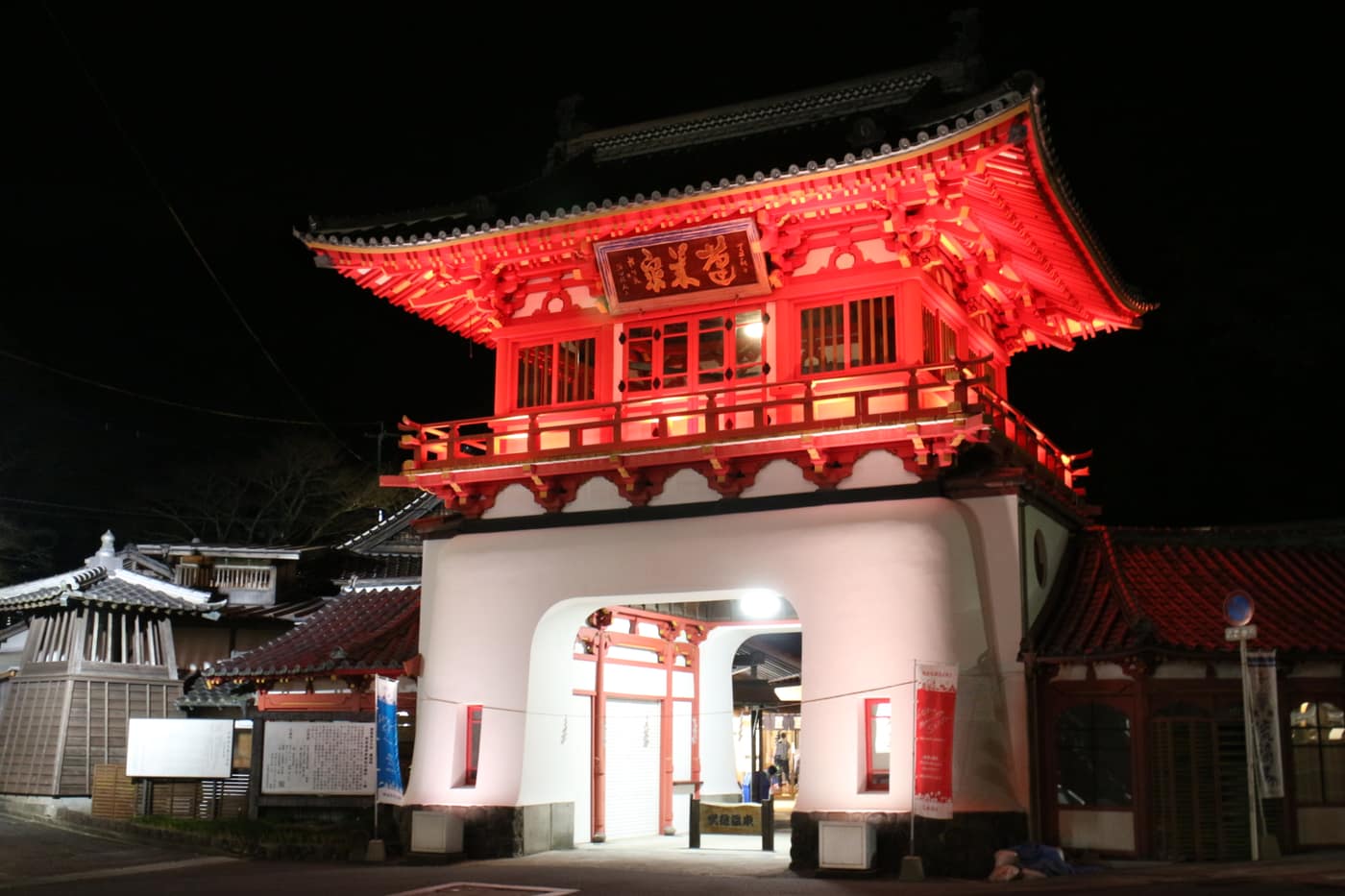
What's genuinely fascinating: during 2013 restoration work, craftsmen found four zodiac carvings on the gate's second-floor ceiling — rat, rabbit, horse, and rooster. Tatsuno Kingo's Tokyo Station Marunouchi dome ceiling has exactly eight zodiac carvings; put the two together and they complete all twelve. Because both came from the same architect, this is read as a deliberate touch he left behind. If you've been to Tokyo Station and then come to Takeo, there's a real thrill in connecting the two across a century — a depth of visit few people know about.
For food, the regional beef brand for Takeo and all of Saga is "Saga beef" (famed for its "tsuyasashi" marbling — not the sometimes-mislabeled "Takeo beef"; Takeo has no separate beef brand, so it's Saga beef). Local bites you'll see include "Kitagata champon," the "Takeo burger" (Wakakusu pork plus a domestic-beef patty, available to go), and nearby Omachi's "Omachi taromen"; for sweets, the "Takeo Onsen smooth pudding" and the madeleine-style "Takeo reine." For souvenirs, the Takeo Onsen Bussankan stocks Saga staples like Ureshino tea, Ogi yokan, and marubolo. (One myth to bust: the "Takeo lemon milk" you occasionally see online does not exist — "lemon milk" is a local drink from Tochigi Prefecture, unrelated to Takeo or Saga, so don't be misled.)
Where to actually eat it (with maps)
So where do you find all of the above? These are the representative shops with verified names and addresses (checked July 21, 2026; hours and closing days can change, so confirm the latest notice before you go):
- Takeo burger | TKB AWARDS — a butcher-shop-turned-burger-joint using Wakakusu pork blended with domestic beef; takeout available; closed Mondays. 7811-5 Tomioka, Takeo-cho, Takeo (map)
- Kitagata champon | Ide Champon main shop — founded 1949, the flagship of the Route 34 "champon road," rich pork-bone broth under a mountain of crisp vegetables; closed Wednesdays. 1928 Shiku-Takano, Kitagata-cho, Takeo (map)
- Omachi taromen | Kazokuan — taromen began as a beef-bone-and-ginger noodle soup for Omachi's Showa-era coal miners; this shop, open since 1985, leans gentle on the seasoning; call ahead for hours. 978-1 Kami-Omachi, Omachi (map)
- Smooth pudding, Takeo reine & souvenirs | Takeo Onsen Bussankan — the "Takeo Onsen purin" is ¥320 a jar and won the pudding division of Saga's 2024 sweets vote; the Takeo reine, Ureshino tea, Ogi yokan, and marubolo are all under this one roof. Open 8:50–17:15, closed only January 1. 805 Showa, Takeo-cho, Takeo (map)
- Saga beef | Sagaya Takeo main shop — a certified A5-grade Saga beef restaurant with grill-it-yourself charcoal shichirin tables, about 5 minutes on foot from Takeo-Onsen Station; opens 17:30, closed Mondays — a natural closer after the night foliage. 3-12 Showa, Takeo-cho, Takeo (map)
One easy misunderstanding to head off: the Bussankan also offers a seasonal "Saga beef toban steak" set, but the official terms require booking 2 days ahead with a minimum of 5 people on the same menu — it is not a walk-in option, so spontaneous solo or duo travelers should simply go to Sagaya.
Beating the crowds and a direct "is it worth it" answer
First, crowds. The peak crush for Mifuneyama's night maples concentrates from when the lights first come on until roughly 8 p.m., especially on weekends. To shoot the pond reflection in relative calm, I'd target two windows: a weekday (same maples, far fewer people — the trade-off being you sort your own JR Kyushu Bus or taxi); or, on a weekend, enter early at the 17:30 day-night boundary as the daytime crowd files out and claim your spot. That's also the payoff of the combo ticket — you finish the daytime garden, wait in place for the illumination, and never fight for position at the entrance.
Now the question everyone asks: is Mifuneyama worth a special trip from Fukuoka? My answer — in the right season, yes. Three reasons: one, access is easy — a one-hour express from Hakata reaches Takeo-Onsen directly, far simpler than mountain spots like Unzen or Yabakei with no weekday transit; two, it's a "one garden, many uses" — beyond foliage you can pair a hot-spring stay and the Tatsuno Kingo gate, so a single trip is dense; three, the autumn Momiji Festival (Nov 6–Dec 6) has firm official dates, easy to plan around, unlike pure natural-peak timing that gambles on the weather.
So which season is most worth the trip? Straight answer: first, autumn night maples (firm dates, the most talked-about scene, Japan's largest illumination); second, spring azaleas (Apr 6–May 6, 200,000 azaleas plus the 170-year wisteria, the most overwhelming in scale). The summer teamLab show, if it runs, is a unique experience — but 2026 is unannounced, and I won't tell you to book flights for an undecided window. The other windows (fresh green, hydrangea, winter dormancy) suit people already staying in Takeo Onsen, not a special trip. To slot Mifuneyama into a Kyushu rail itinerary, see the JR Kyushu northern 3-day pass itinerary — list the cities you want first, then decide whether the pass pays off. Sort your mobile network before you fly; I set up a landing-ready compare the five Japan eSIM options online to skip the airport counter queue.
Frequently Asked Questions
- Q1:How much are Mifuneyama Rakuen tickets? Do prices change by season?
- Yes — this is the single most confusing thing about Mifuneyama, because it runs four completely separate ticket systems. Off-season (no festival): adult (junior-high and up) ¥500, elementary ¥300. Spring Flower Festival (azaleas and wisteria, 2026 dates Apr 6–May 6): adult ¥700, elementary ¥450. Autumn Momiji Festival (2026 dates Nov 6–Dec 6): a single day OR night ticket is adult ¥600 / elementary ¥300, while a day-and-night combo ticket is adult ¥900 / elementary ¥400. The summer teamLab exhibition is a separately ticketed night event. Check which window your date falls into before you buy, because both the price and the opening hours differ. Guests staying at the Mifuneyama Rakuen Hotel or Chikurintei enter the garden free.
- Q2:Is the teamLab "A Forest Where Gods Live" running in 2026?
- As of July 21, 2026, teamLab has not announced a 2026 edition. On teamLab’s official exhibition list, the most recent entry for "A Forest Where Gods Live" reads "2025.7.18–11.03, ENDED," and neither the "on view" nor "upcoming" lists show a 2026 session. Historically this night exhibition runs roughly mid-July to early November (the 2025 actual dates were Jul 18–Nov 3), but whether it happens this year, and at what price, will only be confirmed on teamlab.art closer to the date — I will not invent those numbers for you. Ignore third-party aggregator sites that already list specific "2026" dates and prices; several appear to be last year’s figures mislabeled. Separately, the garden also hosts a permanent teamLab work, "Ruins and Ghosts: A Tea Ceremony of Sweating," installed since 2021, so even outside the summer run there is a teamLab piece on site (check the official site for its hours and price).
- Q3:How do I get to Mifuneyama Rakuen from Fukuoka (Hakata), and is it worth the trip?
- Access is friendlier than most people expect. From Hakata Station, take the limited express "Midori" or "Relay Kamome" to Takeo-Onsen Station in about 60 minutes (reserved ordinary seat fare around ¥3,130, varying by ticket type and time). Note you do not need the Shinkansen to reach Takeo itself — Takeo-Onsen is the terminus of the Nishi-Kyushu Shinkansen, but that line is for transferring onward to Nagasaki; for Takeo you just ride the conventional-line limited express straight there. From the station it is about 5–10 minutes by bus or taxi to the garden. Worth it? If you come during the autumn foliage window (Nov 6–Dec 6) or peak spring azaleas, yes — a one-hour express from metro Fukuoka reaches a garden of this scale, far easier than mountain spots like Unzen or Yabakei that have almost no weekday transit.
- Q4:Is there a weekday shuttle to Mifuneyama Rakuen? What if I don’t drive?
- This is the trap to know up front: the free shuttle runs only during the autumn festival (Nov 6 – Dec 6), and only on Saturdays, Sundays and public holidays — from the north exit of JR Takeo-Onsen Station, 8:00–22:00, three round trips an hour, free and no reservation. No other season has a shuttle, weekends included. On the days without one, use the south exit (a different side of the station): the JR Kyushu Bus "Ureshino Line" runs regular services to the "Mifuneyama Rakuen" stop, 8 minutes, ¥240 for an adult. Weekdays have 14 departures, roughly hourly, first at 7:10 and last at 19:20; the last bus back leaves the garden at 18:56, so after the 22:00 night viewing there is none — that is what the free shuttle is for. Pressed for time or carrying luggage? The garden is only 3 km from the station, about 5 minutes by taxi. If you want to see Romon gate, the great camphor at Takeo Shrine and Mifuneyama in one go, there is a two-hour Takeo sightseeing charter: ¥10,200 for a small car (4 people), ¥15,000 for a large one (9 people), and it runs for a single passenger too.
- Q5:Can non-guests use the hotel’s Rakan-no-yu hot spring?
- Yes — Rakan-no-yu offers day-use bathing that non-guests can reserve. Prices vary by day and time slot: weekdays roughly ¥4,250–¥4,850, weekends/holidays roughly ¥4,850–¥5,450 (tax included; the men’s and women’s baths rotate by slot). It operates in five 2.5-hour slots and requires a reservation — book up to two months ahead by phone (0954-23-3131, 11:00–21:00) or online. A few restrictions matter: children of junior-high age and below cannot use it, same-sex groups of four or more cannot reserve, and people with tattoos or who are intoxicated are refused entry. Hotel guests use Rakan-no-yu free. Note that "free Rakan-no-yu for guests" and "teamLab tickets" are two separate things — the official site does not state any teamLab discount for hotel guests, so do not assume one.
- Q6:What can I see at Mifuneyama Rakuen across the four seasons?
- Mifuneyama is one of the rare gardens with a distinct theme every season. Per the 2026 official calendar: cherry blossom festival Mar 13–Apr 5; the main spring festival (azaleas, wisteria, spring maples — about 200,000 azaleas plus a wisteria of roughly 170 years) Apr 6–May 6; "reverse-reflected maples and satsuki" May 7–May 31; "rainy reflections and hydrangea" Jun 1–Jul 17; an early-autumn single day Nov 5; the Momiji Festival (billed as Japan’s largest maple illumination) Nov 6–Dec 6; and winter dormancy Dec 7–Mar 11, 2027. The mid-July to early-November gap is historically the teamLab summer run, though 2026 is unannounced. If you can only visit once, I’d pick the autumn night maples — it is the one window with firm official dates and the most striking scene.
Read next
Kyushu Autumn 2026: Mifuneyama, Unzen & Yabakei Guide
Mifuneyama 2026 illumination dates are out — Kyushu foliage is scattered, so here is the drive-vs-rail verdict.
Japan Autumn Foliage 2026: Peak Forecast & 5-Region Guide
Region-by-region peak-forecast map from late-September Hokkaido to mid-December Kyushu, with itineraries and booking timing.
Kyushu 3-Day Rail Itinerary 2026
Yufuin no Mori + Aso Boy chain Hakata → Yufuin → Beppu → Kumamoto → Aso. JR Kyushu Pass saves ~¥2,500 post-hike.
📊 See the 2026 Price Index (JR Pass, DPA, eSIM, Airport Transport) →