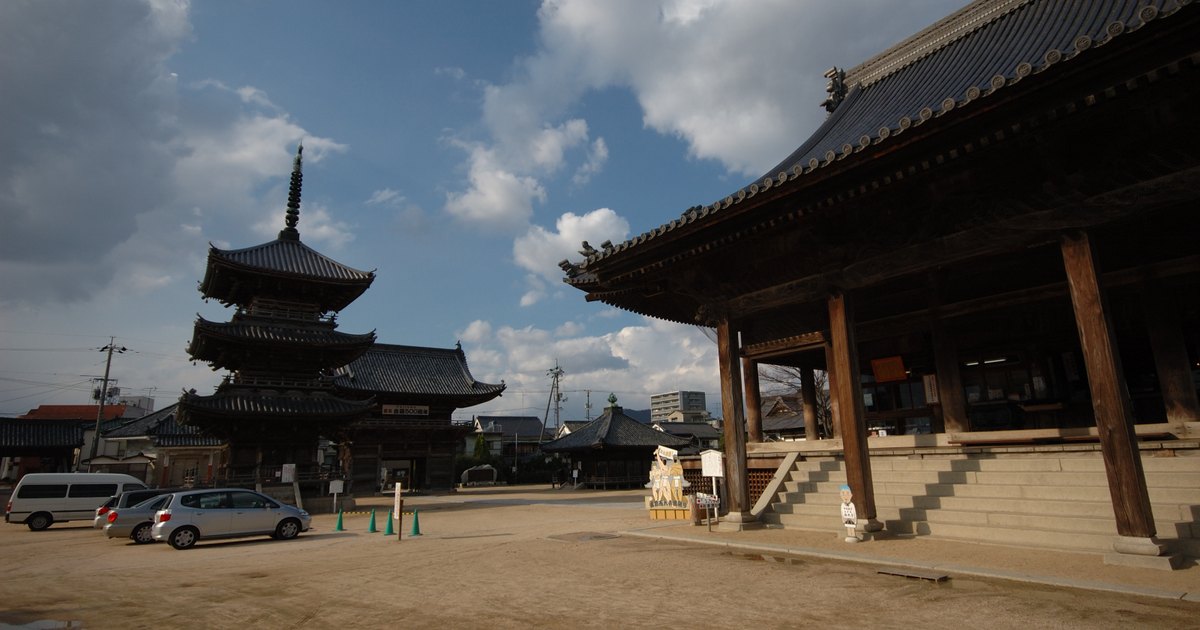
Two men did not go home after the night of February 21, 2026. Three weeks later the organisers of Saidaiji Eyo wrote that they would review the very nature of the festival and rethink it fundamentally — and as of today, not one detail of how the February 2027 edition will run has been published. The organisers have given a single time marker for that: around October 2026. This guide separates three things that are easy to blur together: what is settled, what is not, and which page to check when the October announcement lands. It also sets out the 2026 rules in full, because those rules are exactly what is being reviewed — without them, the October announcement will tell you nothing about what changed.
This guide is about the current status of the festival itself. For planning days around Okayama city and the Kurashiki Bikan district, see the Okayama and Kurashiki travel guide.
- February 2027 is on the calendar; the format is not decided. The organisers' word is "scheduled", and the details are due around October 2026.
- Two timelines, two decision-makers. The 2027 edition is the organisers' own call; the external review committee's recommendations explicitly cover February 2028 onward.
- Every participation rule you can look up right now is from the 2026 edition. Applications, kit, entry hours, disclaimers — read all of it as "last year's".
- There is no insurance. The regulations state the organisers accept no liability at all, including for the outcome of first aid.
- Participants are told to wear their blood type. A name tag goes on the front of the loincloth, and the stated reason is to respond in the event of an accident.
- The official English page is currently wrong. It still gives February 21, 2026 as the next edition and never mentions the deaths.
📖 Contents
- Two men did not go home after February 21, 2026
- What have the organisers actually announced for 2027?
- Is one body deciding the festival's future?
- What date is it in 2027?
- What did the rules look like last time?
- Is anyone insured?
- Can women take part?
- How do you watch without taking part?
- What does the official English page say right now?
- Three dates ahead
- Appendix: official Japanese wording
Two men did not go home after February 21, 2026
This is the ground everything else stands on, so take it first — and only as the organisers stated it.
Four statements signed by the chairman of the Saidaiji Eyo Hosankai were published between February 22 and March 17, 2026. The first said that several participants had been injured and taken to hospital by ambulance, and that the cause and the detailed circumstances were under investigation in cooperation with the police, the fire service and other agencies. The February 27 statement said that of three people left unconscious and in critical condition, one had regained consciousness while two remained in an extremely serious state. The statements of March 9 and March 17 reported that those two had died. The head priest of Kinryozan Saidaiji issued a separate signed document on March 17 confirming the deaths of two men.
That is the full extent of what has been made public. The cause has not been released, and neither has the total number of injuries. The March 9 statement still described the cause as under investigation, and by July the inquiry had been formally handed to an external committee. No account of how the deaths happened has come from the organisers.
One sentence in the March 9 statement set the direction for everything that followed, and it deserves quoting directly: the Hosankai wrote that it would discuss and examine the very nature of Eyo itself together with related bodies, and review it fundamentally. That was published after the first death and before the second.
There is also a juxtaposition worth knowing about, because it has a practical consequence. On February 22, two official things existed at once: the Hosankai's notice of the injuries, and the temple's routine report on the 517th edition — two shingi, six fukuotoko, the times the shingi were handed in, and no mention of any incident. Same day, same festival, two documents. No comment is needed on that, but it explains a research problem: depending on which official page you land on, you can come away with a completely different picture of February 2026.
What have the organisers actually announced for 2027?
One sentence: February of Reiwa 9 is "scheduled", everything else is undecided, and the details come around October.
The Hosankai statement of July 27, 2026 is the only official text about the 2027 edition. It says the specific content of the 518th Saidaiji Eyo, scheduled for February of Reiwa 9, is currently under careful review within the Hosankai, and that this specific content is due to be announced around October of this year.
Unpacked, that single sentence answers more than it first appears to:
| Question | Official answer as of September 6, 2026 |
|---|---|
| Will there be an edition in February 2027? | Yes — the word used is "scheduled" |
| Which day? | Never published (only "February") |
| Will the naked participation run as before? | Undecided — covered by "specific content" |
| Applications, eligibility, kit? | Undecided |
| Will paid spectator seats be sold, and at what price? | Undecided |
| When will we know? | Around October 2026 |
"Specific content" is a wide phrase. It does not only mean the date; it means how the edition is to be run, including the central question of whether the scramble for the shingi happens in its usual form. The organisers have neither ruled anything out nor signalled a direction.
So structure your planning around that: book nothing non-refundable before the October announcement. February is not peak season in Okayama, so there is little pressure to lock rooms and flights half a year out, and paid spectator tickets last time did not go on sale until late January — comfortably after October.
Which page should you watch? Two, and the order matters. Check the Hosankai's news list on the Okayama Chamber of Commerce site first, then the temple's notices page. This is the single most useful research finding here: all four of the statements that changed everything are PDFs sitting on that news list, while the participation page, the seating page, the schedule page and the English page were all still showing 517th-edition content unchanged as of September 6, 2026. A page still being up does not mean the organisers have not changed anything — the current position exists only in the dated statements.
Is one body deciding the festival's future?
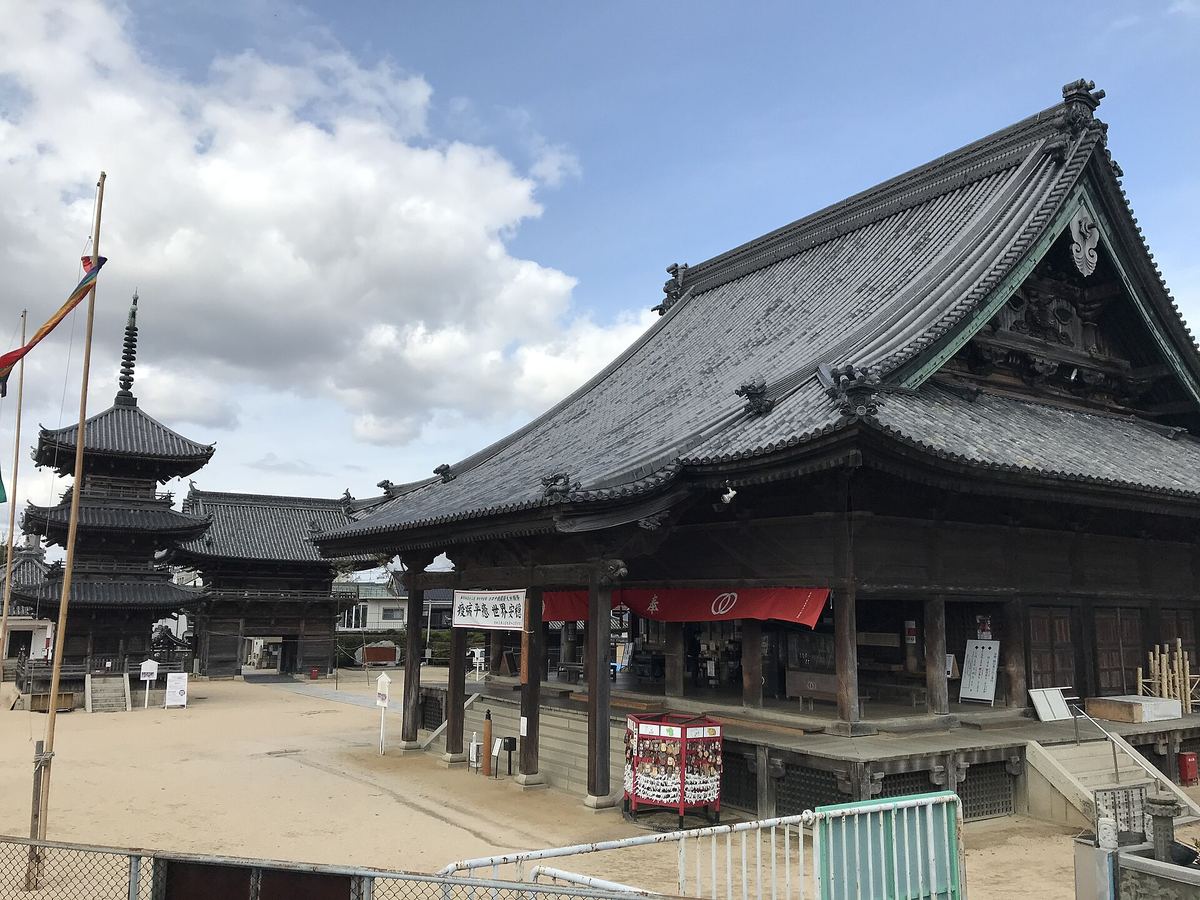
No. Two bodies, and they cover different years — this is the easiest thing in the whole story to get wrong.
On July 9, 2026 the Hosankai established the Saidaiji Eyo Review Committee. The founding document is specific: it is a committee of external experts, asked to verify measures preventing a recurrence from an objective and specialist standpoint, and to make recommendations on reconciling the continuation of the tradition with safety. Three stated purposes: establishing the clinical and objective sequence of events that led to the incident; determining its organisational and structural causes; and recommending measures so that no serious accident happens again.
Then come the two sentences that matter for planning. The recommendations are to be compiled and submitted to the Hosankai with the end of 2026 as the target; and what the Hosankai will then examine, on receiving them, is the holding of the festival from February of Reiwa 10 onward.
| February 2027 (518th) | February 2028 onward | |
|---|---|---|
| Who decides | The Hosankai itself | The Hosankai, acting on the external committee's recommendations |
| When it becomes public | Around October 2026 | Recommendations targeted for end of 2026; review follows |
| Status now | "Scheduled", content under review | Nothing stated |
Between late 2026 and early 2027, two separate things will be moving: the October publication of how 2027 runs, and the year-end recommendations on how the festival should exist from 2028. When the committee's recommendations make the news, do not read them as the rules for February 2027 — the founding document says in writing that they cover Reiwa 10 onward.
Running one transitional edition while a longer review continues is not an unusual shape for a large Japanese festival after a major disruption. What is unusual here is the level at which the review was pitched: the word used is ari-kata, the way the thing ought to exist, rather than a review of crowd flow and stewarding. What that review will conclude has not been signalled.
What date is it in 2027?
Not announced. The rule gives Saturday, February 20 — but that is a calculation, not a published date.
Both official sources state the rule. The temple's schedule page says Eyo is customarily held on the third Saturday of February; the chamber of commerce page carries the same note and lists the 2026 edition as Saturday, February 21, with the shingi thrown at 22:00. February 2026 had Saturdays on the 7th, 14th, 21st and 28th, so the third was the 21st and the rule matches the published date.
| Year | Saturdays in February | Rule gives | Officially published |
|---|---|---|---|
| 2026 (Reiwa 8) | 7 · 14 · 21 · 28 | Feb 21 | Feb 21 (held; 517th) |
| 2027 (Reiwa 9) | 6 · 13 · 20 · 27 | Sat Feb 20 | Not published |
| 2028 (Reiwa 10) | 5 · 12 · 19 · 26 | Feb 19 | Not published |
Why be this careful about a date that seems obvious? Because the only official wording is "scheduled for February of Reiwa 9", with no day at all, in the same statement that says the format as a whole is under review. When the way a festival is run is being redesigned, its scheduling rule sits inside the scope of that redesign. The temple's notices page, whose most recent entry as of the research date was an Eyo paint-art event on August 28, 2026, carries no Reiwa 9 announcement of any kind.
Practically: treat February 20 as a planning placeholder, choose flights and rooms you can cancel for free, and confirm after October. This is the mirror image of another 2027 festival where the date is nailed down and the money is not — Zenkoji's Gokaicho has its full 77-day window published while the ticket arrangements are a blank, and the handling is set out in the Zenkoji Gokaicho 2027 guide. The two kinds of "unknown" call for opposite behaviour: unknown date means do not book, unknown price means booking is fine.
What did the rules look like last time?
Read this section with one label attached to every line: these are the rules of the 517th edition, held February 21, 2026, not a promise about 2027.
They are worth reading precisely because they are the document the external committee is now examining. When the October announcement appears, you will need a baseline to see what moved.
Advance application was required
The traffic notice issued jointly by Okayama Higashi Police Station and the Hosankai states that participants must apply in advance to the Hosankai — individuals for themselves, groups through a representative. For 2026 the mechanism was a Google form titled "Participation Application & Consent Form", opened on January 16, 2026 and since closed.
Two things the organisers never put in writing stay out of this guide: the application deadline was not stated (the form is closed and cannot be read back), and no fee for the naked participation itself is stated anywhere — so do not assume it was free, and do not assume it was paid. Only the surrounding items carry published prices.
Age: no published minimum for taking part
The organisers do publish an age of 18 in two places, but neither is the naked participation itself. The changing facility for general participants is limited to men aged 18 and over (¥3,000 per person, first 150 arrivals, no reservations, 19:30 to 23:30, at the temple's second car park). The Josei Hadaka programme requires women aged 18 and over.
The participation regulations themselves contain no age clause. The accurate statement is that no minimum age for the naked participation has ever been published — do not infer one from those two figures. There is also a boys' Eyo held in the afternoon, organised by the local junior chamber.
Three rules that stop you at the gate
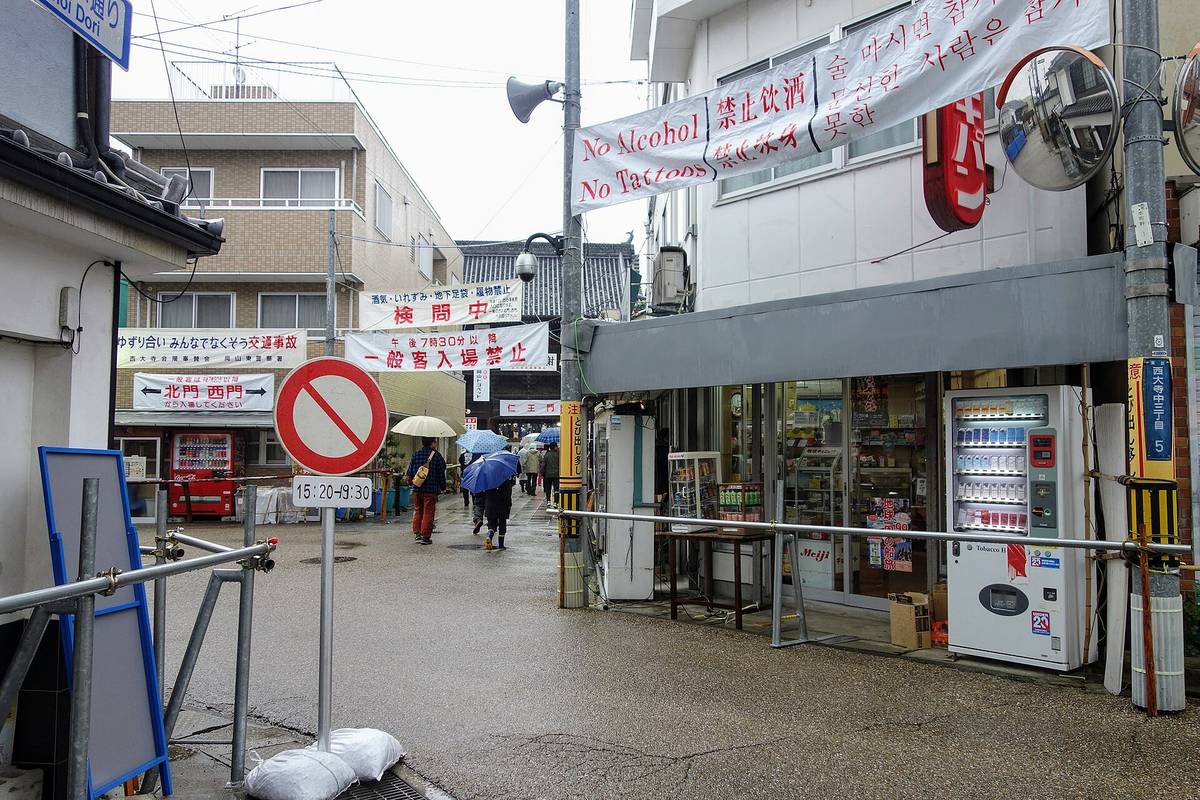
- Drinking disqualifies you. The regulations state that participation by anyone who has been drinking is not permitted under any circumstances, and that if people are found concealing drinking — for instance by having others cover for them — they are removed immediately and restricted from future participation. The traffic notice goes further: where such conduct is identified, the whole group is sent back to the changing area. Drink and body checks take place before entry, on the street beside the Chugoku Bank Saidaiji branch.
- Tattoos disqualify you, and covering them does not help. The regulations state that people with tattoos cannot participate, that concealing them with supports, cloth, tape or make-up is absolutely prohibited, and — this is the part with real force — that if a person with tattoos obtains the shingi, they are not recognised as fukuotoko. Checks happen before entry; discovery inside means removal. That is considerably harder than the hot-spring convention, where policy is set facility by facility and usually stops at discouragement; for how that actually varies in practice, see the guide to tattoos and Japanese onsen.
- Fighting is dealt with on the spot by police and stewards, with removal.
What participants were told to wear
| Item | Official rule, 517th edition |
|---|---|
| Mawashi (loincloth) | Bring your own. Sold near the changing area, along with tabi. No rental scheme is stated |
| Tabi (footwear) | White tabi only. Jikatabi and tobi tabi are prohibited |
| Name tag | Address, name, emergency contact and blood type, displayed on the front of the mawashi. The English version words it differently: write your name, blood type, address and emergency contact on the lining of the loincloth. Both official versions exist and are left as they are here |
| Glasses, jewellery, phones | Absolutely prohibited to bring or wear, with the explicit note that there is no cloakroom at the venue. The flyer adds cameras and cigarettes |
| Supports and tape | No vinyl tape on wrists, arms or ankles. Knees only, as a guide 40 cm above and below; other areas prohibited |
| Headbands, happi, lanterns, banners | Not to be used in the precinct after 21:00 |
| Masks | Participants are asked not to wear masks, the stated reason being the safe conduct of Eyo |
| Changing and valuables | Changing facility ¥3,000. No valuables are looked after at all. The English version adds: do not change clothes in public facilities or on the street |
The name-tag line is worth pausing on. The stated reason is to be able to respond in the event of an accident. Wearing your blood type on your stomach is the organisers' own assessment of the risk, printed on the official traffic notice and the flyer. It needs no adjectives.
Entry hours and what to do on the floor
Entry for the 517th edition ran 20:00 to 21:30, through the Niomon gate after the drink and body check. The organisers also gave three specific instructions: do not go up onto the great floor too early, the stated risks being dehydration and being pulled under; anyone feeling unwell should come down at around 21:30, during the pause before the shingi is thrown; and three self-protection actions — keep your arms up, do not link shoulders, and if you fall, lie face down. A fourth instruction concerns other people: if someone is sinking on the floor or has fallen, alert those around you and help immediately.
The shingi itself carries a rule that surprises most first-time readers. Ownership is only settled at the moment the holder leaves the precinct through the Niomon gate; contesting or seizing it outside the precinct is absolutely prohibited, and once the main shingi has left, contesting the smaller eda-shingi inside the precinct is prohibited too. Whoever secures it must take it immediately to the Hosankai on the ground floor of the chamber of commerce's Saidaiji branch, called the shingi inspection point on the flyer.
The lead-up is published as well: tools are polished at a ceremony 19 days ahead; three days later, at midnight, the shingi is collected from Muryojuin at Kotanizan Nyohoji, with the official note that no one speaks on the journey back so that no evil enters; the shingi is then carved, followed by fourteen days of shushoe rites, and thrown from the main hall's fukumado at 22:00 on the closing day, wrapped in a goo-fuda talisman.
Attendance figures differ between the two official sources: the temple states 9,000 naked men and 30,000 worshippers, while the chamber of commerce states roughly 10,000 participants. Both are official, so both are given here rather than picking one.
Is anyone insured?
No. The official documents say the opposite.
Neither the Japanese word for insurance nor the English word appears in the body text of the participation page, the seating page or the English participation page. What appears instead is three disclaimers, quoted here without commentary.
The temple's notice states that Eyo is a sacred traditional Japanese event and not a sport; that great danger accompanies being inside the crowd; that participants take part at their own risk having accepted this, and must protect themselves; and that the temple accepts no responsibility should injury or a fatal accident occur.
The Hosankai's regulations state that in a naked festival there is a risk of injury or fatal accident through contact with other participants, falls and so on, and that the Hosankai and Kinryozan Saidaiji accept no liability for damages or any other responsibility whatsoever for any injury, death or other accident arising during participation. A further clause extends the same disclaimer to theft, and another states that where first aid is given at the aid station, the organisers accept no responsibility for the outcome or the subsequent course of events.
Read those alongside the blood-type name tag from the previous section and the organisers' position is unambiguous: this is an event they themselves flag as dangerous and for which they explicitly decline responsibility, and the act of applying is defined as accepting that. The 2026 form's full name included the word shodaku, consent — that word was doing real work.
So does travel insurance cover it? That depends on your policy, not on anything the organisers control. Definitions of hazardous activity and the exclusion lists attached to them vary enormously between policies, so describe the event to your own insurer and get the answer in writing. For how emergency help and official warnings work on the ground in Japan, see the Japan disaster and emergency guide.
One more clause, from the flyer: images of the crowd may be used in promotional material, and participants are asked to take part in the knowledge of that.
Can women take part?
The answer is not yes or no. There are two separate things.
On the scramble for the shingi, the temple's page describes the Eyo taiko drummers as "the women who cannot take part in the contest for the shingi" — the group who beat the drums toward the floor to raise the spirits of the men and pray for their safety. Another page on the same site notes that although Eyo is called a men's festival, women are present: at around 19:00 a group in white robes appears at the korritoriba for cold-water purification, and the drummers who announce the start of the festival are all women.
The organisers have never published a reason why women cannot join the contest. What they have published is that sentence, plus the whole programme below.
The Hosankai runs a formal Josei Hadaka: participants wear white, purify themselves at the korritoriba, and walk three circuits of the precinct including a prayer on the floor of the main hall, entering only after a briefing from a guide.
| Item | Official value, 517th edition |
|---|---|
| Assembly point | Reception, 2F, Okayama Chamber of Commerce Saidaiji branch |
| Assembly time | 16:30, with the official note that the time is strictly observed |
| Eligibility | Women aged 18 and over. Accompanied by a woman over 18, girls from primary school age up to under 18 may also take part |
| Capacity | Numbers may be limited; the organisers ask people to apply early |
| Prayer | From 18:15, about 20 minutes |
| What to bring (9 items) | Sarashi cloth; okoshi underskirt (must be thick, non-see-through flannel, long enough to cover the ankles); white boxer-type underwear (no colours or patterns); tabi; a bag for clothes; a towel; a hair tie; a cloth; and the takigoromo specified by the Hosankai (rental ¥500) |
| Applications | By phone or email to the Hosankai office, giving name, address, whether a takigoromo is needed and its size, and a phone number |
| Liability | Valuables are each person's own responsibility; the Hosankai accepts no responsibility for injury either |
One practical trap deserves its own line: Josei Hadaka does not appear on the official schedule page. It exists only in the lower half of the participation page, so anyone planning from the schedule will conclude it is not a thing. Separately, the application email address on that section appears twice in two different forms on the same page, so use the phone number, or the address shown in the page text on the chamber of commerce domain.
Once more: all of the above is the 517th edition. The specific content of the 2027 edition has not been published, and this programme sits inside that.
How do you watch without taking part?
Last time there were six ticket types, seats needed booking, standing did not, and none of them were refundable.
Start with the most useful line, because it overturns the instinct to rush at the words "grandstand seat". The organisers state on the seating page that standing tickets practically never sell out in advance, and that more than half of standing spectators buy at the viewing-area entrance on the day.
| Ticket | 517th edition price | How it was sold |
|---|---|---|
| Reserved seat, grade S | ¥8,000 | Counter, phone, or the organisers' own web reservation. Payment by credit card (web only), Yamato cash-on-delivery, or cash at the counter |
| Reserved seat, grade A | ¥7,000 | |
| Reserved seat, grade B | ¥6,000 | |
| Standing, east | ¥2,000 | From late January at the Saidaiji branch counter, cash only. No phone reservations, no holds. Also sold on the day |
| Standing, west | ¥1,000 | |
| Main hall inner sanctuary viewing | ¥1,000 | As above, plus the reception at the bell-tower gate |
Both categories are explicitly non-refundable. Same-day sales ran 09:00 to 17:30 at the branch counter and from around 19:00 at the viewing-area entrance. Reserved seats could be booked by phone and at the counter; standing tickets could not.
None of these tickets exists on an online travel platform, and structurally none could: the only channels are the organisers' own counter, phone line and website, and even the card payment option is limited to their own site. Anything being resold elsewhere is not an official channel. Festival ticketing in Japan varies more than most visitors expect — Kyoto's Gion Matsuri sells seats across two separate processions, while Tokyo's Kanda Matsuri has never sold spectator seating as a product at all, as set out in the Kanda Matsuri guide.
On-site rules, 517th edition
- From 19:30, general visitors could not pass two stretches: between the Chugoku Bank Saidaiji branch and the Niomon gate, and between the temple's north gate and the chamber of commerce branch. The flyer gives 19:30 to 22:45, with only those in mawashi allowed through.
- The organisers explicitly ask women, children and elderly visitors to come early.
- Pushchairs are discouraged; drones are prohibited; tripods are banned in the paid seating.
- Umbrellas get in others' way, so rainwear is requested. Paid-seat holders are asked to be seated by around 21:00.
- Entry restrictions may be imposed from 20:00, and the traffic notice adds that to prevent crush-related danger the organisers may restrict entry and you may not get in at all.
- Two more on-the-ground notes from the traffic notice: pickpockets are active, and do not climb the precinct's fences, monuments, stone lanterns or trees to watch.
Getting there — and the gap the organisers leave
Traffic restrictions for the 517th edition ran from 14:20 to around 23:00 on February 21, in phases. The nearest station is JR Saidaiji, about a ten-minute walk. Six free car parks offered 1,360 spaces in total, yet the organisers still write in so many words that parking is scarce, congestion is expected, and visitors should use public transport.
The organisers do not publish last-train times. Their access page links out to a commercial timetable site instead, and those links still carry parameters pointing at February 2025. The shingi is thrown at 22:00, handed in around 23:00, and traffic restrictions run to about 23:00. "How do I get home afterwards" is a real question, and the organisers have not published the answer. Check the JR timetable for the actual year, and treat "staying to the end" and "catching the last train" as two things to confirm separately.
There is an official way to watch from anywhere
The 517th edition's flyer advertised a live stream of the shingi being thrown, hosted on the temple's own site and flagged as available on the day only. The page exists but carries no content outside the event. For anyone who wants to see this festival without entering a dense crowd, that is a route the organisers themselves provided. Whether it happens again in 2027 falls under the same "content undecided" heading as everything else.
What does the official English page say right now?
It says February 21, 2026 — a date six months in the past, and the night two men were fatally injured.
This is in the guide because it actively misleads people, not to score a point. The Okayama Chamber of Commerce's English Saidaiji Eyo page reads, verbatim as of the research date: "The next Saidaiji Eyo will be held on Saturday, February 21, 2026." A past date presented as the next one. The same page makes no mention of the 2026 incident and none of the review committee. The English participation page embeds the same application form that has been closed since February.
One detail shows how long that page has sat untouched: its main image is loaded from an address on web.archive.org — the official English page is pulling its own old photograph out of the internet archive.
So a traveller working in English is currently being handed three things through official channels: an expired date, a set of rules that may be rewritten, and no information about risk at all.
The practical use of this is direct: do not stop at the English page. Read the dated PDFs on the Hosankai's news list at the chamber of commerce site. The pace at which the organisers announce things and the pace at which their language pages are updated are not the same thing.
Three dates ahead
October, the end of the year, and 2028 — each answers a different question.
- Around October 2026: the specific content of the 518th edition. This is the only announcement that affects a February 2027 trip. Date, format, seating, applications — all of it sits in that one publication.
- End of 2026 as a target: the review committee's recommendations. They cover February 2028 onward, not 2027. Read the news coverage with that separation in mind.
- February 2028: the first edition shaped by those recommendations. Whatever this festival settles into next, that is the year it happens.
Reiwa 10 carries a second meaning for the temple as well: Kinryozan Saidaiji has a prospectus covering the unveiling of its principal image and a 1,250th anniversary of its founding, which confirms the plan exists — but the dates and period were not obtained for this guide, so none are given here.
The action fits in one line: book nothing you cannot cancel, hold February 20, 2027 as a placeholder, and check the Hosankai's news list in October. Festivals are hard to plan around because "how to take part" and "how to watch" are usually two entirely separate systems built by different people — the same split runs through Hakata Gion Yamakasa, which handles the identical problem in Fukuoka.
Appendix: official Japanese wording (click to expand)
The originals quoted above are collected here so they can be checked directly. Two sources: Kinryozan Saidaiji (Saidaiji Kannonin) and the Saidaiji Eyo Hosankai, whose secretariat is the Saidaiji branch of the Okayama Chamber of Commerce and Industry. The official statements are PDFs signed by the Hosankai chairman. All retrieved on September 6, 2026.
1. The 518th edition: content undecided, announcement around October (July 27, 2026)
令和9年2月に予定しております第518会西大寺会陽の具体的な開催内容につきましては、現在、奉賛会内において慎重に検討を重ねております。次回の具体的な開催内容につきましては、本年10月頃に皆様へ公表させていただく予定です。
2. The February 21, 2026 incident (four official statements)
複数名の参加者が負傷し、救急搬送される事態が発生いたしました(令和8年2月22日)
事故の発生原因や当時の詳しい状況につきましては、警察および消防などの関係機関と連携の上、目下調査中(令和8年2月22日)
負傷し意識不明の重体となられていた3名のうち、お一人の意識が回復されました/現在もなお2名の方が意識不明の極めて厳しい状態(令和8年2月27日)
事故原因を究明中でありますが、会陽の在り方そのものを関係団体とともに協議・検討し、根本的に見直してまいる所存であります(令和8年3月9日)
3月9日にお亡くなりになられた方に続き、もうお一方の尊い命が失われました(令和8年3月17日)
3. The Saidaiji Eyo Review Committee (established July 9, 2026)
客観的かつ専門的な視点から事故の再発防止策を検証し、伝統の継承と安全の両立に向けた提言をいただくための外部有識者委員会を…設置
事故に至った臨床的、客観的な事実経過の把握/組織的、構造的な事故原因の究明/今後二度と重大事故を起こさないための「再発防止策」の提言
本年内を目途に…提言を取りまとめ、奉賛会へ提出いただく予定
奉賛会は提言を受け、令和10年2月以降の開催について、安全を最優先としたこれからの西大寺会陽の実現に向けて検討を進めてまいります
4. The scheduling rule
会陽は例年2月の第3土曜日に行われます。
※毎年2月の第三土曜日/令和8年2月21日(土)/宝木投下22時
5. Advance application and the changing facility
事前に会陽奉賛会へ…参加申込みをしてください。個人の場合は参加者、グループの場合は代表者が事前に申し込んでください。
③18歳以上の成人男性のみご利用いただけます。
6. Alcohol, tattoos, violence
飲酒者の参加は一切認めません/飲酒を隠蔽するような行為(周囲がサポートする等)が確認された場合は、即刻退場とし、今後の参加を制限(禁止)
飲酒が判明しないよう周囲がサポートする等の悪質行為を確認した場合、グループごと着替場所へ引き返していただきます
入れ墨(タトゥー)のある方は参加できません。サポーター、布、テープ、化粧等で隠しての参加も絶対禁止です。万が一、入れ墨をした人が宝木(心木)を取得しても「福男」とは認められません。
7. Kit and the name tag
万一の事故発生に対応するため、住所・氏名・緊急連絡先・血液型等を記入した名札をまわしの腹部に表示してください
White Loincloth — Write your name, blood type, address, and emergency contact information (for family, etc.) on the lining of your loincloth.
メガネ、ネックレス・ピアス等の貴金属、携帯端末(スマートフォン等)の持ち込み・着用は絶対禁止です。(会場に一時預かり所はありません)
白足袋のみ/地下足袋(ジカタビ)、トビ足袋の着用は禁止
ビニールテープを手首・腕・足首に巻くのは不可/ヒザのみ(上下40cm目安)可
会陽を安全に執行するため、マスクを着用しての参加はお控えください
貴重品などの管理は一切行いません/Please do not change your clothes in public facilities or on the street.
8. Entry timing and self-protection on the floor
あまり早く大床へ上がらないようにしてください
午後9時30分頃(宝木投下前の一時停止時)に下りてください
手を上げる・肩を組まない・転倒時腹這いになる
床に沈み込んでいる人や転倒した人がいた場合は、周囲に知らせ、直ちに助け合ってください
9. Disclaimers (no insurance exists)
西大寺会陽は日本の伝統的な行事で神聖なものです。スポーツではありません。/裸群の中では多大の危険が伴います。この事を承諾の上、自己の責任において参加し自分を守ってください。怪我・死亡事故等が発生しても当会は責任を負いません。
奉賛会並びに金陵山西大寺は、祭り参加中に生じる可能性のあるいかなる怪我、死亡等の事故に関しても損害賠償その他一切の責任を負担いたしません。
万が一負傷した場合、救護所にて応急処置を行いますが、その処置の結果およびその後の経過について、主催者は一切の責任を負いません。
裸群の画像を宣伝物に利用することがあります。承知の上ご参加ください。
10. Women
宝木の争奪戦に参加できない女性たちが、裸の男たちの士気を高め、安全を祈願するために場内に向って打ち鳴らします。
「男の祭り」とされる西大寺会陽だが、女性の姿もある。…また祭りの開始を告げる「会陽太鼓」の打ち手は全て女性である。
女性はだか 白装束を身にまとい、こり取り場で身を清め、本堂大床での祈願を含め、境内を3周練り歩きます。
参加資格 18才以上の女性に限ります。但し、参加する18才以上の女性が同伴する場合は、小学生以上18才未満の女子も参加が可能です。
集合時間 午後4時30分(時間厳守)/祈願 午後6時15分から20分程度
11. Ownership of the shingi
宝木の所有権:境内(仁王門)を出た段階で所有者が確定します。境内の外での争奪・奪い合いは絶対禁止です。
当山に帰るまで、魔が入らないように、道中は一切無言の決まり
12. Seating and on-site rules
立見席は事前に売り切れることはまずありません。立見席で観覧される方の半数以上は当日観覧席入口でご購入されています。
払い戻しはできません
女性・子どもや高齢者の方は、早目にご参拝ください。
雑踏による危険を防止するため、場合によっては、主催者による入場制限が行われ、入場できないことがあります
駐車場が少なく混雑が予想されますので公共交通機関を利用してください
13. Live stream
世界初!宝木投下の感動をLIVE配信/※当日のみ
14. The official English page as of September 6, 2026
The next Saidaiji Eyo will be held on Saturday, February 21, 2026.
Frequently Asked Questions
- Q1:Will Saidaiji Eyo be held in 2027?
- Yes, but nobody knows yet what it will look like. The organising body, the Saidaiji Eyo Hosankai, wrote on July 27, 2026 that the 518th Saidaiji Eyo is "scheduled for February of Reiwa 9" — and in the very next sentence, that the specific details of how it will be held are still under careful internal review, with publication planned for around October 2026. So two things are established: the edition is on the calendar, and its format is not decided. Note that this is not the same as a date being announced — the organisers have never published which day in February 2027 it falls on.
- Q2:What happened at Saidaiji Eyo in 2026?
- The 517th edition, held on February 21, 2026, ended in a serious incident, and two men later died. Four signed statements from the Hosankai chairman track what was made public: on February 22, that several participants were injured and taken to hospital by ambulance; on February 27, that of three people who had been left unconscious and in critical condition, one had regained consciousness; and on March 9 and March 17, that two of them had died. The head priest of Kinryozan Saidaiji issued his own signed statement on March 17. The cause of the incident and the total number of injuries have not been published — the March 9 statement still described the cause as under investigation, and in July the inquiry was handed to an external committee. Anything you read online about the mechanism of the deaths does not come from the organisers.
- Q3:What date is Saidaiji Eyo 2027?
- It has not been announced. It can be calculated, but treat the result as an estimate. Both the temple and the chamber of commerce state that Eyo is held on the third Saturday of February, and the 2026 edition on February 21 was indeed that year's third Saturday, so the rule holds. February 2027 has Saturdays on the 6th, 13th, 20th and 27th, which makes Saturday, February 20, 2027 the calculated date. But the only official wording available is "scheduled for February of Reiwa 9", with no day given, in a statement that also says the whole format is under review — and a review of how a festival is run can reach its scheduling rule too. Book refundable flights and rooms, and wait for the October announcement before locking anything in.
- Q4:Can foreigners take part in Saidaiji Eyo?
- Under the 2026 rules, yes, and the organisers actively provided English. There is a full English version of the participation page and the regulations, and the 2026 application form was bilingual in its own title — "Participation Application & Consent Form". No nationality condition appears anywhere in the participation page, the regulations or the seating page. But all of that describes the 517th edition. Whether the same application mechanism even exists for 2027 has not been published, so do not plan around those pages until the October announcement. One more warning: the official English page still carries the date "February 21, 2026" and makes no mention of the incident or the review committee.
- Q5:Is there insurance for Saidaiji Eyo participants?
- No — and the official documents say the opposite. The Hosankai regulations state that the organisers accept no liability whatsoever for any injury or death arising during participation, extend the same disclaimer to theft, and add that even where first aid is given at the aid station, the organisers accept no responsibility for the outcome or for what follows. The temple's own notice states plainly that Eyo is a sacred traditional event and "not a sport", that great danger is involved, and that participants take part at their own risk and must protect themselves. The 2026 application was called a "Participation Application & Consent Form" — applying is defined by the organisers as consenting to that disclaimer. Whether your own travel policy covers an event like this is a question for your insurer, in writing, not for the organisers.
- Q6:Can women take part in Saidaiji Eyo?
- The answer is not yes or no — there are two separate things. For the scramble for the shingi, the temple's own page describes the drummers of the Eyo taiko as "the women who cannot take part in the contest for the shingi". But the Hosankai runs a formal Josei Hadaka programme: participants wear white, purify themselves at the korritoriba, and walk three circuits of the precinct including a prayer on the main hall floor. Eligibility is women aged 18 and over, with girls of primary school age and up admitted when accompanied by a woman over 18; assembly is 16:30 with the official note that the time is strictly observed, and the required takigoromo can be rented from the Hosankai. This programme does not appear on the official schedule page — it is only in the lower half of the participation page, so anyone planning from the schedule alone will conclude it does not exist. All of the above describes the 517th edition.
- Q7:How do you buy spectator tickets for Saidaiji Eyo?
- For the 2026 edition: reserved seats needed booking, standing tickets did not. Reserved grandstand seats came in S, A and B grades and were sold at the counter, by phone, or through the organisers' own web reservation. Standing tickets, split into east and west areas, went on sale from late January at the Okayama Chamber of Commerce Saidaiji branch counter, cash only, with no phone reservations and no holds. On whether they sell out, the organisers answer it themselves: standing tickets "practically never sell out in advance", and more than half of standing spectators buy at the entrance on the day. Two things to know before planning: no ticket type is refundable, and none of these tickets exist on any online travel platform — the only channels are the organisers' own counter, phone line and website. Ticket types and prices for 2027 have not been published.
Read next
Okayama & Kurashiki Guide 2026: Korakuen, Bikan & Denim
Korakuen (one of Japan's three great gardens), the white-walled Kurashiki Bikan quarter and Kojima denim — the best stop on the Sanyo Line.
Hakata Gion Yamakasa: 15 Days, But Only 6 That Move
What starts on 1 July is a static display; the floats only move for six days. Oiyama begins at 4:59am with road closures from 1:00 — and the organisers name their own highlight elsewhere.
Zenkoji Gokaicho 2027: Why It Came a Year Early
Only five years since the last one, because the Nagano chamber of commerce petitioned for it. Ticket tiers were redrawn in April 2026 and the site everyone quotes still shows 2022 prices.
📊 See the 2026 Price Index (JR Pass, DPA, eSIM, Airport Transport) →