Tokushima is the prefecture most travelers skip in Shikoku, and the one that rewards them most with a real sense of wilderness: the north has the Naruto whirlpools, one of the world's three great tidal currents; the deep southwest hides the Iya Valley vine bridge and the Oboke gorge; and high summer brings Japan's most frenetic festival, Awa Odori. But here is the blunt thing to know first: the Naruto whirlpools are not there whenever you turn up — go without checking the day's tide chart and you may just see flat, calm sea and waste the trip; and deep Iya is genuine car country, where without a rental or an overnight you simply cannot chain the vine bridge, Oboke, the onsen, and the Peeing Boy into one sensible loop. This guide covers how to choose the Uzu-no-Michi glass walkway (¥510) versus a boat (from ¥1,600), the vine bridge (¥550) and the Oboke cruise (¥1,500), the cable-car onsen bath, Awa Odori's August dates and the year-round hall, and how to get in from Osaka or Takamatsu. To extend across Shikoku, chain Takamatsu and Naoshima or Matsuyama and Dogo Onsen.
- Naruto whirlpools need the tide chart: strongest at spring tides (full/new moon), but you must also hit the ~1.5-hour window around each tidal peak — check the daily chart
- Uzu-no-Michi ¥510 overhead vs. boats from ¥1,600 up close: the glass walkway is steady and seasick-proof; boats hit harder but must match the tide
- Iya vine bridge ¥550: woven from real vines, rebuilt every 3 years, sways but is safe; open year-round
- Oboke cruise ¥1,500: ~30 min through a Yoshino River gorge, no reservation; Oboke Station is the gateway to Iya
- Deep Iya needs a car or an overnight: ¥2,000 cable-car onsen bath, cliff-top Peeing Boy statue — hard to link without wheels
- Awa Odori: officially "the five days from 11 to 15 August" (the 11th is an indoor stage, not an eve festival); off-season, see and join it year-round at the Awa Odori Kaikan
📖 Contents
Why visit Tokushima
Honestly, Tokushima is not a city-type destination where you step off the train into a cluster of walkable sights. What it sells is two extremes of natural drama: one dynamic and roaring — the Naruto whirlpools — and one still and remote — the Iya wilderness, a deep mountain canyon. Geographically those two sit at opposite ends of the prefecture, the whole of Tokushima between them, so the smart way to plan is to treat them as two half-day themes, not one frantic day that tries to do both. It suits three kinds of traveler: anyone who wants a world-class tidal spectacle, anyone who wants to burrow into Japan's deepest hidden valley, and anyone coming for the August Awa Odori festival. If you want shopping and a dense checklist, Tokushima is not your pick; but if you'll work around the tides and rent a car into Iya, it gives you something the rest of Shikoku can't. My framing is direct: Tokushima is a "weather-and-tide-dependent plus deep-mountain-driving" destination — keep the itinerary flexible, don't over-schedule.
Naruto whirlpools: tides first
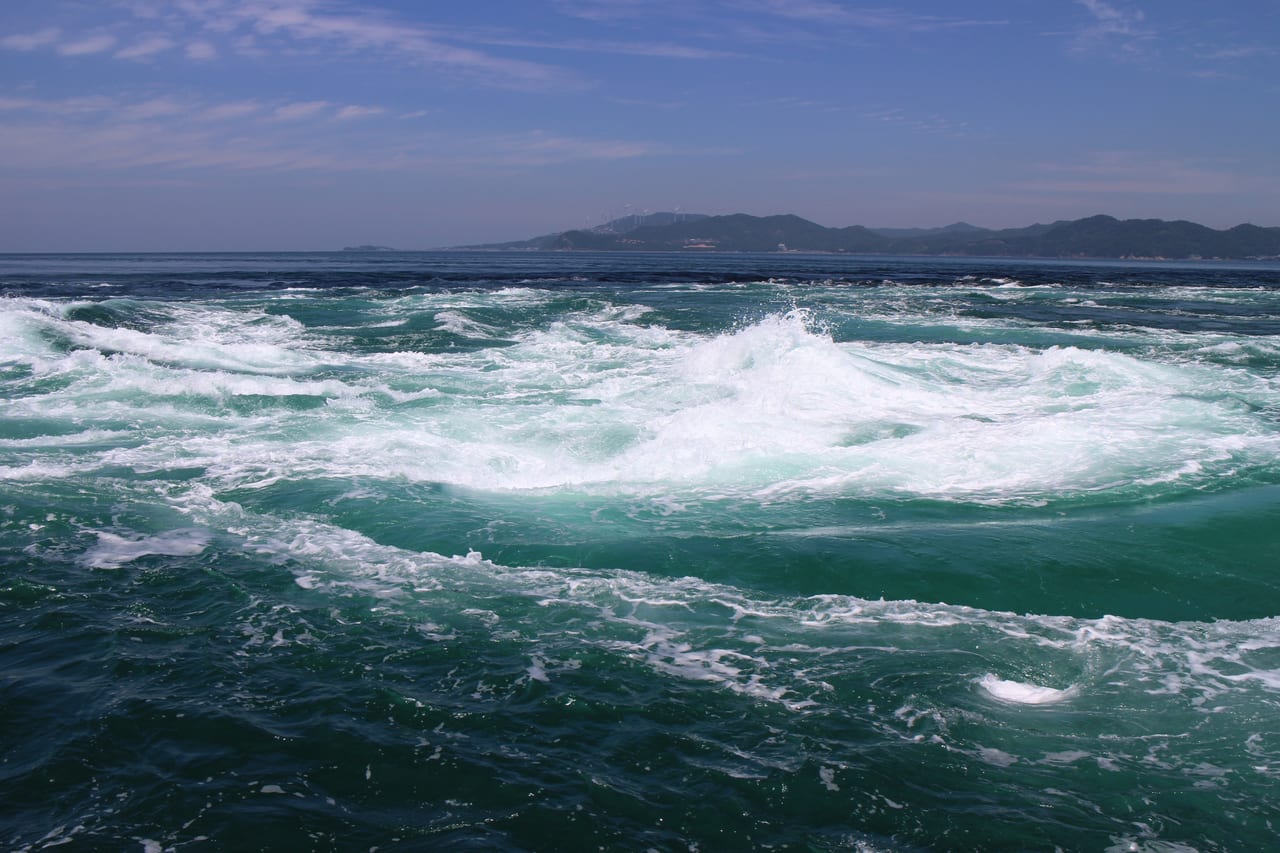
Tokushima's headline act is the Naruto whirlpools, ranked alongside Italy's Messina and Canada's Seymour as one of the world's three great tidal currents. The mechanism: the tide level differs between the two sides of the Naruto Strait (the Seto Inland Sea and the Kii Channel), forcing huge volumes of water through the narrow strait at high speed, and where that fast current meets the slower water at the edges it spins off whirlpools — at spring tide they can reach 20 meters across and roar audibly. But there is one thing 90% of visitors miss, and you must remember it:
- The whirlpools are not there all day. They are driven by the current, so there are only about four golden windows a day — two high-tide peaks and two low-tide peaks, with the ~1.5 hours around each being the most dramatic; the rest of the time the water can look fairly calm.
- Spring tides (near full and new moon) are strongest, and neap tides are much weaker. Per official sources, the spring tides of spring and autumn produce the largest whirlpools — the best season to watch.
- Always check the day's "best viewing times" chart: both the Uzu-no-Michi and the boat operators publish a day-by-day table — point your schedule at that window rather than guessing.
Let me put it plainly: on this trip the tide chart is the difference between success and failure. I've seen too many people skip it, arrive in the wrong window, find ordinary sea, wonder "where are the whirlpools?" and leave. Spend ten minutes confirming the day's golden window before you fix your transport — this step is not optional.
Glass walkway vs. boat
Once you've got the chart, the next question is where to watch from. There are two main angles, and if time allows I'd do both (overhead and up-close are completely different); if you can only pick one, here's the trade-off:
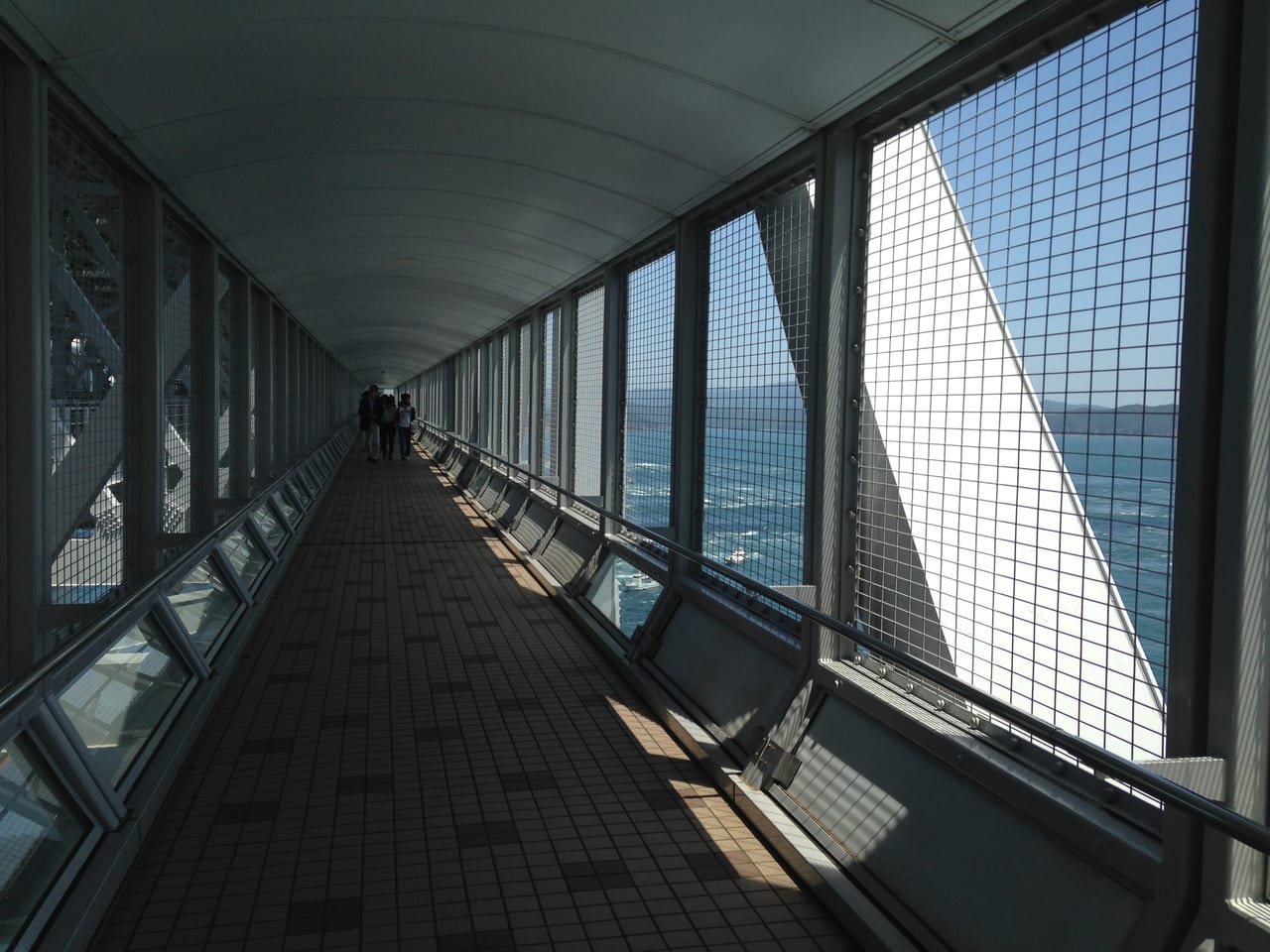
- Uzu-no-Michi (overhead): a roughly 450-meter walkway under the Onaruto Bridge, with a glass floor at the end where you look straight down on the whirlpools from 45 meters up. Admission is ¥510 adults, ¥410 for middle/high schoolers (elementary cheaper, free under 6); it runs rain or shine, isn't tied to a boat schedule, and suits anyone prone to seasickness or after a steady overhead shot. The downside is the distance — no up-close immediacy.
- Sightseeing boat (up close): takes you right alongside the swirls, and for sheer impact the boat wins. Uzushio Kisen runs a small boat that gets closest (and rocks hardest) at about ¥1,600 adults; Wonder Naruto is a larger, steadier boat with seats, better for older travelers and kids, at about ¥1,800. If you get seasick easily, think twice about the small boat.
My call is simple: seasick-prone, traveling with kids or elders, or want to compose your shots → Uzu-no-Michi; want the "whirlpool roaring at your feet" immediacy and don't mind the rocking → take the boat. But whichever you choose, line it up with the day's tidal window — I can't stress this enough. There are also boats from the Awaji Island side (the Kanrin-maru and others), so if you're coming down from the Kansai region via Awaji you can ride from that side to see the same whirlpools.
The Iya vine bridge
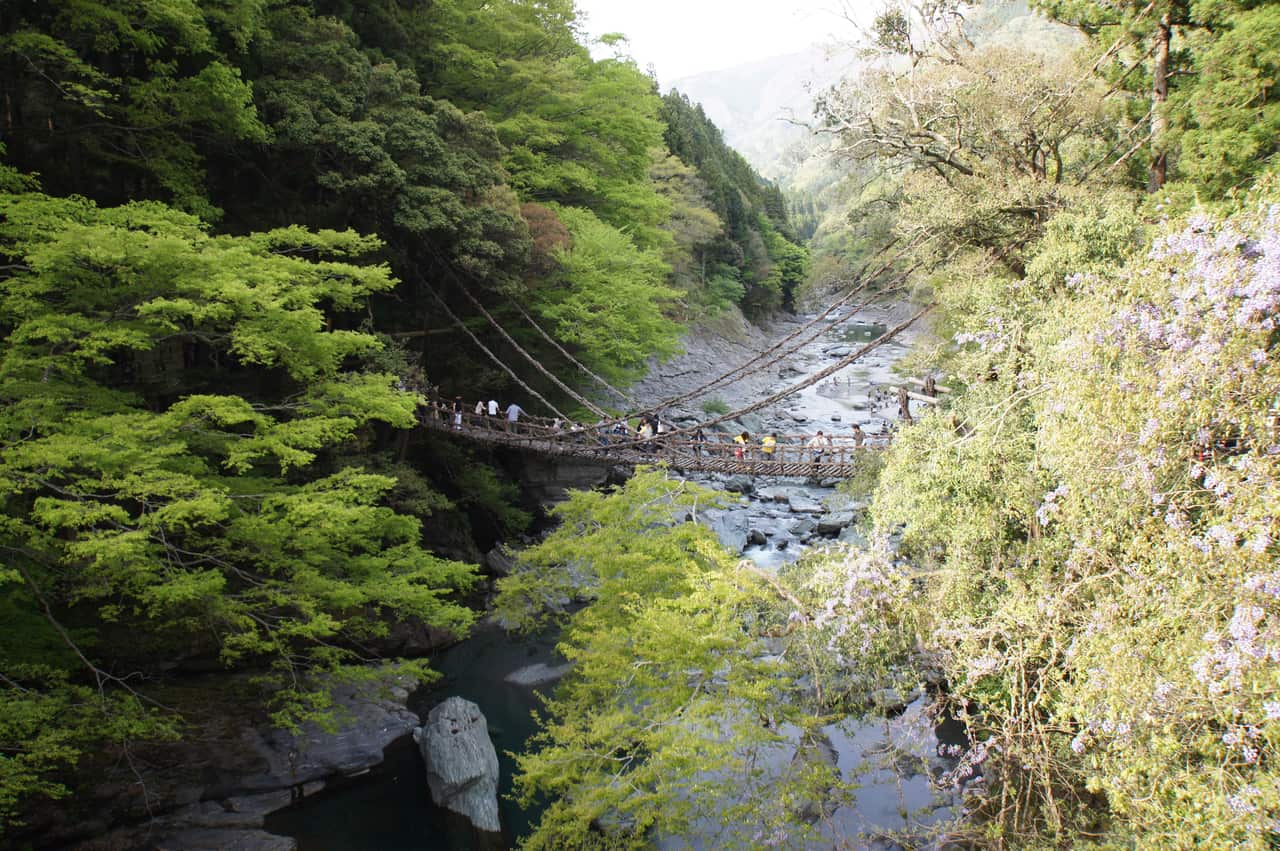
Cross the whole prefecture into the southwestern mountains and Iya's most famous sight is the Iya Kazurabashi vine bridge — a suspension bridge woven from real mountain vines, spanning the Iya River, one of only a handful of vine bridges left in Japan. Legend has it the defeated Heike clan built them so they could be cut down at once if an enemy pursued. What makes it special isn't the length but the feel: there are clear gaps between the deck planks, it sways as you cross, and the clear Iya River runs directly below — genuinely a little thrilling, and anyone afraid of heights will get sweaty palms. On safety, don't worry: steel cables are concealed inside the vines for reinforcement, the whole bridge is rebuilt new every three years, it's managed to standard, and normal crossing is safe.
The practicals: the toll is ¥550 for adults, ¥350 for elementary schoolers, open year-round with seasonal hours (Apr–Jun 8:00–18:00, Jul–Aug 7:30–18:30, Sep–Mar 8:00–17:00), and it can close in heavy-rain warnings. Crossing is one-way only, and queues form in peak season (Golden Week, autumn foliage, summer holidays) — get there early. Biwa Falls sits right beside it. For an even wilder, less-touristed version, the deeper "Oku-Iya Double Vine Bridges" (a "husband" and "wife" bridge) lie further in — emptier and rawer, but the road is tougher and even more dependent on having a car.
Oboke & Koboke gorge cruise
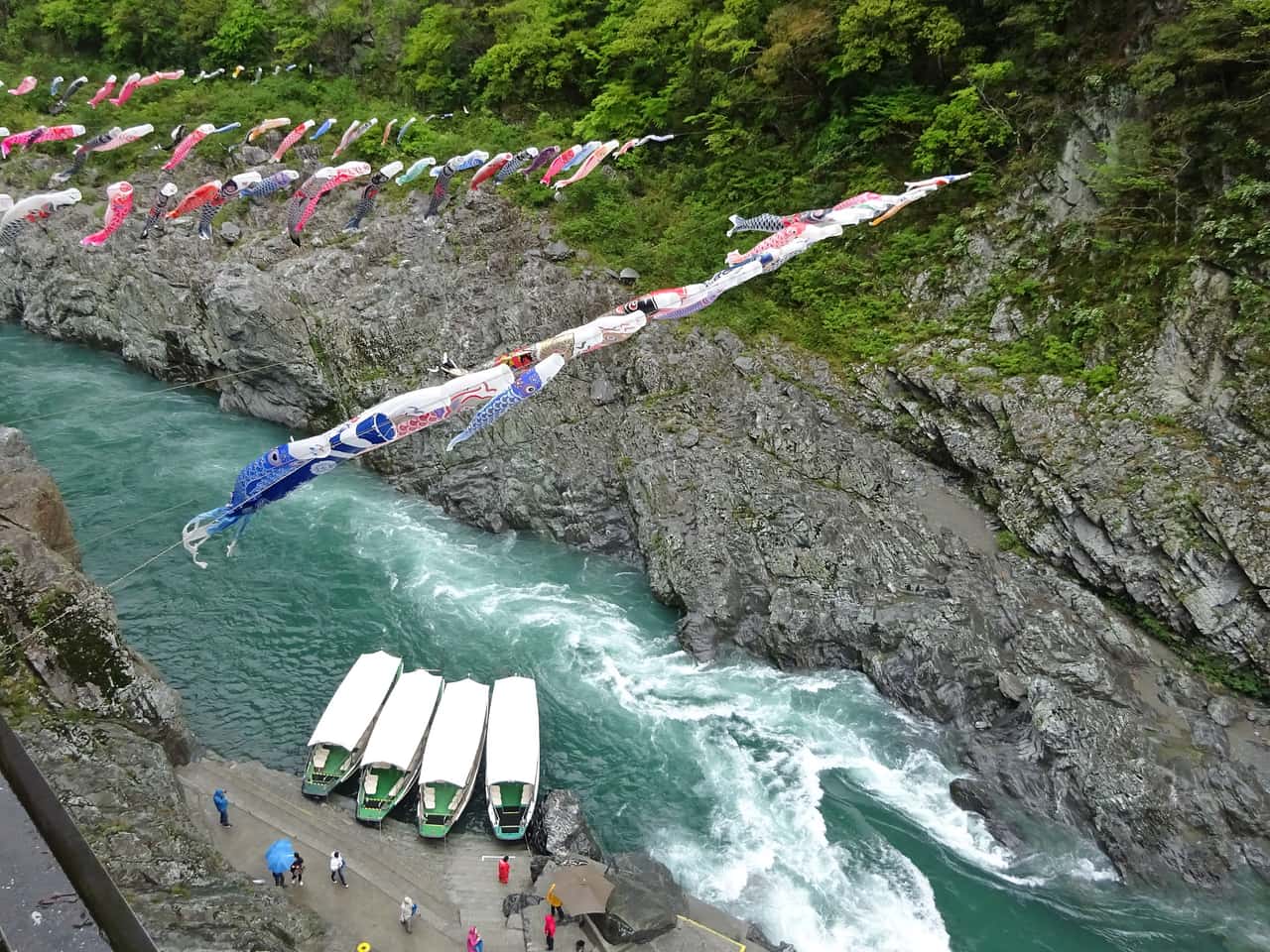
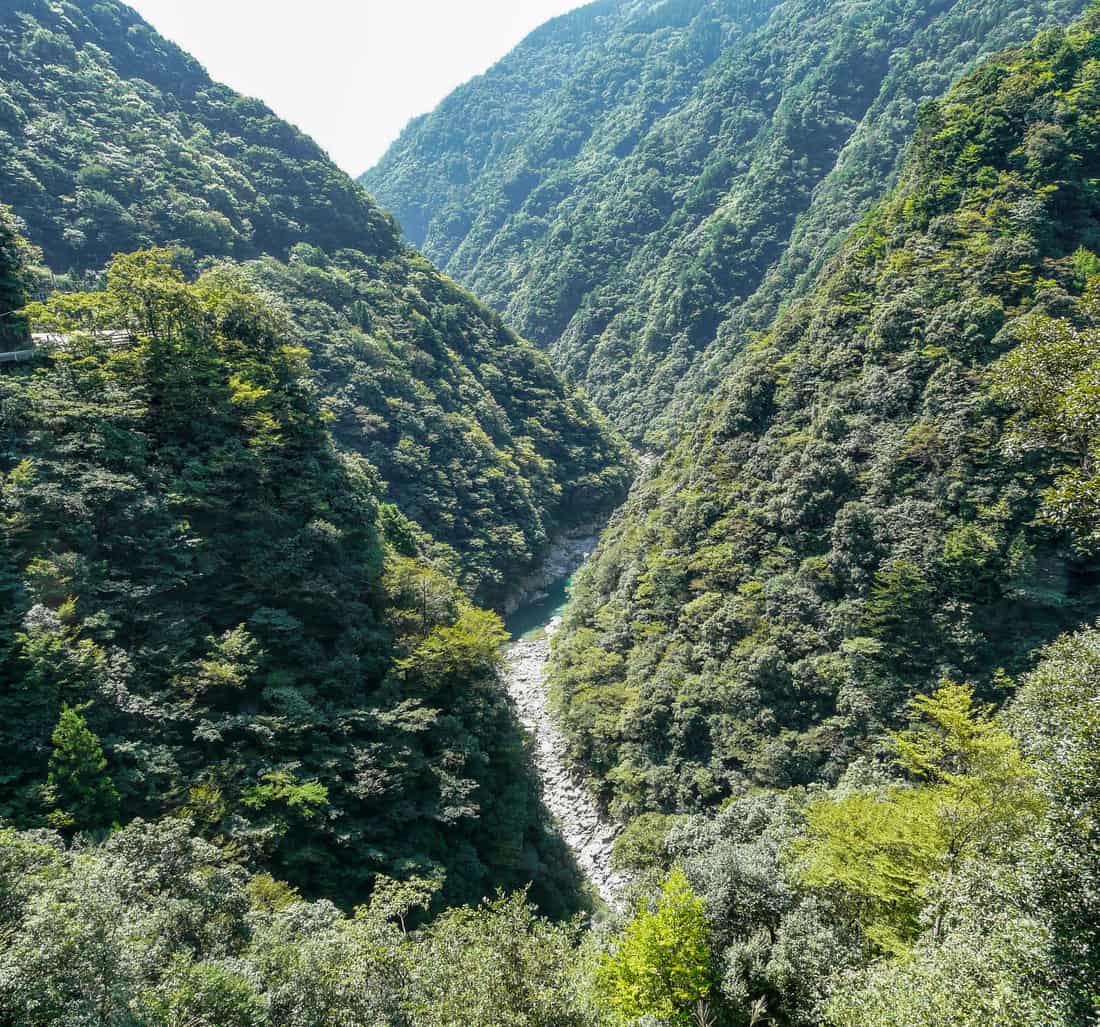
The gateway into deep Iya is Oboke and Koboke — a V-shaped gorge the Yoshino River has cut over ages, walled by crystalline schist that formed on an ancient seabed some 200 million years ago and was later thrust to the surface; that unusual geology has it designated a national natural monument and place of scenic beauty. The main way to see it is the Oboke Gorge sightseeing boat:
- The ride: departs the Oboke-kyo Mannaka dock and runs about 30 minutes round trip along the Yoshino River.
- Fare: ¥1,500 adults, ¥750 children (per official sources).
- Operation: 9:00–17:00 (last boat 16:30), year-round, no reservation needed, departing once it fills.
The boat eases between strange rock walls and water so clear it runs blue-green; fresh green in spring, red leaves in autumn, and carp streamers strung across the gorge in summer — good in every season. The crucial transport point: JR Oboke Station on the Dosan Line is the hub for this whole area — reachable direct by the limited express "Nanpu" from Okayama or Takamatsu — and from there you transfer to a Shikoku Kotsu bus into Iya (Oboke Station to the vine bridge is about 20–30 minutes, roughly ¥600). For non-drivers, "JR to Oboke plus the local bus" is the realest way into Iya, but services are sparse — check the timetable first.
Cable-car onsen & the Peeing Boy
Deep inside Iya there are two stops I'd never skip. The first is the cable-car open-air bath at Hotel Iya Onsen — its standout feature is that you ride the hotel's private cable car down about 170 meters to a riverside open-air bath at the bottom of the gorge: the pools are built from stacked boulders, the milky free-flowing sulfur water sits right by the Iya River, and you soak watching the canyon and green walls. That "hidden hot spring" feel is something no city onsen can match. Day-use bathing including the cable car and the open-air plus indoor view baths runs about ¥2,000 for adults (around ¥1,000 for children), reception until 17:00 (open 7:30–18:00). For an experience this remote, the price is very fair — if you're passing through Iya, build in a soak.
The second is the Peeing Boy (Shoben Kozo) — a small bronze statue of a boy relieving himself, set on a rock outcrop on a roughly 200-meter cliff along the Iya gorge road. It marks where local kids and travelers once stood on the outcrop and dared each other over the drop; the statue went up to commemorate it. The statue itself is a minor thing, but the spot — a 200-meter abyss directly below — is the point, and it's the most famous photo stop on that road, so pull over if you drive past. Both of these sit deep in Iya with distance between them, and they're hard to chain without a car — exactly why I keep repeating that Iya needs a rental or an overnight.
Awa Odori: festival & year-round hall
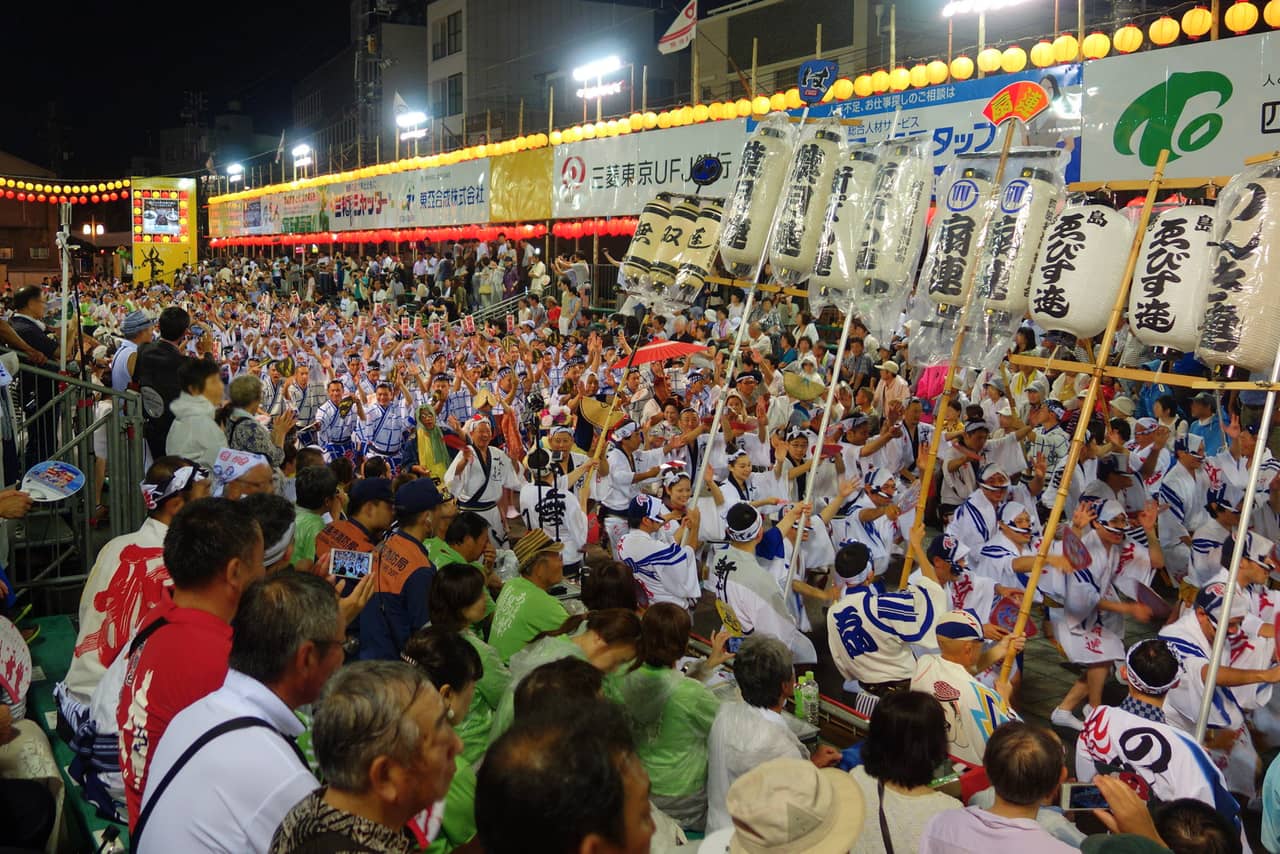
Tokushima's third trump card is the summer Awa Odori — one of Japan's biggest, most frenetic Bon dance festivals. The organising committee defines the run as "the five days from 11 to 15 August every year" (2026: Aug 11–15) in central Tokushima City. One point to get straight: 11 August is not an "eve festival". Under the current structure the 11th is the indoor paid stage "Suguribi" at Asty Tokushima, and the outdoor grandstands run 12–15 August. For several nights, tens of thousands of dancers in troupes called "ren" parade the streets to the famous refrain "you're a fool either way, so you may as well dance," driven by shamisen, taiko, and bell; the organisers counted around 1.11 million attendees in 2025. The city sets up paid outdoor grandstands (Sansan Aibahama, Awagin Minamiuchimachi, Bal Konyamachi) that need tickets in advance, plus three free viewing streets; lodging is ferociously tight and prices double during the festival, so book months ahead. ⚠️ The official site is awaodorimirai.com; the older awaodori.tokushima.jp address now serves an unrelated blog. Seat prices, stage times and the sales calendar are in our complete Obon guide.
The good news: you don't have to come in August to see Awa Odori. The Awa Odori Kaikan in Tokushima City is a year-round venue whose second-floor hall runs professional troupe performances nearly every day and lets you get up and try the steps; the building also holds an Awa Odori museum and the Mt. Bizan ropeway. If you visit off-season, the Kaikan is the place to feel the dance without fighting the August crowds. The city itself is compact, so pairing the Awa Odori Kaikan with the Naruto whirlpools as one "Tokushima City plus Naruto" block — and Iya/Oboke as a separate block — gives the cleanest flow.
Transport & lodging (Iya needs a car)
Read this section before you build the itinerary, because Tokushima's two zones run on completely different transport logic. Getting in and out is easiest by highway bus: Osaka (Umeda / Namba / USJ) → Tokushima on the "Awa Express Osaka" takes about 2.5–3 hours for roughly ¥4,100 one way (revised June 1, 2026 fare; advance online tickets are cheaper), frequent and great value — the choice for most. There's also an "Awa Express Kobe" from Kobe. Or take JR: the limited express "Nanpu" from Okayama or Takamatsu runs direct to Oboke Station (handy if you're heading straight for Iya), or you go to Tokushima City and split from there.
Inside the prefecture, think of the two zones separately:
- Tokushima City + Naruto (north): relatively easy. Tokushima City to Naruto is about 40 minutes (JR or bus), and route buses around Naruto Park serve the Uzu-no-Michi and the boat docks, so you can do it without a car — but still time your arrival to the tidal window.
- Iya / Oboke (southwest mountains): strongly favor a rental car or an overnight. Without a car, "JR to Oboke Station plus a Shikoku Kotsu bus" into Iya works, but services are sparse and the vine bridge, the onsen, and the Peeing Boy are far apart, so on buses alone you'll be stuck waiting. To run deep Iya smoothly in a day, self-driving is far easier; if you'd rather not drive the mountain roads, stay a night at Iya Onsen or near Oboke and split the valley into two half-days — a much more comfortable solution.
If your wider Shikoku trip (Tokushima plus Takamatsu or Matsuyama, say) uses several JR limited expresses, run the break-even math in our JR Pass guide to judge whether a Shikoku-area pass pays off — but note the Tokushima highway buses and the local Iya buses largely aren't covered by the JR Pass and are paid separately. For lodging, split it: in Tokushima City stay central for the Awa Odori Kaikan and Naruto runs; for deep Iya, stay at Iya Onsen or a gorge ryokan near Oboke (note Tokushima isn't on our hotel-booking system, so book these directly) for quiet evening soaks after the day-trippers leave. Pre-trip weather and packing — deep Iya swings cold between day and night and is humid in summer — are in our Japan packing & weather guide.
A two-day plan
Here's the same content shaped into a route (written for a car or flexible transport; bus-only travelers should pad the transfers heavily):
- Day 1 (Tokushima City + Naruto): Awa Express from Osaka to Tokushima → start at the Awa Odori Kaikan for a performance and the Mt. Bizan ropeway → Tokushima ramen for lunch → afternoon, timed to the day's tidal window, head to Naruto and walk the Uzu-no-Michi for the overhead view or take a sightseeing boat up close (do both if time allows) → overnight in Tokushima City or Naruto.
- Day 2 (Iya / Oboke mountains): set out early for the southwest interior (self-drive, or JR to Oboke Station then bus) → the Oboke Gorge cruise through the V-gorge → into Iya for the vine bridge and the cliff-top Peeing Boy → ride the cable car to the riverside bath at Iya Onsen → back to Oboke Station, or stay a second night in Iya.
If you have more time, I strongly recommend an overnight in Iya, splitting the deep valley into two unhurried half-days (the Oku-Iya double vine bridges, the Ochiai hamlet, and Biwa Falls are all worth adding) — far better than cramming it into one. Tokushima also chains nicely with the rest of Shikoku: north over the Seto Ohashi to Takamatsu and the Naoshima art islands (see our Takamatsu and Naoshima guide), or west to Matsuyama and Dogo Onsen (see our Matsuyama and Dogo guide), for a 5–7 day loop of the island.
FAQ
- Q1:Are the Naruto whirlpools guaranteed? How do I avoid missing them?
- This is the single biggest trap of a Tokushima trip, so let me be blunt: the whirlpools are not there all day, and a bigger tide does not automatically mean a better show. They form from the tidal current in the Naruto Strait — strongest at spring tides (near full and new moon) — but on any given day you also have to hit the right window: the roughly 1.5 hours around each high-tide and low-tide peak (four windows a day) is when they churn; in between the water can look flat. So check the daily "best viewing times" chart before you go (both the Uzu-no-Michi site and the boat operators publish a day-by-day table) and aim your schedule at that window — do not just show up and hope. Per official sources, the whirlpools reach their largest diameter at the spring tides of spring and autumn. Turn up without checking the chart and you may well stare at calm sea and leave disappointed.
- Q2:Glass-floor walkway (Uzu-no-Michi) or a sightseeing boat?
- They're completely different angles, so if you have time, do both; if you can only pick one, it comes down to overhead view versus up-close. The Uzu-no-Michi is a 450-meter walkway slung under the Onaruto Bridge, with a glass floor at the end where you look straight down on the whirlpools from 45 meters up; admission is ¥510 adults, ¥410 for middle/high schoolers, it runs rain or shine and isn't tied to a boat departure, so it suits anyone who gets seasick or wants a steady overhead shot. The sightseeing boats take you right up beside the swirls — Uzushio Kisen's small boat gets closest (and rocks hardest) at about ¥1,600 adults, while the larger Wonder Naruto is steadier and better for kids and older travelers at about ¥1,800. For raw impact the boat wins — but either way you must match the daily tide window.
- Q3:Is the Iya vine bridge really made of vines? Is it dangerous to cross?
- Yes — it is woven from actual mountain vines and rebuilt new every three years. The Iya Kazurabashi is one of only a handful of vine bridges left in Japan; legend says the defeated Heike clan built them so they could be cut down fast if pursued. There are visible gaps between the deck planks and it sways as you walk, with the Iya River running right below — it genuinely feels a little thrilling, and anyone afraid of heights will get sweaty palms. But on safety: steel cables are hidden inside the vines for reinforcement, the whole bridge is renewed on schedule, and normal crossing is safe. The toll is ¥550 for adults, ¥350 for elementary schoolers, open year-round with seasonal hours (latest until 18:30 in summer, 17:00 in winter), and it can close in heavy-rain warnings. Crossing is one-way only and queues form in peak season — get there early.
- Q4:What are Oboke and Koboke, and how do I experience them?
- Oboke and Koboke are a V-shaped gorge carved by the Yoshino River, walled by crystalline schist formed about 200 million years ago — the signature scenery of Tokushima's deep interior. The main way to see it is the Oboke Gorge sightseeing boat from the Oboke-kyo Mannaka dock: a roughly 30-minute round trip, ¥1,500 for adults and ¥750 for children, running 9:00–17:00 (last boat 16:30), year-round, no reservation needed — it departs once a boat fills. It glides between the strange rock walls and clear blue-green water; fresh green in spring, red leaves in autumn, carp streamers strung across in summer. Oboke is also the gateway into deep Iya: JR Oboke Station on the Dosan Line is the transit hub here, reached by the limited express "Nanpu," and you transfer to a Shikoku Kotsu bus to reach the valley.
- Q5:Is the Iya Onsen cable-car bath worth it? And what is the Peeing Boy?
- Both are worth it and both are Iya icons. Hotel Iya Onsen's signature is that you ride a private cable car down about 170 meters to a riverside open-air bath at the bottom of the gorge — the pools are built from stacked boulders, the milky free-flowing sulfur water sits right by the Iya River, and you soak with the canyon walls around you. Day-use bathing including the cable car and the open-air plus view baths runs about ¥2,000 for adults (around ¥1,000 for children), reception until 17:00. For a hidden-valley experience, that price is very reasonable. The Peeing Boy (Shoben Kozo) is a small bronze statue of a boy relieving himself, perched on a rock outcrop on a roughly 200-meter cliff along the Iya gorge road — it marks where local kids and travelers once dared each other over the drop, and it's the most famous photo stop on that road. Both sit deep in Iya and are hard to chain without a car — which is exactly why I say Iya needs a rental or an overnight.
- Q6:When is Awa Odori? Can I see it outside the festival? And how do I get to Tokushima?
- The organisers define the run as "the five days from 11 to 15 August every year" (2026: Aug 11–15) in central Tokushima City. Note the correction: 11 August is not an "eve festival" — that is an outdated label. Under the current structure the 11th is an indoor paid stage, and the outdoor grandstand streets run 12–15 August. It is one of Japan's biggest Bon dances, with tens of thousands of dancers in troupes ("ren") parading the streets for several nights to the famous "you're a fool either way, so you may as well dance" rhythm; around 1.11 million people attended in 2025. Paid viewing stands need tickets bought ahead (advance sale mid-June, general sale from 1 July), and lodging sells out, so book months early. Seat-by-seat prices and the indoor/outdoor comparison are in our complete Obon guide. But you can see it outside festival season too: the Awa Odori Kaikan hall runs professional performances nearly every day year-round and lets you join in and try the steps. Getting in: Osaka → Tokushima on the "Awa Express" highway bus takes about 2.5–3 hours for roughly ¥4,100 one way (June 2026 revised fare), the easiest route; you can also take JR via Takamatsu. Naruto is about 40 minutes from Tokushima City, while deep Iya means transferring by bus from Oboke Station. If your wider Shikoku trip uses JR limited expresses, run the numbers with our JR Pass guide first.
Related reading:
Takamatsu & Naoshima Guide 2026: Ritsurin & Art Island
55 minutes from Okayama over the Seto Ohashi to Takamatsu, then a ferry to Naoshima for Ando's Chichu Art Museum and Kusama's pumpkins — Ritsurin, Sanuki udon, ferries and a two-day plan.
Matsuyama & Dogo Onsen Guide 2026: Honkan, Castle, Train
Dogo Onsen Honkan fully reopened in July 2024 (bathing from ¥700), and Matsuyama Castle is one of Japan's 12 original keeps — plus Asuka-no-Yu, the castle ropeway, the Botchan train, and access from Okayama.
JR Pass 2026: Is It Still Worth It?
Four real routes calculated, six alternatives that may beat the Pass.